


Views: 0 Author: Site Editor Publish Time: 2026-11-12 Origin: Site


Selecting the correct replacement components for your motorcycle is a critical maintenance decision. It directly impacts braking predictability, rotor longevity, and rider safety. The Lifan motorcycle lineup spans a wide variety of machines. You will find everything from lightweight urban commuters to capable dual-sport models. Applying a universal approach to friction materials often results in sub-optimal stopping power. It can also lead to accelerated component wear. You might experience dangerous brake fade during a steep descent. This guide breaks down the technical realities of modern friction materials. We will help you evaluate and select the right Brake Pad for Lifan models based on empirical performance metrics and your specific riding conditions. You will learn how organic, sintered, and ceramic compounds perform under stress. We also cover crucial installation realities. By the end, you will know exactly how to match pad chemistry to your daily riding style.
Original equipment manufacturer (OEM) brake components eventually wear out. They may also fail to meet the rigorous demands of your specific riding environment. Choosing the wrong aftermarket replacement introduces serious risks. You might experience dangerous brake fade on a long mountain descent. You could suffer through excessive, annoying brake squeal at every stoplight. Incorrect materials often mandate premature rotor replacement.
Riders face a common problem when upgrading braking systems. They often choose a racing-spec pad for a daily commuter motorcycle. This mismatch causes poor cold-weather bite. The pads never reach their optimal operating temperature. Conversely, installing basic organic pads on a heavy touring bike leads to overheating. The resin binders melt and glaze the rotor surface.
A successful brake pad upgrade must deliver specific results. We define success across three distinct criteria. First, the system must provide predictable, linear stopping power under expected loads. You need consistent feedback through the brake lever. Second, the upgrade must maintain an acceptable wear ratio. The pad should act as the sacrificial component, preserving the more expensive brake rotor. Third, you need appropriate thermal stability. The pad's resistance to heat fade must align directly with your motorcycle's primary use case.
Manufacturers build organic pads using a precise blend of materials. They combine carbon, Kevlar, fiberglass, and various high-temperature resins. This composition contains virtually no metal fragments. Mechanics often refer to them as resin pads.
They provide a softer, highly manageable initial bite. You will notice incredibly quiet operation during city riding. They operate cleanly and produce very little brake dust. This keeps your motorcycle wheels looking spotless. They are notoriously gentle on standard steel brake rotors.
However, organic compounds suffer from poor thermal management. They trap heat against the rotor rather than dissipating it. Heavy, continuous braking creates a high risk of brake fade. They also exhibit a rapid wear rate in wet or muddy conditions. Grit easily tears the soft resin apart.
We recommend organic pads for everyday urban commuting. They suit models like the Lifan LF150 or the KP Mini perfectly. In these environments, speeds remain moderate. The stock steel rotors handle the low heat generation easily.
Sintered pads utilize a completely different manufacturing process. Factories fuse metallic particles together under extreme heat and pressure. They commonly blend copper, bronze, and iron powders. This creates a dense, highly durable friction block.
They deliver exceptional stopping power across all conditions. Sintered compounds remain highly resistant to severe heat fade. They perform consistently in rain, deep mud, and highly abrasive off-road environments. Water easily disperses from the metallic surface.
This extreme performance brings notable limitations. Sintered pads are frequently noisy. They squeal loudly during slow-speed stops. They also transfer maximum heat directly to the caliper and brake fluid. Furthermore, they are extremely abrasive. They will quickly wear down softer stock rotors.
They are best suited for dual-sport and adventure riding. A Lifan KPX 250 thrives on sintered pads during trail rides. They also suit aggressive canyon riders who push thermal thresholds to the limit.
Ceramic pads represent a hybrid approach. They incorporate strong ceramic fibers embedded alongside copper threads. This specialized mix aims to capture the best traits of both organic and sintered designs.
This compound bridges the performance gap beautifully. It offers a strong initial bite. Ceramic fibers provide excellent heat dissipation. You benefit from long pad life. They remain relatively gentle on your OEM rotors. They also produce light-colored dust that does not stain wheels.
Cost remains the primary limitation. Ceramic options generally carry the highest upfront purchase price. Some riders note a slight delay in initial bite on freezing mornings. The material requires a moment to warm up before delivering maximum friction.
We highly recommend ceramic compounds for sport-touring. Heavier models like the Lifan KPR 200 benefit greatly here. They require consistent performance across highly variable speeds and fluctuating temperatures.
Table: Friction Material Comparison Matrix
| Material Type | Initial Bite | Fade Resistance | Rotor Wear | Ideal Riding Environment |
|---|---|---|---|---|
| Organic | Soft / Progressive | Low | Very Low | Urban Commuting / Low Speed |
| Sintered | Aggressive / Sharp | High | High | Off-road / Wet / Aggressive |
| Ceramic | Moderate / Strong | High | Low | Sport Touring / Mixed Use |
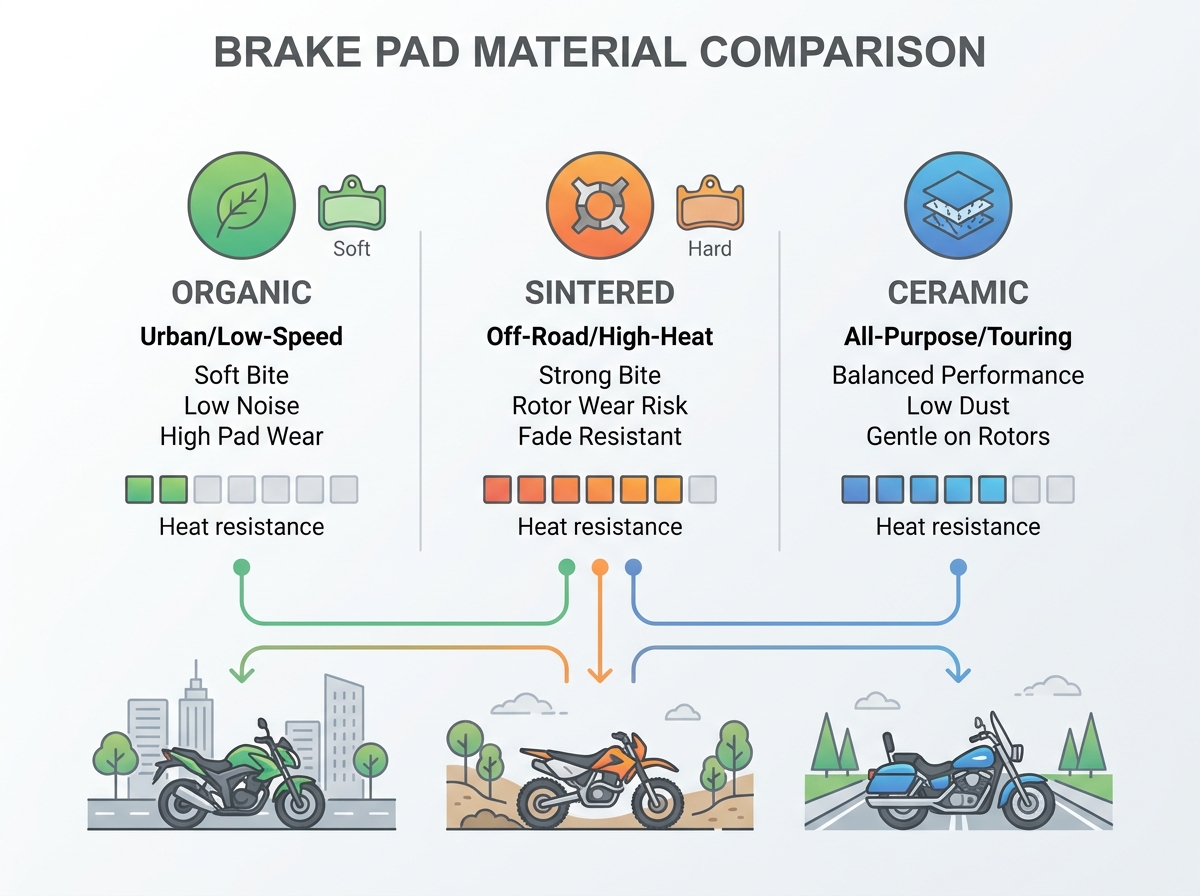
You must evaluate replacement pads across several specific dimensions. We rely on standardized metrics to determine true street performance. Do not rely solely on marketing claims when protecting your safety.
Evaluate how quickly the pad engages the rotor. Initial bite determines your stopping confidence. Sintered materials offer immediate, sharp feedback. You feel deceleration the instant you touch the lever. Organic compounds offer a more progressive feel. You squeeze harder to generate more stopping force. The Department of Transportation (DOT) grades friction using a two-letter edge code. Look for codes like GG or HH. The first letter denotes cold friction. The second letter indicates hot friction. An HH pad offers the highest street-legal bite.
Assess the pad's ability to maintain friction at elevated temperatures. Brake fade occurs when resins melt and produce a lubricating gas. Riders traversing mountainous regions require extreme high-temperature stability. Sintered and ceramic pads excel here. They prevent heat from overwhelming the friction boundary layer. Excellent thermal stability also prevents your brake fluid from boiling inside the caliper.
Analyze the sacrificial relationship between components. It remains significantly cheaper to replace friction pads than stainless steel rotors. Ensure the pad material does not exceed the hardness rating of your OEM rotor. Sintered pads chew through untreated steel rapidly. You will notice deep scoring and a prominent lip on the rotor edge. Always match pad aggression to your rotor's specific metallurgy.
Factor rider comfort into your final decision. Noise ruins a pleasant motorcycle ride. High-metallic pads inherently produce more harmonic vibration against the rotor surface. This vibration translates into a high-pitched squeal. Organic pads absorb these micro-vibrations effectively. They provide a smooth, silent stop. If you hate brake squeal, avoid fully sintered race pads.
Choosing the correct pad is only half the battle. Poor installation practices ruin premium components instantly. You must understand the mechanical realities of brake system maintenance. Avoid common mistakes to ensure maximum safety.
A brand new brake pad will only achieve roughly 60% of its stopping power upon installation. You cannot install new pads and immediately ride aggressively. A proper bed-in procedure is absolutely mandatory. Mechanics call this process burnishing.
Burnishing transfers a microscopic layer of friction material directly to the bare rotor. True stopping power relies on this adherent friction layer. To bed your brakes, execute a series of controlled decelerations. Accelerate to 30 mph. Brake smoothly down to 5 mph. Do not stop completely. Repeat this six times. Next, accelerate to 50 mph. Brake firmly down to 15 mph. Repeat this three times. Finally, ride for ten minutes without braking to let the system cool. This prevents the new material from warping.
Installing fresh pads on a compromised rotor guarantees poor performance. A scored, glazed, or chemically contaminated rotor will instantly ruin your new upgrade. Brake cleaner residue left on the friction surface causes severe glazing.
You must measure rotors for minimum thickness using a digital caliper. Check the factory specification stamped on the rotor hub. If the rotor remains thick enough, you must resurface it. Use fine-grit sandpaper or a Scotch-Brite pad. Scuff the surface in a cross-hatch pattern. This removes old pad deposits. It gives the new Brake Pad for Lifan an ideal surface for bedding.
Upgrading to high-heat sintered pads introduces a hidden risk. Sintered metal transfers intense heat directly through the caliper pistons. This heat enters your brake fluid. Old DOT 3 or DOT 4 fluid absorbs moisture over time. This moisture drastically lowers the fluid's boiling point.
Boiling fluid creates vapor bubbles in your brake lines. Your brake lever will pull entirely to the handlebar without slowing the bike. You must bleed and replace your brake fluid when installing high-performance metallic pads. Fresh fluid guarantees a firm lever and reliable stopping power during extreme heat cycles.
Navigating aftermarket catalogs feels overwhelming. You can simplify the process using a straightforward decision tree. Follow these three logical steps to finalize your purchase.
Be brutally honest about where you ride your motorcycle. Do not buy track-day pads for a grocery getter.
You must check the physical stamp on your OEM brake rotor. Manufacturers laser-etch vital information onto the inner hub. Look closely for a warning label. If the rotor says "Resin Pads Only," you face a strict limitation. You cannot safely install sintered metal pads on this rotor. The aggressive metal will destroy the soft steel within a few hundred miles. If you demand sintered performance, you must purchase an upgraded, hardened aftermarket rotor.
Avoid unbranded, white-label pads sold on discount websites. These cheap alternatives utilize unverifiable friction ratings. The resin binders often fail under moderate heat. Look for standardized certifications on the product packaging. Reputable brands display DOT or European TUV/KBA certification numbers. These codes prove the friction material passed rigorous safety and consistency tests. Your life depends on these small components. Never compromise on manufacturing quality.
Sourcing the correct replacement components for Lifan motorcycles requires moving beyond flashy brand names. You must understand the underlying friction chemistry driving your motorcycle's braking system. Matching the core material to your specific riding environment ensures optimal stopping performance. Organic pads dominate the urban commute. Sintered metals conquer the dirt. Ceramic composites rule the open highway.
Always prioritize rotor compatibility before making a final purchase. Inspect your current brake hardware for deep scoring or thinning. Remember, even the highest-quality pad will underperform on a compromised surface. Always perform a strict burnishing procedure after installation. Upgrade your brake fluid simultaneously to prevent dangerous vapor lock. By following these technical principles, you will maximize rider safety and protect expensive brake hardware for thousands of miles.
A: Replacement intervals vary entirely by material and riding style. Organic pads may require replacement every 3,000–5,000 miles. Sintered or ceramic pads can last 10,000 miles or more under normal conditions. Always rely on a visual inspection of the pad's wear-indicator grooves rather than mileage. Once the friction material wears down to 2mm, replace them immediately.
A: Only if the rotor is rated for it. Many entry-level commuter bikes use softer steel rotors designed specifically for organic/resin pads. Installing aggressive sintered pads on these rotors will cause rapid, uneven rotor wear and potential warping. Always check the rotor hub for a "Resin Pads Only" warning stamp.
A: Squeaking is typically caused by high-frequency vibration between the pad backing plate and the caliper pistons. It also stems from an incomplete bed-in process. It is highly common with sintered metallic pads. Applying a specialized anti-squeal compound to the back of the pad during installation often mitigates this issue.


