


Views: 0 Author: Site Editor Publish Time: 2026-11-07 Origin: Site


Have you just heard a loud metallic "bang" after hitting a deep pothole? Perhaps you now notice a visibly sagging corner on your Chery. These sudden signs immediately spark anxiety for any responsible driver. It feels tempting to keep driving if your car still technically moves forward. You will often see dangerous online forum myths claiming this behavior is perfectly fine. However, your vehicle suspension system serves as a critical safety and compliance baseline. You simply cannot ignore a compromised structural component. This guide will definitively answer your most urgent safety questions regarding suspension damage. We detail the severe secondary mechanical risks you face by delaying repairs. Finally, we provide a clear, actionable framework for selecting the right replacement part.
You might wonder if you can just push through the problem. We must give you a very direct answer here. No, regular driving is fundamentally unsafe. You cannot treat a broken suspension part like a minor exhaust rattle. At most, a slow, cautious "limp" to a nearby mechanic is acceptable. You should only attempt this if the broken metal hasn't collapsed onto your tire. Driving at normal highway speeds invites absolute disaster.
Let us take a moment to debunk the "partially broken" myth. You will frequently find this dangerous misconception roaming around driver forums. Amateur mechanics often claim a spring missing just one coil remains functional. We must clarify that partially broken springs simply do not exist. Your suspension relies on highly specific mathematical calculations. Missing just one single coil completely destroys the engineered spring rate. Your car immediately shifts dangerous loads to other delicate components. Your control arms and strut mounts are not designed to carry these forces. They will fail rapidly under the unexpected stress.
You also face severe compliance and insurance risks. We need to highlight the legal liability angle clearly. Driving a vehicle with known suspension failure acts as gross negligence. It can completely void your insurance coverage in the event of an accident. Adjusters will quickly spot the pre-existing suspension damage during an inspection. Furthermore, a sagging vehicle fails standard road-worthiness safety inspections instantly. You put yourself and other innocent drivers at extreme risk by ignoring this defect.
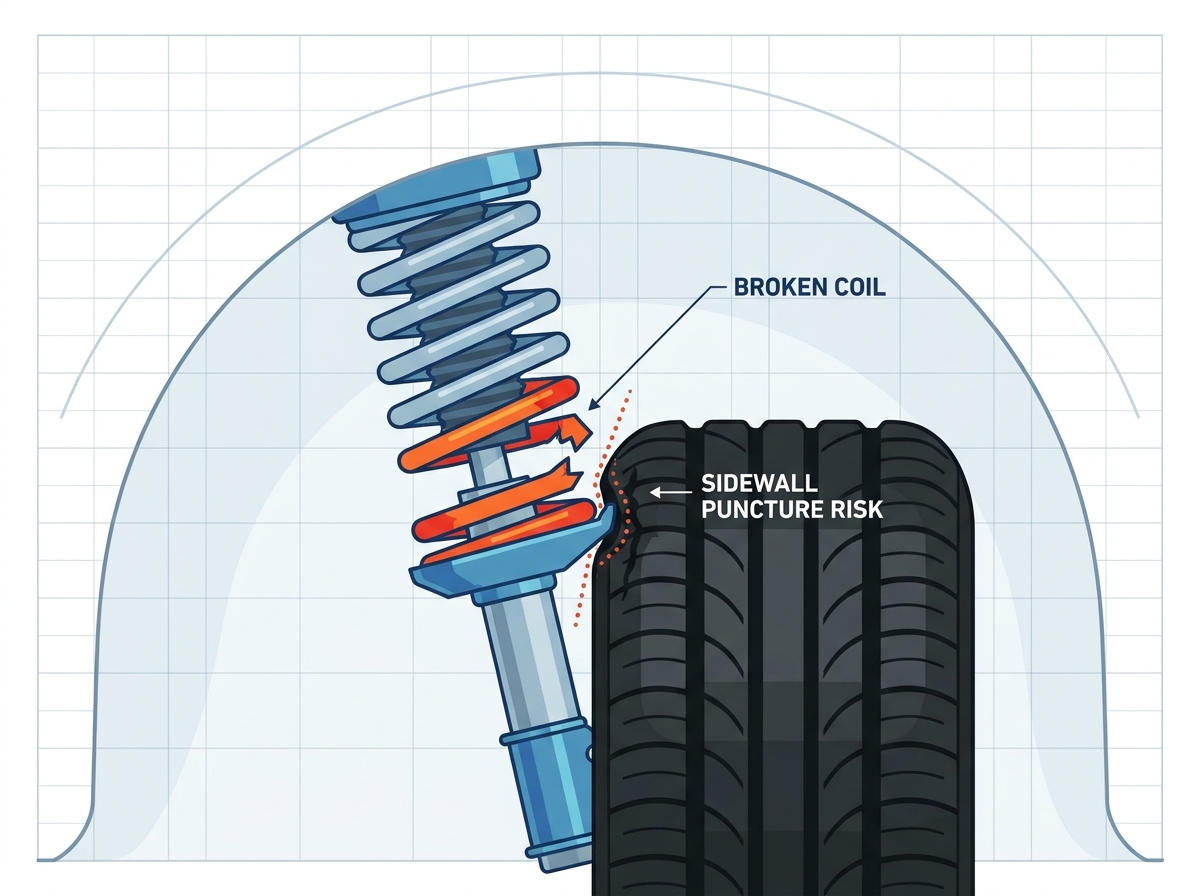
Ignoring suspension damage never saves you money in the long run. It only creates a cascading chain of expensive mechanical failures across your vehicle.
Let us detail the most immediate physical risk first. A broken jagged edge of a metal coil can drop unexpectedly. It will easily slice the soft inner sidewall of your tire. This leads directly to an instant blowout at high driving speeds. Sidewall punctures are entirely different from normal tread punctures. You cannot patch or plug a sliced tire sidewall safely. You will lose total control of the steering wheel instantly. This terrifying scenario causes countless severe highway collisions every single year.
We must also discuss strut and shock absorber failure. A fractured spring completely loses its engineered tension. Your car will begin bottoming out harshly over minor road bumps. This violent metal-on-metal impact destroys the internal hydraulic seals inside your shock absorbers. Fluid and gas will quickly leak out of the damaged strut cylinder. You just turned a simple single-part replacement into a full strut assembly repair. This cascade of damage easily triples your required repair budget.
Finally, consider your braking distance and vehicle handling. Evidence-based realities show exactly how a sagging corner affects physical driving dynamics. It drastically shifts your vehicle's static center of gravity. This uneven weight distribution significantly increases your emergency stopping distances. Your front brakes can no longer grip the road evenly. You will also experience unpredictable body roll during routine cornering maneuvers. The car will feel incredibly unstable and difficult to control during evasive swerves.
You need a proper evaluation framework when buying replacement parts. The automotive aftermarket offers many confusing choices for average consumers to navigate.
First, you must frame the basic purchasing decision carefully. You will usually choose between OEM and premium aftermarket options. OEM parts guarantee the exact factory ride height for your specific car. They restore the precise feel you experienced off the showroom floor. Premium aftermarket options can often offer better long-term value. Some brands even engineer upgraded load capacities for heavier driving demands. Both paths work exceptionally well if you verify the manufacturer's overall reputation.
Next, you must scrutinize material and metallurgy standards. We instruct readers to look specifically for cold-coiled, heat-treated steel construction. Superior material quality actively prevents premature sagging over thousands of miles. It also fights off microscopic metal fatigue caused by endless road vibrations. Finding a durable, precision-engineered Coil Spring for Chery ensures long-lasting safety. You simply cannot afford to install cheap, brittle steel components on your vehicle.
Corrosion resistance requires your absolute undivided attention during shopping. Rust acts as the primary killer of automotive suspension springs worldwide. Road salt and moisture eat away at unprotected bare metal quickly. You must evaluate the factory surface treatment on the replacement part carefully. Look for thick powder coating or highly durable epoxy finishes. A lightly painted spring will chip and rust within a single winter. Evaluating this protective finish remains absolutely non-negotiable.
Finally, you need strict fitment verification before checkout. You must match your exact Chery model, production year, and engine type. Engineers calibrate specific spring rates precisely to your vehicle's front or rear axle weight. A heavier engine block requires a much stiffer front suspension setup. Installing the wrong part ruins your daily ride quality instantly.
Suspension Material Evaluation Guide
| Feature Element | Standard Specification | Premium Quality Specification |
|---|---|---|
| Manufacturing Process | Hot-coiled standard steel | Cold-coiled heat-treated steel |
| Surface Protection | Basic liquid paint coat | Heavy-duty baked powder coating |
| Load Calibration | Generic platform average | Exact engine weight specific |
| Lifespan Expectancy | 30,000 to 50,000 miles | 80,000+ miles under normal use |
Purchasing the right part is only half of the overall battle. You must understand the mechanical realities of the actual installation process.
We must explain the critical mechanical logic behind the "replace in pairs" rule. You should never replace just one side of your suspension setup. Replacing only one spring creates a massive imbalance across the vehicle axle. You mix a brand-new, stiff spring with an older, fatigued spring on the opposite side. This extreme mismatch leads directly to aggressive steering pulling. You will fight the steering wheel constantly just to drive straight. You will also suffer from rapid, uneven tire wear over a short time.
We strongly advise against risky DIY replacement attempts at home. You should never attempt this without heavy-duty, professional-grade MacPherson strut spring compressors. A fully compressed automotive spring stores lethal amounts of kinetic energy inside. Cheap, bolt-style clamp tools break frequently under these immense physical pressures. A sudden slip during removal releases the coil like a cannonball. This easily causes catastrophic physical injury or even fatal accidents. Professional mechanics use wall-mounted hydraulic compressors for a very good reason.
Your maintenance job is not finished after bolting on the new parts. A full four-wheel alignment remains strictly mandatory after major suspension work. Replacing a Coil Spring for Chery fundamentally alters your baseline steering geometry. You must restore your factory camber and toe specifications immediately. Skipping this crucial final step will destroy your front tires in weeks. Proper alignment ensures predictable handling and optimal fuel efficiency going forward.
You need a clear action plan to handle this stressful situation properly. Follow these sequential steps to ensure maximum safety and minimal financial waste.
First, you must perform an immediate triage of the situation safely. You need to visually inspect the wheel well before moving the car again. Grab a bright flashlight and crouch down safely beside the tire. Look closely behind the wheel to visually confirm the metal break. Do not reach your bare hands blindly into the dark wheel well. Sharp metal edges can easily cause severe cuts and bleeding.
Next, you face the critical tow versus drive decision. Use this quick, practical checklist to decide if a tow truck is strictly required:
If you experience any of these dangerous conditions, you must call a tow truck immediately. Driving will only multiply your repair costs exponentially.
Finally, you must begin sourcing the correct replacement part quickly. We recommend consulting directly with certified auto parts distributors online or locally. Look for reputable vendors who provide clear warranties on their products. You should also demand exact-match fitment guarantees before paying any money. Chery suspension components require highly precise engineering tolerances for optimal daily safety. Avoid generic universal parts promising to fit dozens of different car brands.
Let us briefly summarize the critical facts we covered today. A bad suspension spring represents a severe, critical mechanical failure. It is never just a minor cosmetic annoyance or a simple noise issue. Driving on a fractured coil puts your life at serious risk.
We strongly recommend prioritizing your personal safety and long-term vehicle health above all else. Ground the damaged vehicle immediately upon discovering a broken coil. Do not attempt to commute to work or run quick errands. Source a verified, high-quality replacement part right away to minimize downtime.
Take direct action to protect your vehicle today. Browse certified suspension catalogs to find your necessary components. Contact a dedicated parts specialist to verify your exact factory spring rate. Ensure you get the perfect fitment for your specific Chery model and hit the road safely.
A: You will typically hear loud metallic clunks when driving over road bumps. You might also notice aggressive grinding noises when turning the steering wheel. Sometimes, the initial failure announces itself with a sudden, alarming "bang" while driving down the road. These noises clearly indicate a complete structural collapse.
A: The raw metal parts themselves are generally quite affordable. However, the manual labor involved takes considerable time and requires specialized tools. You must also factor in the mandatory four-wheel wheel alignment afterward. These combined professional service factors usually make up the bulk of your final repair bill.
A: Yes, it absolutely can. The sudden loss of structural ride height severely alters your wheel alignment geometry. This immediate imbalance causes aggressive pulling toward the damaged side. It also leads directly to accelerated and highly uneven tire wear over a very short time.


