


Views: 0 Author: Site Editor Publish Time: 2026-11-05 Origin: Site


Experiencing a harsh ride in your Chery Tiggo or Arrizo can feel incredibly frustrating. You might notice excessive body roll around tight corners or experience harsh bottoming out over common speed bumps. Many owners face common diagnostic confusion when ride quality degrades. You might naturally wonder if you need new springs or fresh dampers to solve the problem. Establishing the fundamental mechanical relationship between these suspension components is essential for a proper fix. Springs actively support the vehicle's weight. Shock absorbers directly control the spring's upward and downward movement. Misdiagnosing the root cause often leads to wasted money on the wrong replacement parts. We designed this comprehensive guide to help you navigate these issues effectively. You will learn an evidence-based framework for diagnosing suspension wear. We will also help you make cost-effective, safety-compliant replacement decisions for your specific model. Read on to restore your vehicle's original comfort, handling, and safety standards.
Pinpointing the exact source of a suspension problem presents a unique evaluation challenge. Mechanics and owners often misdiagnose degrading ride quality because symptoms frequently overlap. A bumpy ride could point to a fatigued spring or a blown damper. This confusion often leads to unnecessary component replacements. You might end up wasting valuable labor costs on parts you did not actually need. We want to prevent this by isolating the exact symptoms associated with each specific part.
When a spring begins to fail, it loses its ability to support the vehicle properly. You will typically notice structural and height-related issues. Keep an eye out for the following warning signs:
Unlike springs, dampers fail by losing their hydraulic resistance. When they fail, you will experience a severe lack of motion control. Watch for these specific dynamic indicators:
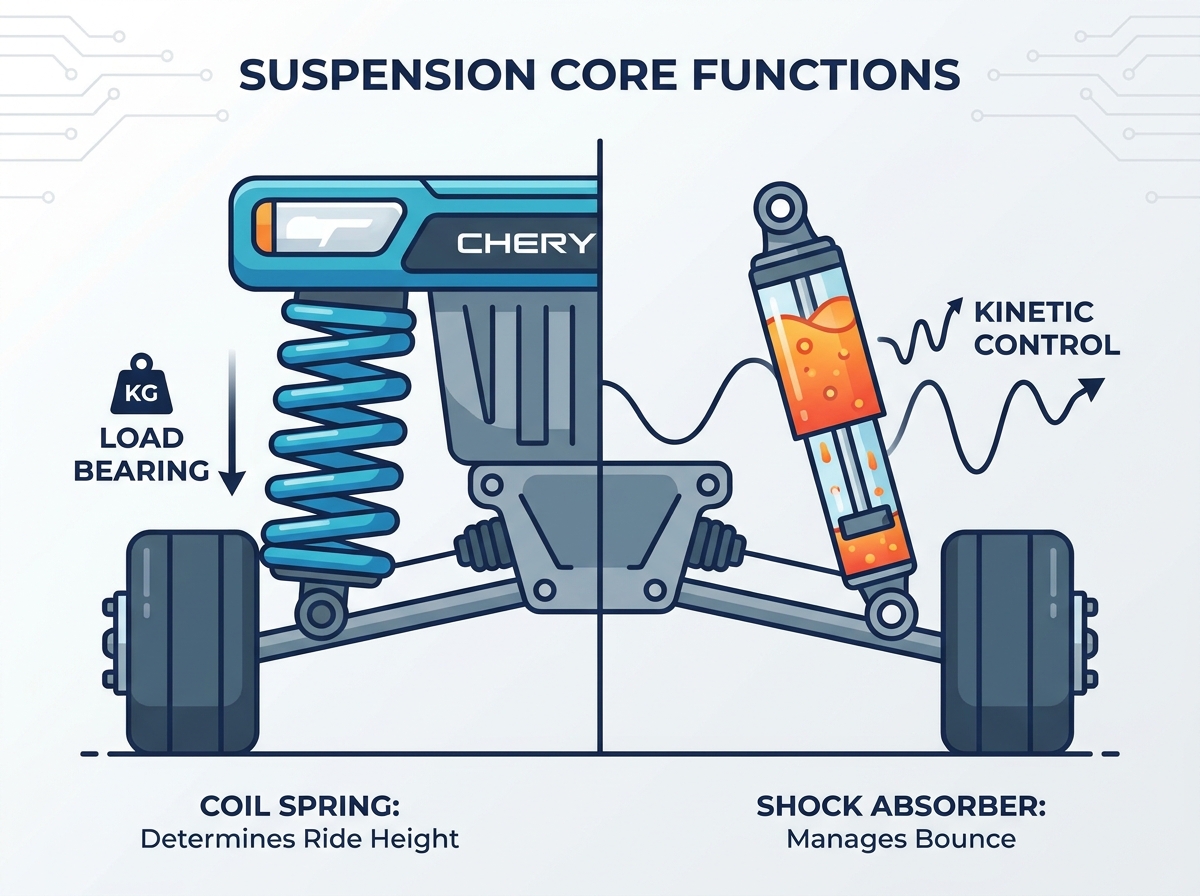
Understanding how your suspension operates requires breaking down the distinct roles of its two main components. They work closely together, yet they perform entirely different physical tasks. Separating these functions helps you make informed maintenance decisions.
The spring serves as the foundation of your vehicle's stance. It acts as the primary structural support, holding the vehicle's heavy chassis securely above the axles. When you encounter road irregularities, the spring absorbs the initial sudden impact forces. It compresses to allow the wheel to move upward. Furthermore, it defines the baseline suspension geometry. The resting height of the spring dictates your static alignment angles. If the spring sags, your wheel alignment geometry immediately shifts out of factory specifications.
The damper does not hold up any weight. Instead, it functions purely as a velocity-sensitive hydraulic damping unit. As the spring compresses and rebounds, it creates kinetic energy. Left unchecked, this energy would cause your car to bounce endlessly down the road. The shock absorber converts the kinetic energy of the moving coil spring into thermal energy. This heat safely dissipates into the surrounding air. By controlling this bouncing motion, the damper ensures a continuous tire contact patch with the road surface. You rely entirely on this constant contact for maximum traction and braking efficiency.
Suspension Component Comparison Chart
| Component | Primary Function | Energy Management | Key Failure Symptom |
|---|---|---|---|
| Coil Spring | Supports vehicle weight and dictates ride height | Absorbs initial impact forces from the road | Vehicle sagging, harsh bottoming out |
| Shock Absorber | Controls the speed of suspension movement | Converts kinetic bouncing energy into heat | Excessive bouncing, fluid leaks, nose-diving |
When the time comes to repair your vehicle, selecting high-quality parts is crucial. Not all aftermarket suspension components meet the rigorous demands of daily driving. You must evaluate potential replacements across several critical dimensions to ensure longevity and comfort.
The raw materials used in manufacturing directly dictate the lifespan of the component. High-tensile silicon-manganese spring steel represents the industry gold standard. It resists premature sagging and metal fatigue far better than standard carbon steel. This alloy maintains its structural memory even after millions of compression cycles.
Surface protection is equally important. Epoxy powder coating is critical to prevent rust formation. Road salt, moisture, and debris constantly attack suspension parts. Rust introduces microscopic stress fractures into the spring coils. These fractures eventually cause the metal to snap entirely under load.
Finally, consider NVH (Noise, Vibration, Harshness). Aftermarket components must meet or exceed Chery’s baseline NVH targets. Poorly designed springs transmit excessive road noise directly into the cabin. You want to avoid cabin droning or harsh, jarring ride characteristics that ruin your daily commute.
You generally have two distinct pathways when choosing a replacement type. A standard replacement replicates the original factory spring rates and damping curves. This option remains ideal for standard daily commuting. It perfectly restores your original ride comfort and handling characteristics.
Alternatively, you might consider a heavy-duty or progressive-rate upgrade. This path proves best for Chery SUVs, such as the Tiggo 7 or Tiggo 8, that frequently carry heavy payloads or tow trailers. A progressive spring gets stiffer as it compresses. This design increases stability significantly under heavy loads. However, you must accept a slight compromise. These stiffer springs often reduce empty-load ride comfort, making the vehicle feel slightly firmer over bumps when you drive alone.
Sourcing the correct parts requires careful attention to your vehicle's specific platform architecture. Chery builds several distinct vehicle classes, and their suspension needs differ wildly.
We must emphasize that suspension geometry varies significantly across the model lineup. Chery's sedan platforms, like the Arrizo series, prioritize smooth aerodynamics and low-slung comfort. In contrast, the crossover and SUV platforms, like the Tiggo series, demand longer suspension travel and higher load capacities. You cannot interchange parts between these platforms. Even within the Tiggo lineup, a spring designed for a Tiggo 4 will fail catastrophically if installed on a heavier Tiggo 8.
When purchasing a Coil Spring for Chery, you must follow a strict verification process. First, verify exact OEM part number cross-references. Do not rely solely on visual similarities. Second, check the specific spring rate. Determine if it is a linear or progressive design. Ensure this design aligns perfectly with your primary use case, whether you prioritize soft comfort or rugged load capacity.
Most importantly, avoid generic, multi-fit springs at all costs. Some aftermarket brands market "universal" springs to reduce inventory costs. These generic springs inevitably alter the vehicle's baseline geometry. Changing the ride height even slightly can trigger Advanced Driver Assistance Systems (ADAS) sensor misalignments. Forward-facing cameras and radar units require a perfectly level chassis to function correctly. A generic spring compromises these vital safety systems.
Installing suspension components involves significant mechanical force and precise calibration. Doing the job incorrectly introduces severe safety hazards. Following established industry best practices ensures a safe and effective repair.
You must always replace suspension components across the same axle simultaneously. Replacing a single spring or shock creates an asymmetric suspension bias. One side of your car will feature stiff, brand-new components, while the other side relies on fatigued, weakened parts.
This imbalance leads to highly unpredictable handling, especially during emergency evasive maneuvers. The vehicle may pull sharply to one side when you swerve. It also causes uneven braking distribution, significantly increasing your stopping distance. We strictly advise against single-side replacements under any circumstance.
Suspension repairs often involve complex teardowns. For front suspensions utilizing MacPherson struts, replacing a coil spring requires heavy-duty spring compressors. You must completely remove the strut assembly from the vehicle. Because the labor involved in dismantling the strut is so extensive, it is almost always more labor-efficient to replace the shock absorber simultaneously. Reusing an old shock inside a newly rebuilt strut assembly wastes labor money when that old shock eventually fails a few months later.
Post-installation procedures are equally critical. Any structural suspension replacement mandates a full 4-wheel alignment. Removing and reinstalling struts shifts the steering knuckles and mounting plates. You must restore precise toe, camber, and caster angles on an alignment rack. Skipping this step leads to rapid, uneven tire degradation and compromised steering feel.
Restoring your vehicle's ride quality requires a logical, step-by-step decision framework. First, you must diagnose the specific symptom accurately. Differentiate clearly between static height or load issues and dynamic bouncing or control issues. Once you isolate the failing component, carefully match the replacement part to your specific Chery platform. Pay close attention to OEM part numbers and specific spring rates. Always prioritize balanced, axle-pair replacements to maintain critical vehicle safety dynamics.
We highly recommend consulting a certified suspension specialist before purchasing any parts. They can perform a thorough physical inspection. They will measure your exact ride height, check for hidden hydraulic leaks, and evaluate the condition of surrounding bushings. Taking these professional steps ensures you restore your Chery's factory comfort, handling, and safety for years to come.
A: No. It compromises vehicle stability, risks puncturing the tire, and places severe stress on surrounding suspension linkages. Driving on a snapped spring creates an immediate safety hazard. You should tow the vehicle to a repair facility to prevent further catastrophic damage.
A: Coil springs generally last 100,000+ miles unless subjected to heavy corrosion or overloading. Shock absorbers typically require replacement between 50,000 and 80,000 miles, depending on road conditions. Frequent driving on rough, unpaved roads will accelerate wear on both components significantly.
A: A loaded strut assembly (pre-assembled shock, spring, and mount) reduces installation labor time and eliminates the safety risks of manually compressing old springs. This approach often results in a lower total cost of repair and provides entirely fresh hardware for maximum reliability.
A: Heavy-duty springs may slightly raise the static ride height if you are replacing worn, sagging springs. However, they are primarily designed for load management, not dedicated off-road lifting. They ensure the vehicle remains level and stable when towing or carrying heavy interior cargo.


