


Views: 0 Author: Site Editor Publish Time: 2026-11-10 Origin: Site


When you ride, nothing impacts your safety more directly than your braking system. Navigating the crowded aftermarket landscape for replacement parts often leaves riders feeling overwhelmed and unsure. While finding a replacement Brake Pad for Lifan motorcycles or vehicles might seem straightforward at first glance, the reality is far more complex. Slight variations in friction material and backing specifications drastically alter your stopping distance. These differences also dictate rotor lifespan and overall fade resistance during aggressive riding. This guide provides a purely objective, specification-driven framework to help you evaluate and select the correct components. You will learn how to match friction formulas to your specific riding style and load requirements. We also explore verifiable performance metrics to ensure your next brake job delivers reliable, consistent stopping power without compromising safety on the road.
When Lifan manufactures a vehicle, they equip it to satisfy the broadest possible range of riders. These Original Equipment Manufacturer (OEM) parts prioritize a quiet, highly predictable experience. Factory pads usually rely on organic or mild semi-metallic friction formulas. They keep brake noise to an absolute minimum. They also extend the lifespan of your rotors significantly. However, this generalized approach severely limits performance under extreme conditions.
Many riders eventually outgrow these factory limitations as their skills improve. The aftermarket value proposition becomes clear once you encounter demanding environments. You might need better wet-weather grip during heavy rain storms. Perhaps you carry heavy touring luggage across steep mountainous terrain. These scenarios demand rapid thermal dissipation to prevent complete brake failure. Upgrading your friction components solves these specific riding challenges effectively.
We must also address the risks of stepping outside the OEM ecosystem. Counterfeit parts flood global online marketplaces daily. Uncertified aftermarket pads introduce dangerous inconsistencies. You must mitigate these risks actively. Follow a simple rule of thumb during your purchasing process. If a replacement pad lacks a stamped friction edge code or valid regulatory certifications, reject it immediately. A sub-standard component introduces a single point of failure. You cannot afford to risk a catastrophic failure at highway speeds.
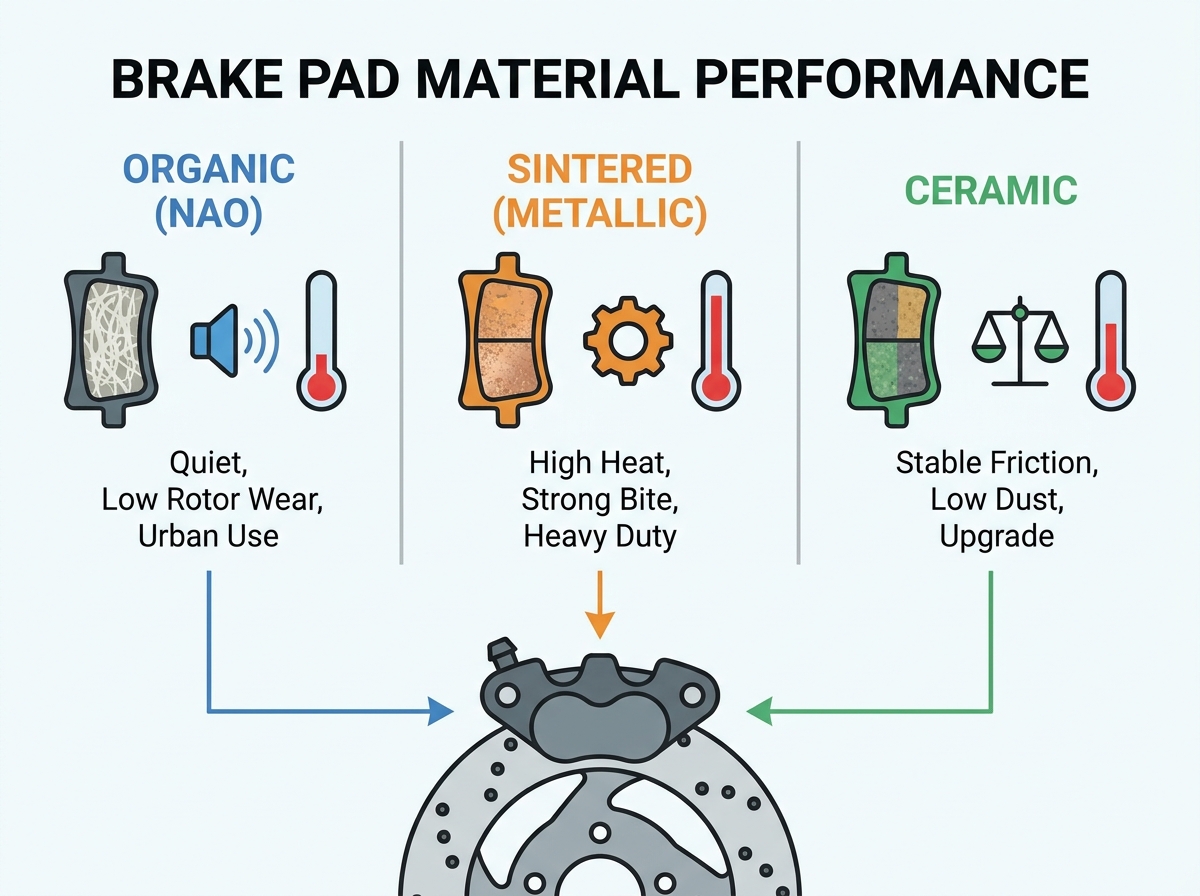
Friction material determines exactly how your motorcycle or vehicle behaves under pressure. The automotive industry divides these formulas into three primary categories. Each category offers distinct advantages for specific environments.
Organic pads utilize non-asbestos organic (NAO) compounds. Manufacturers blend Kevlar fibers, high-temp resins, and fillers to create a relatively soft friction block. These pads deliver nearly silent operation. They cause minimal wear on your expensive stainless-steel rotors. We highly recommend organic pads for urban commuting. They suit lighter Lifan models perfectly. They also excel for casual, low-speed riding around town. However, they carry notable trade-offs. The softer material simply wears out faster. Organic compounds also suffer from severe brake fade under high temperatures. They often lose their stopping power entirely during sustained downhill braking.
Sintered metallic pads represent the opposite end of the performance spectrum. Factories fuse metallic particles together under intense heat and massive pressure. This creates a dense, highly abrasive friction surface. They offer exceptionally high friction levels instantly. Their heat dissipation capabilities remain unmatched. Sintered compounds deliver strong, reliable performance even in pouring rain. Heavy-duty use, loaded touring, and high-speed riding require these rugged attributes. The trade-offs include highly aggressive rotor wear. Sintered formulas also tend to generate noticeable squealing noises at low speeds.
Ceramic and semi-metallic composites beautifully bridge the gap between organic and sintered options. They maintain a remarkably stable friction coefficient across varying temperature ranges. They produce very little corrosive brake dust. Riders seeking a distinct upgrade from organic compounds often choose ceramic. It provides a much firmer lever feel without destroying expensive rotors prematurely.
| Material Type | Primary Characteristics | Ideal Use Case | Notable Trade-Offs |
|---|---|---|---|
| Organic (NAO) | Soft friction, silent operation, gentle engagement. | Urban commuting, lighter vehicles, casual riding. | Prone to thermal fade, shorter overall lifespan. |
| Sintered (Metallic) | High friction, excellent heat dissipation, wet grip. | Heavy-duty use, loaded touring, high-speed riding. | Accelerates rotor wear significantly, potential noise. |
| Ceramic Composite | Stable friction across temps, very low brake dust. | Balanced upgrade from organic materials. | Slightly less initial cold bite than sintered options. |
Understanding marketing claims is helpful. Verifying actual performance specifications is absolutely mandatory. Industry standards use specialized codes to classify stopping capabilities objectively.
First, you must examine the friction coefficient. Look closely at the steel backing plate. You will usually find a two-letter edge code stamped directly into the metal.
Next, consider the operating temperature range and thermal fade resistance. Pad materials react differently to continuous heat cycling. Poor materials lose their structural integrity quickly. As temperatures climb rapidly, cheap compounds outgas. The resins binding the material literally boil off. This gas creates a microscopic barrier between the pad and the rotor. We call this dangerous phenomenon thermal fade. You might squeeze the lever entirely to the handlebar without slowing down. Maintaining a consistent brake lever feel requires high thermal stability.
Finally, rigorously evaluate the backing plate quality. The friction block bonds directly to this steel plate. It must resist immense hydraulic clamping forces from the caliper pistons. Examine its overall thickness and rigidity carefully. A thin or poorly stamped steel plate will warp under pressure. Warping causes uneven pad wear. It also leads directly to a dangerous, spongy feeling at the brake lever.
Motorcycle and vehicle braking dynamics require distinct strategies for the front and rear wheels. Treating both calipers identically often leads to suboptimal handling and compromised safety.
Your front brake system handles the vast majority of the workload. Under heavy deceleration, weight transfers dramatically to the front suspension. Consequently, the front tire manages roughly 70% to 80% of your total stopping power. The pads installed here require a massive initial bite. They must grip the rotor instantly when you squeeze the lever. Superior heat tolerance is equally non-negotiable. Sintered materials are frequently the preferred choice for front calipers. This remains especially true on heavier Lifan models designed for highway speeds. Sintered compounds easily absorb the immense thermal load generated during emergency panic stops.
Conversely, the rear brake performs a very different task entirely. It primarily serves to modulate your speed smoothly. We use it for tight low-speed control and overall chassis stability. Weight shifts away from the rear tire during hard braking. Because traction decreases heavily, an overly aggressive rear pad poses a significant hazard. It can easily cause unwanted rear-wheel lock-up. A sliding rear tire compromises your directional control instantly. Therefore, organic or mild semi-metallic pads are often the safer, smarter choice for the rear caliper. They offer softer engagement and far better predictability.
Assuming a part fits simply because a seller lists it as "Lifan compatible" is a common and costly mistake. The manufacturer utilizes various caliper designs across different vehicle families. You must verify fitment using a highly precise methodology.
First, match the caliper and model exactly. A generic listing is never sufficient for braking components. Buyers must align the prospective replacement with their specific year and model designation. The brake calipers on a Lifan KPR 200 differ entirely from those bolted onto a Lycan or an X-Pect. Always cross-reference the OEM part number directly before finalizing any purchase online.
Second, perform strict dimensional checks. Minor variations in the backing plate shape will prevent correct installation. Advise checking the aftermarket manufacturer's technical schematic closely. Compare the exact width, height, and overall thickness in millimeters. A pad measuring even one millimeter too thick will drag constantly against the rotor. A pad that is slightly too small will rattle loosely inside the caliper housing.
Finally, evaluate the included hardware and accessories. Quality replacement kits provide more than just the friction blocks alone. Note whether the package includes fresh anti-rattle clips. Check for the presence of thermal shims securely attached to the backing plate. These small components absorb high-frequency vibrations effectively. They are absolutely crucial for ensuring quiet operation. Missing hardware often forces you to reuse old, fatigued clips, leading to persistent noise issues. If you want a dependable setup, seeking out a precision Brake Pad for Lifan upgrade ensures these exact engineering tolerances are met perfectly.
Purchasing premium components only solves half the equation. Even the most expensive friction materials will fail to deliver optimal stopping power initially. They must undergo a strict bedding-in process to function correctly.
The science of bedding relates strictly to material transfer. Brand new pads and bare rotors do not mate perfectly. You must transfer a microscopic layer of friction material evenly onto the brake rotor surface. This creates an ideal, high-friction mating surface. Until this transfer layer forms, you are simply squeezing bare metallic compounds against smooth steel.
Follow a standard break-in procedure to ensure proper mating. Execution steps require patience and an empty, safe stretch of road:
You must strictly avoid making complete stops while the brakes remain scorching hot. Clamping down aggressively on a hot rotor leaves an uneven deposit of pad material.
We must warn you heavily about the consequences of skipping this procedure. Failing to bed in new pads leads directly to a condition called glazing. The intense, concentrated heat creates a hardened, glossy surface on the pad itself. Glazed pads cause persistent, incredibly loud squealing. More importantly, they drastically reduce your overall stopping power.
Selecting the right friction material requires a methodical approach rather than blind guesswork. To summarize the decision funnel, start by verifying exact fitment using your OEM part numbers. Once you confirm compatibility, honestly assess your primary riding environment. This assessment expertly guides your choice between organic, ceramic, or aggressive sintered materials. Finally, validate the component's underlying quality. Always check for verifiable friction edge codes and official safety certifications to avoid dangerous counterfeit products entirely.
We leave you with some final actionable advice for your garage installation. Never replace your friction blocks in complete isolation. Flush and replace your hydraulic brake fluid simultaneously. Old fluid absorbs moisture constantly, which boils under pressure and causes a spongy lever feel. Additionally, always measure your rotor thickness using precise digital calipers. Confirm they remain well above the minimum safety threshold stamped on the inner carrier. Taking these extra mechanical steps ensures your entire braking system operates at its absolute peak capability.
A: Look closely for the wear indicator groove cut into the pad surface. The industry standard mandates immediate replacement when the friction material reaches 2mm in total thickness. You should also replace them immediately if you experience metallic grinding noises, a sudden drop in fluid levels, or a spongy brake feel.
A: Yes, but you must do so with a clear caveat. Sintered pads are highly abrasive by design. While they offer superior stopping power and heat resistance, they will wear down standard stainless-steel rotors significantly faster than organic pads. Expect to replace your rotors more frequently if you choose a sintered compound.
A: Squeaking is usually caused by high-frequency vibration between the pad backing plate and the caliper pistons. It can also result from glazed pads caused by an improper bedding-in process. Applying specialized high-temperature brake caliper grease directly to the back of the pad and ensuring a proper break-in usually resolves this issue completely.
A: No. Brake pads must precisely fit the specific caliper pins, retainers, and housing dimensions of your vehicle. A loose pad can jam during operation or fall out entirely, leading to catastrophic brake failure. You must always buy model-specific pads engineered specifically for your exact caliper design to ensure maximum safety.


