


Views: 0 Author: Site Editor Publish Time: 2026-08-07 Origin: Site


Restricted intake airflow directly degrades engine performance, especially in modern turbocharged engines common in Great Wall Motor (GWM) vehicles. When an engine cannot breathe efficiently, it struggles to produce power, leading to sluggish acceleration and compromised fuel economy. For fleet managers and vehicle owners, maintaining optimal airflow protects internal engine components from premature wear. A common maintenance dilemma arises when dealing with a dirty filter: should you attempt to clean it to extend its life, or invest in a direct replacement to guarantee filtration integrity? This decision impacts both immediate vehicle performance and long-term mechanical reliability. Making the wrong choice can lead to severe engine damage or costly sensor failures. This article provides a technical evaluation framework to determine when an air filter can be safely maintained and when a full replacement is the only viable option to protect the engine and maintain warranty compliance.
Understanding the mechanical distinction between the combustion engine air filter and the HVAC cabin air filter prevents catastrophic maintenance errors. The engine air filter sits inside the engine bay, usually housed in a sealed plastic airbox connected to the intake manifold. Its sole function is preventing dust, dirt, and debris from entering the engine cylinders. It acts as the primary defense mechanism for the powertrain. Conversely, the cabin air filter resides behind the glovebox or under the cowl. It regulates interior climate control air quality, trapping pollen, road dust, and exhaust odors before they enter the passenger compartment.
Cabin filters require regular replacement to maintain interior air health and ensure the HVAC blower motor operates without restriction. A clogged cabin filter causes poor air conditioning performance and musty odors. Engine air filters dictate mechanical integrity. A failure in engine filtration leads directly to internal component wear. Dust bypassing a compromised engine filter acts as an abrasive compound inside the cylinders, making the engine filter maintenance schedule far more critical for the vehicle's operational lifespan.
| Feature | Engine Air Filter | Cabin Air Filter |
|---|---|---|
| Location | Engine bay, inside the intake airbox | Interior, usually behind the glovebox |
| Primary Function | Protects internal engine components from dust | Protects passengers from pollen and pollutants |
| Impact of Failure | Engine wear, turbo damage, poor fuel economy | Reduced HVAC airflow, bad odors, allergens |
| Media Type | Heavy-duty cellulose, synthetic blend, or oiled cotton | Lightweight paper, often carbon-activated |
Modern GWM engines, such as the 2.0L turbocharged units found in Haval SUVs and the GWM Ute/Cannon, require precise air-volume measurements to function correctly. Internal combustion relies on a specific stoichiometric ratio—typically 14.7 parts air to 1 part fuel for gasoline engines. The engine control unit (ECU) constantly monitors incoming air mass and temperature to calculate the exact injector pulse width needed for optimal combustion. A clean filter ensures this airflow remains consistent, unrestricted, and predictable.
When a filter becomes restricted by heavy dirt loading, it creates a pressure drop in the intake tract. The ECU detects this reduction in air mass and adjusts fuel trims to compensate, preventing a lean condition. This forced adjustment leads to decreased fuel economy, sluggish throttle response, and increased exhaust emissions. Turbocharged GWM models suffer even more, as the turbocharger must work harder to pull air through the restriction, increasing spool times and elevating intake temperatures. Maintaining a clean intake path ensures the engine operates at its designed volumetric efficiency.
OEM filtration systems are engineered to capture contaminants down to 5–10 microns. To put this into perspective, a human hair is roughly 70 microns thick. This microscopic level of filtration is necessary to protect the highly machined surfaces inside the engine. Modern engines operate with incredibly tight tolerances between the piston rings and cylinder walls. Even microscopic particles cause significant damage if they bypass the filter media.
If filtration fails, abrasive silica dust and road debris enter the combustion chamber. These particles mix with the engine oil, creating a grinding paste that acts like sandpaper against cylinder walls, piston rings, and bearings. In turbocharged GWM vehicles, unfiltered air hits the compressor wheel spinning at over 100,000 RPM. Dust particles pit and erode the aluminum compressor blades, destroying turbo efficiency and eventually leading to bearing failure. Proper filtration stops this chain reaction at the source.
Standard GWM service schedules typically recommend replacing the engine air filter every 15,000 to 30,000 kilometers. These baseline intervals assume standard highway commuting, such as driving a Haval H6 in clean urban environments. The actual lifespan of a filter depends entirely on the operating environment, making mileage a secondary indicator behind physical condition.
Severe driving conditions heavily accelerate filter clogging. Operating a GWM Ute/Cannon on unsealed gravel roads, construction sites, or in heavy agricultural dust reduces a filter's lifespan to a fraction of the factory recommendation. In these scenarios, visual inspection supersedes mileage. Technicians look for specific physical inspection criteria: pleat distortion from high vacuum pressure, heavy soot loading from following diesel trucks, oil blow-by saturating the media, and physical structural decay of the polyurethane seal. If any of these indicators are present, immediate replacement is necessary regardless of the odometer reading.
Only specific filter types are designed for cleaning, primarily oiled cotton gauze and synthetic foam filters. These are typically aftermarket upgrades installed by owners seeking higher airflow. The cleaning process requires strict adherence to chemical procedures to avoid damaging the filter media. The preliminary step involves gently tapping the filter structure against a hard surface to release large, loose debris, bugs, and leaves before applying any liquids.
The cleaning procedure requires a multi-step chemical process that cannot be rushed.
This process requires significant operational downtime. Vehicles are often grounded for 12–24 hours waiting for the filter to dry completely, making this method impractical for fleet vehicles requiring maximum uptime.
Standard OEM and standard aftermarket dry filters are manufactured from heavy-duty cellulose or synthetic fiber blends. These are depth-loading filters. Unlike surface-loading filters that trap dirt only on the outside layer, depth-loading media traps dirt deep within the complex web of fibers. Because of this depth-loading nature, dirt embedded deep within the matrix cannot be extracted without destroying the filter structure.
Attempting to clean a paper filter is mechanically ineffective and highly dangerous to the engine. Water destroys the cellulose binders, causing the paper to disintegrate. Installing a brand-new filter provides immediate performance restoration and peace of mind. It guarantees the engine receives maximum airflow and complete particulate protection without the severe risks associated with compromised, weakened filter media. For standard maintenance, replacement is the only mechanically sound procedure.
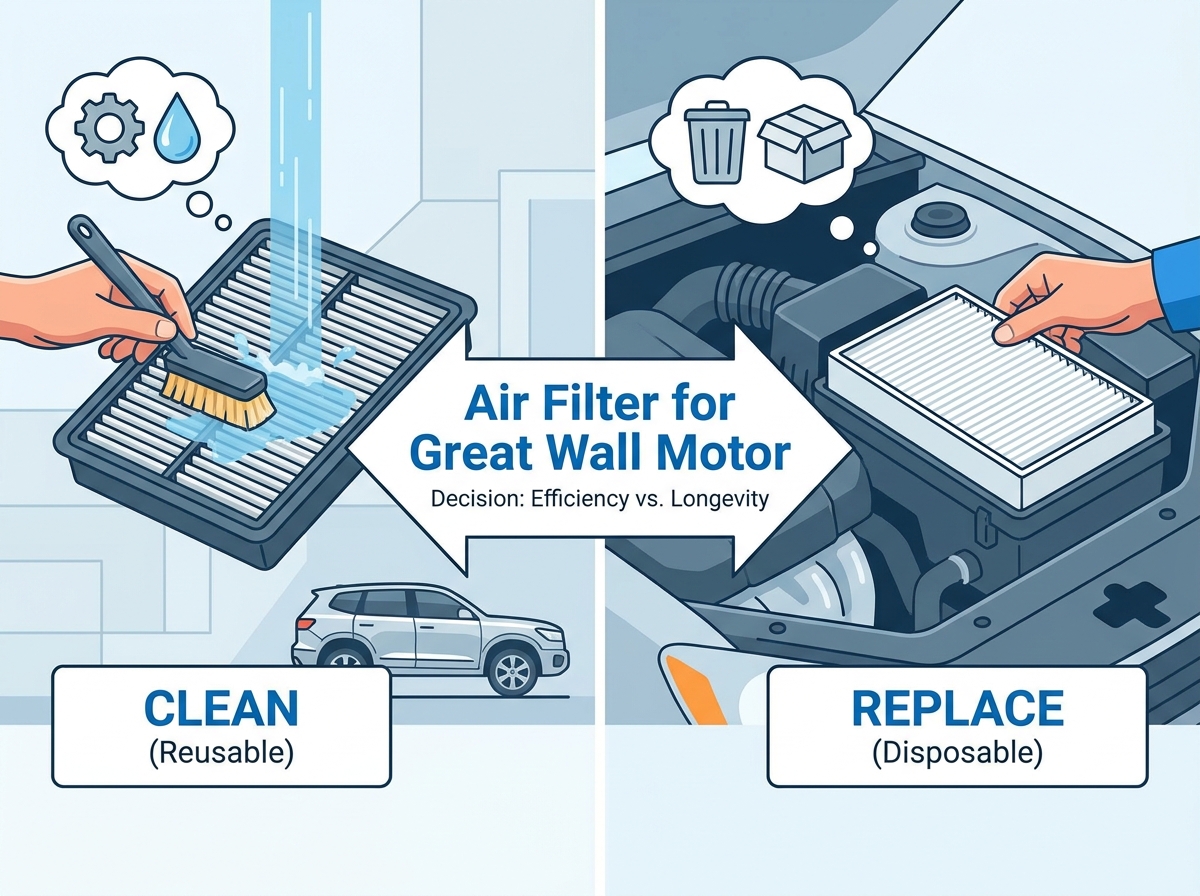
When selecting a replacement, owners must compare Genuine GWM parts against reputable aftermarket alternatives. Key evaluation factors include pleat count, gasket sealing quality, and filtration media density. A higher pleat count packs more filtration media into the same physical footprint, offering more surface area for dirt capacity and reducing restriction. A robust, pliable gasket ensures a proper, airtight seal within the plastic airbox.
Fitment tolerances are critical for GWM airboxes. The filter must fit perfectly to prevent unfiltered air bypass. Even a one-millimeter gap between the filter seal and the airbox housing allows significant amounts of dust to bypass the media entirely, getting sucked directly into the intake manifold. Always ensure the replacement Air Filter for Great Wall Motor matches the exact dimensions, seal thickness, and structural rigidity of the original equipment.
Evaluating the long-term return on investment involves calculating the lifetime cost of different filter types against their operational risks. A reusable filter requires a high initial purchase cost, ongoing purchases of specialized cleaning and oiling kits, and significant labor time for maintenance. In contrast, disposable OEM-style filters have a recurring, lower unit cost and require zero maintenance time—simply swap the old unit for a new one in under five minutes.
Owners must factor in the potential cost of engine repairs or sensor replacements caused by maintenance errors. An improperly oiled reusable filter easily destroys a MAF sensor, resulting in expensive diagnostic fees and replacement parts. Furthermore, a poorly cleaned reusable filter that lets dust pass will accelerate engine wear, leading to early rebuilds. For most applications, the reliability, guaranteed filtration, and low risk of disposable filters provide a vastly superior long-term return on investment.
A persistent and dangerous myth in vehicle maintenance involves blowing out paper filters with compressed air or using a shop vacuum to extend their life. This practice is highly destructive. The physics of micro-tearing dictate that high-velocity air from a compressor nozzle expands and rips the microscopic pores of the cellulose media.
While the filter may look visually clean after blasting it with 90 PSI of compressed air, it is functionally useless against fine dust. The expanded, torn pores allow microscopic silica particles to pass straight through the media and into the engine. This hidden damage accelerates internal wear while providing the owner with a false sense of security. A filter that has been blown out with compressed air is a compromised filter and must be discarded immediately.
For those utilizing aftermarket reusable filters, applying too much oil during the servicing process presents a significant mechanical risk. The tacky oil is necessary to trap fine dirt particles within the cotton or foam matrix, but excess oil creates severe drivability problems. When the engine draws high-velocity air through an over-oiled filter, the excess oil droplets are pulled out of the media and into the intake tract.
This atomized oil coats the delicate heated wire of the Mass Air Flow (MAF) sensor located just behind the airbox. A contaminated MAF sensor cannot accurately measure incoming air mass, skewing the data sent to the ECU. This causes the engine to run excessively rich or lean, resulting in rough idling, poor fuel economy, transmission shifting issues, and triggering check engine lights. Precise, measured oil application is mandatory to prevent this failure.
Modifying the factory intake system or using non-compliant, damaged filters impacts the manufacturer's powertrain warranty on GWM vehicles. Dealerships routinely inspect the intake tract during major engine claims. If they find dust in the intake manifold, a damaged aftermarket filter, or evidence of a blown-out paper filter, they will likely deny warranty coverage, citing improper maintenance practices and outside influence as the cause of engine failure.
To mitigate these risks, owners should keep detailed maintenance logs, retain receipts for all filter purchases, and utilize exact-match replacement parts. Using high-quality dry filters that meet or exceed OEM specifications ensures the vehicle remains compliant with warranty requirements while providing maximum protection for the engine internals.
Navigate to your vehicle's service manual and check the current mileage against the recommended air filter replacement intervals.
Open the airbox and physically inspect your current filter for signs of heavy soot loading, pleat distortion, or structural damage to the perimeter seal.
Access a trusted parts catalog to verify exact model fitment, distinguishing between specific GWM models like the Cannon Ute or Haval H6, and purchase a high-quality replacement dry filter.
Install the new filter, ensuring the polyurethane gasket seats perfectly within the airbox housing to prevent any unfiltered air bypass.
A: No. Standard paper air filters are strictly single-use components. Washing them with water or solvents destroys the cellulose binders, causing the paper to disintegrate. This renders the filter useless and allows dirt, water, and paper fragments directly into your engine.
A: The cabin filter cleans the outside air entering the passenger compartment through the HVAC system, trapping pollen and dust. The engine air filter cleans the air entering the intake manifold for combustion. They are entirely separate systems requiring different filters.
A: Under normal highway driving conditions, replace it every 15,000 to 30,000 kilometers. If you frequently drive on dusty, unsealed roads or construction sites, inspect the filter every 10,000 kilometers and replace it immediately if heavy dirt loading is visible.
A: High-pressure compressed air creates microscopic tears in the cellulose filter media. While the filter looks clean visually, these invisible tears allow fine dust and abrasive silica to bypass the filter entirely, causing severe damage to internal engine components.
A: Yes. A heavily restricted filter reduces incoming airflow, creating a pressure drop. The engine control unit detects this and adjusts fuel trims to compensate. This imbalance often leads to decreased fuel efficiency, sluggish acceleration, and increased exhaust emissions.
A: Disposable filters are typically made of dry paper or synthetic cellulose and have a white, yellow, or green appearance. Reusable filters are aftermarket upgrades, usually made of oiled cotton gauze or thick synthetic foam, and require specific chemical cleaning kits.
A: Using a high-quality aftermarket dry filter that meets exact OEM specifications will not void your warranty. However, engine damage directly caused by a poorly fitting filter, an over-oiled reusable filter, or a damaged filter can lead to a denied powertrain claim.


