


Views: 0 Author: Site Editor Publish Time: 2026-11-09 Origin: Site


Selecting the correct replacement brake components for motorcycles represents a critical safety decision. Riders must move beyond simple price-based choices. Lifan manufactures a highly diverse range of motorcycles. You will find urban commuters, agile mini-bikes, rugged dual-sport machines, and heavy-duty cargo motorcycles. Each specific model demands entirely different braking characteristics. Choosing the ideal Brake Pad for Lifan requires careful evaluation of these unique demands.
We maintain a skeptical, evidence-based approach toward marketing claims. Our goal is to provide a transparent framework for evaluating friction materials. You will learn how organic, sintered, and ceramic compounds perform in the real world. We will test them against specific riding conditions, strict rotor compatibility rules, and essential performance requirements. Upgrading your brakes successfully requires matching the right compound to your environment.
Factory original equipment (OEM) parts usually prioritize cost-efficiency and noise reduction. These baseline components perform adequately during gentle rides. However, they frequently fall short during demanding scenarios. Aggressive trail riding or hauling heavy cargo pushes OEM friction materials past their limits. You need replacement options tailored to your actual riding habits.
Riders must evaluate upgrades using three specific success criteria. First, consider predictability. Your lever feel should remain consistent across varying temperatures. Wet or dry conditions should not drastically alter your stopping distance. Second, prioritize thermal management. Effective friction materials prevent severe brake fade. They maintain stopping power during long downhill descents or repeated high-speed stops. Third, focus on component preservation. You must minimize excessive wear on the brake disc, commonly called the rotor.
Balancing these factors guarantees a strong return on your upgrade investment. High-quality friction materials require a slightly higher upfront cost. However, they save you from the expensive long-term replacement of damaged rotors. More importantly, they provide the unquantifiable value of rider safety. You cannot put a price tag on reliable stopping power.
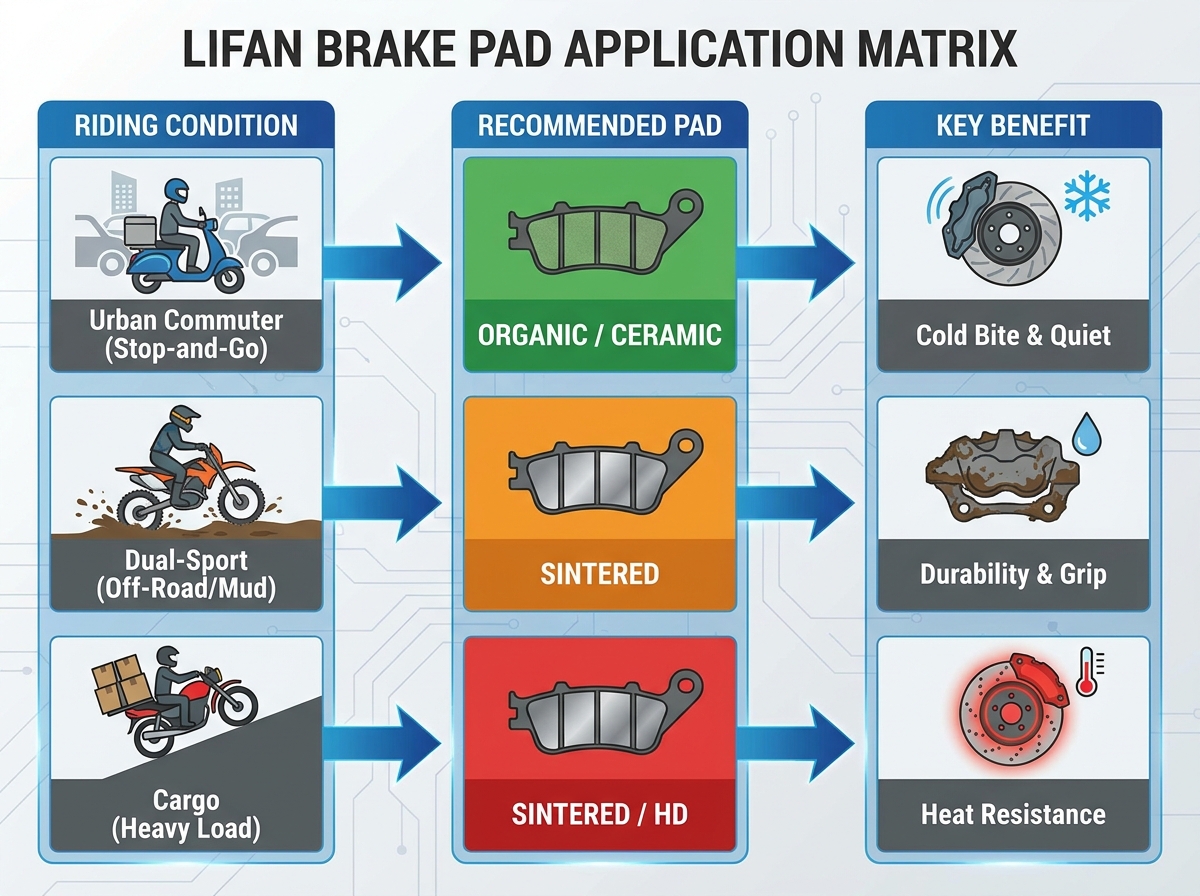
Motorcycle brake compounds fall into three distinct categories. Each material utilizes different manufacturing techniques. They offer unique advantages and distinct drawbacks.
Manufacturers build organic pads using a precise blend of Kevlar, carbon, and specialized rubber. High-temperature resins bind these soft materials together tightly. We often refer to these as resin pads.
The primary advantage is an excellent initial bite when cold. You do not need to warm them up for maximum performance. They operate silently and generate very little dust. Furthermore, they remain incredibly gentle on standard OEM rotors.
However, organic materials suffer under aggressive use. They wear rapidly when pushed hard. High temperatures cause the binding resins to outgas. This gas creates a microscopic barrier between the pad and rotor. We call this phenomenon brake glazing. It leads to terrifying brake fade and total loss of stopping power.
Sintered pads utilize copper alloys and other metallic particles. Factories fuse these metals together under extreme heat and massive pressure. This process creates a dense, highly durable block of friction material.
These pads boast the highest possible friction coefficient. Rain, deep mud, and sand barely affect their performance. They deliver exceptional high-temperature stability. You will experience virtually zero fade during aggressive mountain descents.
The trade-offs are significant. Sintered compounds act like sandpaper against softer rotors. They require hardened stainless-steel discs. They also lack a strong initial bite when cold. Finally, they generate immense heat. This thermal energy transfers directly into the brake caliper and fluid.
Engineers designed semi-metallic and ceramic options as hybrid solutions. They blend synthetic fibers alongside metallic elements or ceramic particulates. This creates a versatile middle ground.
These hybrid pads offer beautifully balanced heat dissipation. They produce much lower dust levels than fully sintered versions. Riders appreciate their highly progressive lever feel. They respond smoothly to subtle pressure changes.
Because they act as a jack-of-all-trades, they have limitations. A ceramic pad cannot match the extreme cold bite of an organic compound. Simultaneously, it cannot survive the extreme thermal thresholds of a fully sintered racing pad. They remain an excellent compromise for daily riders.
We must look past flashy marketing adjectives. Evaluating braking performance requires analyzing standardized metrics. You can predict how a compound will behave by understanding these four core dimensions.
Friction coefficient dictates how firmly the pad grips the rotor across a specific temperature delta. Professional testing assigns a two-letter Department of Transportation (DOT) edge code to the backing plate. The first letter represents cold friction. The second letter indicates hot friction. An "EE" code means moderate grip overall. A "GG" code offers strong, consistent grip for street riding. An "HH" code represents the absolute highest friction rating available. Look for these standardized stamps to verify performance claims.
Riders frequently confuse initial bite and modulation. Bite refers to the aggressive initial grab when you first squeeze the lever. Organic pads offer high bite. Modulation refers to your ability to finely control braking force. Good modulation lets you trail-brake deep into a corner safely. Sintered pads often provide superior modulation, allowing micro-adjustments without instantly locking the front wheel.
Brakes convert kinetic energy into thermal energy. Assessing heat dissipation means understanding how efficiently a pad transfers this heat away from the friction interface. Sintered pads hold heat well but transfer it into the caliper pistons. If your brake fluid boils, the lever pulls directly to the bar. Fade resistance ensures your stopping distances remain identical on the first corner and the fiftieth corner.
Every braking event causes microscopic wear. You must balance the economic trade-off between pad life and rotor life. Sintered pads outlast organic pads by a wide margin. However, they aggressively wear down the metal rotor. Harder, more expensive stainless-steel rotors become mandatory. Replacing a cheap organic pad frequently is usually more economical than replacing a deeply scored metal rotor.
| Performance Metric | Description | Ideal Outcome |
|---|---|---|
| DOT Edge Code | Standardized friction rating (e.g., GG, HH). | Matches riding style (GG for street, HH for heavy-duty). |
| Initial Bite | The immediate grab upon lever application. | Predictable engagement without sudden jarring. |
| Modulation | The ability to scale stopping force linearly. | Smooth control deep into corners. |
| Heat Transfer | Direction of thermal energy movement. | Heat dissipates without boiling caliper fluid. |
Lifan builds highly specialized motorcycles. We must match the friction material to the specific vehicle weight and riding environment. A universal approach fails here.
Selecting the best compound is only half the battle. Improper installation guarantees poor performance and compromises your safety. You must navigate several critical implementation risks.
You must inspect your current rotor before ordering replacements. Look closely at the inner hub. Many factory rotors feature a stamped warning reading "Resin Pads Only". Manufacturers use softer iron alloys for these discs to reduce production costs. Installing metallic sintered pads on incompatible soft rotors creates severe safety hazards. The hard metal will gouge deep grooves into the iron, ruining the disc in a matter of weeks.
Never install fresh friction material onto deeply scored rotors. You must measure the disc thickness using a digital caliper. Compare this measurement against the minimum thickness specification. Factories usually stamp this limit (e.g., "MIN TH 3.5mm") directly onto the rotor carrier. A thin rotor warps easily under heat. It also dissipates thermal energy poorly, leading to rapid fluid boiling.
Brand new brakes require a strict bedding-in procedure. You cannot simply install them and ride normally. Bedding-in creates a microscopic "transfer layer" of friction material on the rotor surface. Without this layer, the brakes will underperform and cause severe juddering.
Installing thicker new pads requires pushing the caliper pistons back into their bores. This action forces fluid back up into the master cylinder. Remind yourself to check the reservoir first. If you recently topped it off, pushing the pistons back will overflow corrosive fluid onto your paintwork. Furthermore, always check your brake fluid's age. Old fluid absorbs moisture from the air. Water drastically lowers the boiling point. Old fluid boils much faster regardless of how premium your new brake pads are.
We can summarize this entire decision framework easily. You must match the specific compound to your riding environment, thermal loads, and existing hardware. Different conditions demand different chemical solutions. There is no single universal upgrade.
Maintain a practical stance when shopping. Avoid over-spending on highly aggressive, race-spec HH sintered options for a low-speed urban commuter. They will never reach their optimal operating temperatures. Conversely, never compromise on a proven, sintered metallic setup for heavy-duty cargo or off-road Lifan models. Your safety depends on thermal stability under load.
Before making a final purchase, take action. Inspect your current rotor's health with a digital caliper. Verify its material compatibility. Always consult your specific motorcycle's factory service manual to confirm torque specs and baseline requirements. Smart upgrades start with accurate measurements.
A: No. You must verify if the factory rotor is hardened stainless steel. Softer iron or specific OEM rotors may be rated for organic pads only and will degrade rapidly with sintered materials.
A: Noise is typically caused by a lack of anti-squeal grease on the backing plate, glazed rotors, or an incomplete bedding-in process. Sintered pads are also naturally noisier than organic ones.
A: Mileage varies drastically by material and riding style. Replace them when the friction material thickness drops to 2mm, or if the wear indicator grooves are no longer visible.


