


Views: 0 Author: Site Editor Publish Time: 2026-08-05 Origin: Site


Engine longevity and fuel efficiency rely directly on combustion air quality. Precise filtration specifications represent a mandatory maintenance factor, not an optional upgrade. Installing an improperly spec'd filter leads to severe mechanical consequences. Incorrect micron ratings, poor seal integrity, or inadequate airflow capacity allow particulate bypass. This bypass accelerates engine wear, fouls mass airflow (MAF) sensors, and degrades overall performance.
Navigating the technical specifications required for automotive filtration means moving beyond basic physical dimensions. You must evaluate media density, pleat geometry, and seal construction. This guide breaks down the engineering specifications, testing standards, and performance trade-offs. You will learn exactly how to evaluate and select the optimal Air Filter for Great Wall Motor engines to ensure maximum protection and efficiency under heavy load.
Modern internal combustion engines require absolute protection from airborne contaminants. The baseline requirement for any filtration system is to deliver a massive volume of clean air while blocking microscopic abrasive particles. Success is measured by the filter's ability to maintain optimal combustion chemistry without starving the engine. If a filter restricts airflow too much, performance drops and fuel trims run rich. If it flows too freely without proper media density, the engine ingests destructive silica, leading to catastrophic internal scoring.
Engine displacement and operating RPM dictate the exact volume of air required for combustion. A turbocharged engine running at highway speeds demands hundreds of cubic feet per minute (CFM). When a filter cannot meet this CFM demand, the engine starves for air. This restriction forces the engine management system to compensate, often resulting in rich fuel mixtures. Rich mixtures reduce power output, increase tailpipe emissions, and cause unburnt fuel to wash lubricating oil from cylinder walls, accelerating ring wear.
Physical dimensions and clearance limits within engine bays further complicate airflow management. Vehicles like the Tank 300, Haval series, and GWM Ute have specific airbox volume constraints. Engineers must maximize the filter surface area within these tight spaces. They achieve this by optimizing pleat depth and count. A filter that perfectly matches the airbox dimensions ensures that the maximum possible surface area is exposed to incoming air, reducing the velocity of air passing through the media and improving particle capture.
Silica and airborne dust are highly abrasive. When these contaminants bypass a faulty filter and enter the combustion chamber, they act like liquid sandpaper. The mechanical impact is immediate and severe. You can observe this damage during engine teardowns through several specific failure points:
Engineers grade filtration media using strict technical metrics. These metrics translate physical features into performance outcomes. Media thickness determines dust-holding capacity. Pore size dictates the micron rating and capture efficiency. Structural rigidity prevents media collapse under heavy suction. Understanding these dimensions allows you to look past marketing claims and evaluate a filter based on its actual protective capabilities in the field.
The automotive industry relies on the ISO 5011 test protocol to validate air filter performance. This standard uses a specific grade of test dust to measure both restriction and fractional efficiency under controlled laboratory conditions. It removes the guesswork from filter selection. ISO 5011 testing differentiates between initial efficiency when the filter is brand new and cumulative efficiency over the filter's entire service life.
Filtration efficiency actually increases as dust loads onto the media. This is known as the restriction-efficiency lifecycle. The initial layer of trapped dust forms a dust cake that acts as an additional filtration layer. This cake catches even smaller particles. Waiting until a critical restriction threshold is reached protects engines better than premature changes. Changing a filter too early constantly subjects the engine to the lower initial efficiency phase, allowing more fine dust to pass.
Engine wear is primarily caused by particles ranging from 5 to 20 microns in size. To put this in perspective, a human hair is about 70 microns thick. A high-quality filter must capture these invisible abrasives before they reach the intake manifold. Understanding micron ratings is essential for evaluating filter media.
You must distinguish between nominal and absolute micron ratings. A nominal rating means the filter captures a certain percentage of particles at that size. An absolute rating guarantees the capture of nearly 100% of particles at that specified size. Automotive applications demand high absolute efficiency in the 5 to 20-micron range to prevent premature component degradation.
| Particle Size (Microns) | Contaminant Type | Impact on Engine Components |
|---|---|---|
| 1 - 5 | Fine Soot / Smog | Minimal mechanical wear, contributes to oil degradation over time. |
| 5 - 10 | Fine Silica / Silt | High risk for MAF sensor fouling and initial cylinder wall polishing. |
| 10 - 20 | Coarse Dust / Sand | Severe abrasive wear on piston rings, valve guides, and turbo blades. |
| 20+ | Debris / Plant Matter | Blocks airflow, causes rapid pressure drop, easily caught by standard media. |
Filter media inherently creates resistance to airflow. This resistance is measured as differential pressure or pressure drop. It is the difference in air pressure between the dirty side and the clean side of the filter. As dust accumulates in the media pores, restriction increases. Engineers measure this restriction in inches of water or kilopascals (kPa).
There is a direct relationship between dust accumulation and increased restriction over the filter's service life. A filter with high dust-holding capacity can trap a large volume of dirt before the pressure drop reaches an unacceptable level. Monitoring this restriction using a physical gauge is the most accurate way to determine when a filter actually needs replacement, rather than relying on arbitrary mileage intervals.
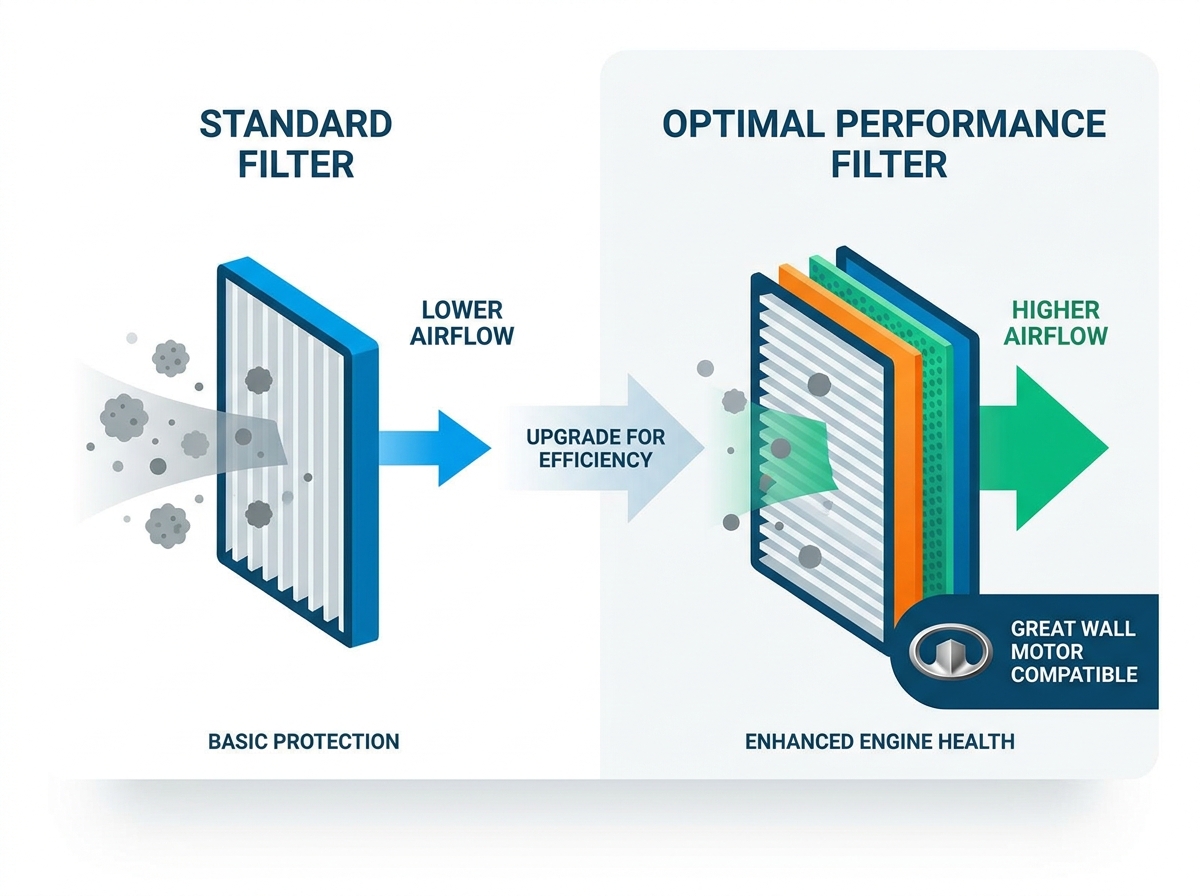
The physical construction of the filter media dictates its performance characteristics. Different options are available for various driving conditions. Cellulose media is the standard OEM baseline. It is cost-effective and perfectly suitable for normal urban driving environments. However, standard cellulose can swell if exposed to high moisture, temporarily increasing restriction and reducing airflow.
Synthetic and nano-fiber blends offer superior performance. They provide greater dust-holding capacity and resist moisture degradation. Synthetic fibers are more uniform than cellulose, allowing for lower restriction at higher efficiency levels. Oiled cotton filters are reusable aftermarket options. While they offer high airflow, you must be extremely careful during maintenance. Over-oiling these filters causes oil migration, which coats and destroys sensitive MAF sensors, leading to immediate drivability issues.
Even the best synthetic media is useless if the filter housing leaks. The polyurethane or EPDM rubber sealing gasket is a critical component. It must compress perfectly against the airbox margins. A fraction of a millimeter in dimensional variance causes bypass leaks. Unfiltered air will always take the path of least resistance, flowing right past a poorly fitting gasket and straight into the intake tract.
Housing tolerances also affect the media itself. If a filter is slightly too large, forcing it into the airbox causes media distortion. This leads to pleat pinching. Pinched pleats clump together, blocking airflow and creating high-restriction dead zones. The filter must drop into the housing smoothly to maintain uniform pleat spacing and optimal surface area utilization.
Pleat geometry directly impacts a filter's lifespan and structural integrity. Pleat depth and count determine the total surface area available for filtration. More surface area means lower air velocity through the media, which improves particle capture and reduces pressure drop. Deep, tightly packed pleats maximize capacity within a confined airbox.
Stabilization is equally important. Under heavy turbocharger suction, weak pleats can bend and collapse against each other. Manufacturers prevent this by applying glue beads across the pleats or backing the media with wire mesh. This structural reinforcement ensures the pleats remain open and functional under maximum engine load, preventing sudden airflow restriction during hard acceleration.
Selecting a filter requires weighing competing specifications based on real-world use. The engineering reality is straightforward: denser media traps more dirt but restricts air, while looser media flows better but passes more dirt. You must find the acceptable middle ground for your specific engine model.
A high-performance petrol turbo engine requires massive airflow at peak boost. A diesel turbo engine operates at lower RPMs but requires robust protection against heavy soot and dust. You must match the media density to the engine's specific CFM demands and tolerance for particulate ingestion. Always prioritize absolute efficiency in the 5-20 micron range to ensure long-term mechanical durability.
Your driving environment dictates your filter specification. Urban and highway driving exposes the vehicle to relatively low dust levels. In these conditions, standard efficiency media and regular replacement intervals are sufficient. The primary contaminants are tire dust and industrial fallout, which standard cellulose handles easily without premature loading.
Dusty, off-road, or mining environments require a completely different approach. Vehicles operating in these conditions need filters with massive dust-holding capacity. Heavy-duty synthetic media is mandatory. If you upgrade the intake system with a snorkel or cold-air box, you must ensure the new filter maintains the factory airflow characteristics. Sudden changes in intake dynamics can cause mass airflow deviations, triggering Diagnostic Trouble Codes (DTCs) and forcing the engine into limp mode.
| Operating Environment | Recommended Media Type | Primary Maintenance Focus |
|---|---|---|
| Urban / Highway Commuting | Standard Cellulose | Visual inspection for debris, standard mileage intervals. |
| Off-Road / High Dust / Mining | Synthetic / Nano-fiber Blend | High dust capacity, monitoring via restriction gauges. |
| Towing / High Load | Reinforced Synthetic | Airflow maintenance, structural integrity under heavy suction. |
The automotive aftermarket is flooded with counterfeit parts. Installing a fake filter is incredibly dangerous for your engine. Counterfeiters copy the packaging and physical dimensions but use substandard media and cheap plastics. You must know how to identify poor manufacturing before installing a part.
Inspect the filter closely before installation. Look for inconsistent pleat spacing or excess glue slopped onto the media. Check the gasket material; it should be pliable and resilient, not hard or brittle. Authentic filters usually feature clear batch numbers and precise manufacturing stamps. If the polyurethane pour looks uneven or has air bubbles, reject the filter immediately, as it will fail to seal in the airbox.
The standard rule of changing an air filter every 15,000 miles is outdated and often counterproductive. Because filtration efficiency improves as the dust cake forms, changing a filter too early actually exposes your engine to more fine dust. You should base maintenance intervals on actual restriction, not arbitrary mileage markers.
Advocate for visual inspections and the use of filter restriction gauges. A restriction gauge measures the exact pressure drop across the filter. It tells you precisely when the media has reached its maximum capacity. This approach maximizes filter life, ensures peak filtration efficiency, and prevents accidental engine starvation. If your vehicle lacks a factory gauge, aftermarket options are easily retrofitted to the airbox.
Using aftermarket filters can have implications for factory warranties. Dealerships may attempt to blame engine damage on non-OEM parts. To protect yourself, you must ensure any selected filter meets or exceeds original equipment specifications. The filter must match the exact dimensional and performance requirements set by the manufacturer.
Keep detailed maintenance logs and purchase receipts. If an aftermarket filter causes a MAF sensor failure due to poor seal integrity or oil migration, the vehicle manufacturer will not cover the repair. Always source filters from reputable brands that explicitly state compliance with your specific engine codes and provide testing data to back up their claims.
A: The standard requirement is capturing particles in the 5 to 20-micron range. This absolute efficiency is necessary to prevent premature cylinder wall and piston ring wear caused by abrasive silica entering the combustion chamber.
A: Efficiency is measured using the ISO 5011 standard. This protocol uses standardized test dust in a laboratory setting to accurately measure both airflow restriction and fractional particle capture efficiency over the filter's lifespan.
A: There is a trade-off between media density and pressure drop. However, high-quality synthetic media mitigates power loss by providing deep pleats and high surface area, maintaining necessary airflow while trapping fine dust.
A: Initial dust loading creates a dust cake that actually improves filtration efficiency. Premature replacement removes this beneficial layer, temporarily allowing more fine particulates to bypass the new media during its initial break-in period.
A: While 15,000 to 20,000 miles is a common baseline, intervals must be adjusted based on environmental dust levels. Use visual inspections and mechanical restriction gauges to determine the exact replacement time based on actual pressure drop.
A: A poor seal causes immediate particulate bypass. Unfiltered air enters the engine, accelerating mechanical wear on internal components, fouling sensitive intake sensors, and potentially voiding factory warranties due to negligence.
A: They can be used, but carry significant risks. The primary danger is MAF sensor fouling. If oiled filters are improperly maintained or over-oiled, the excess fluid migrates and damages sensitive intake sensors, causing drivability issues.


