


Views: 0 Author: Site Editor Publish Time: 2026-07-29 Origin: Site


Engine mounts dictate drivetrain alignment and cabin comfort, yet they are frequently overlooked until catastrophic failure occurs. These structural components serve as the primary isolation barrier between the engine's kinetic energy and the vehicle's chassis. Sourcing a reliable Engine mount for Chery vehicles requires navigating a fragmented aftermarket. You have to balance the need for precise fitment against varying material durometers and manufacturing tolerances.
This guide provides an evidence-based framework for evaluating OEM and aftermarket engine mounts, comparing material types, and mitigating installation risks. By understanding the mechanical differences between solid rubber, hydraulic, and polyurethane isolators, you can ensure long-term drivetrain stability and optimal Noise, Vibration, and Harshness (NVH) control without guessing.
Identifying a failing engine mount requires visual inspection and tactile feedback. Physical signs of mount degradation manifest as deep cracking or dry rot in the rubber isolator. For hydraulic variants, look for leaking fluid. This typically presents as a glycol-based oily residue pooling around the base of the mount. Collapsed mount structures, where the metal brackets rest directly on one another, indicate complete isolator failure.
Acoustic and tactile symptoms provide further diagnostic clues. You might notice a pronounced clunking sound originating from the engine bay during gear shifts or abrupt throttle changes. Excessive engine movement under heavy acceleration is a clear indicator of compromised structural integrity. Increased steering wheel vibration at idle, particularly when the transmission is engaged in drive or reverse, points directly to diminished vibration dampening capabilities.
You must distinguish between different mount failures. A failed passenger-side hydraulic mount transmits high-frequency engine vibrations directly into the cabin. Conversely, a worn transmission mount or torque strut mount results in excessive fore-and-aft engine pitching. You will feel this as a harsh jolt during acceleration or deceleration.
Ignoring a compromised engine mount initiates a chain reaction of mechanical stress throughout the vehicle. The engine block and transmission operate as a unified mass, suspended by three or four mounting points. When a single mount fails, the remaining mounts absorb torque loads far exceeding their design parameters. This shifts the drivetrain's center of gravity and accelerates the degradation of the surviving isolators.
Secondary damage risks escalate rapidly when engine movement remains unchecked. Excessive engine pitch strains the exhaust system. This frequently causes stress fractures in the flexible exhaust pipe sections. Constant Velocity (CV) joints suffer premature wear due to altered axle geometry, as the transmission shifts out of its engineered alignment. Radiator hoses and wiring harnesses can stretch or chafe against engine bay components, leading to coolant leaks or electrical shorts.
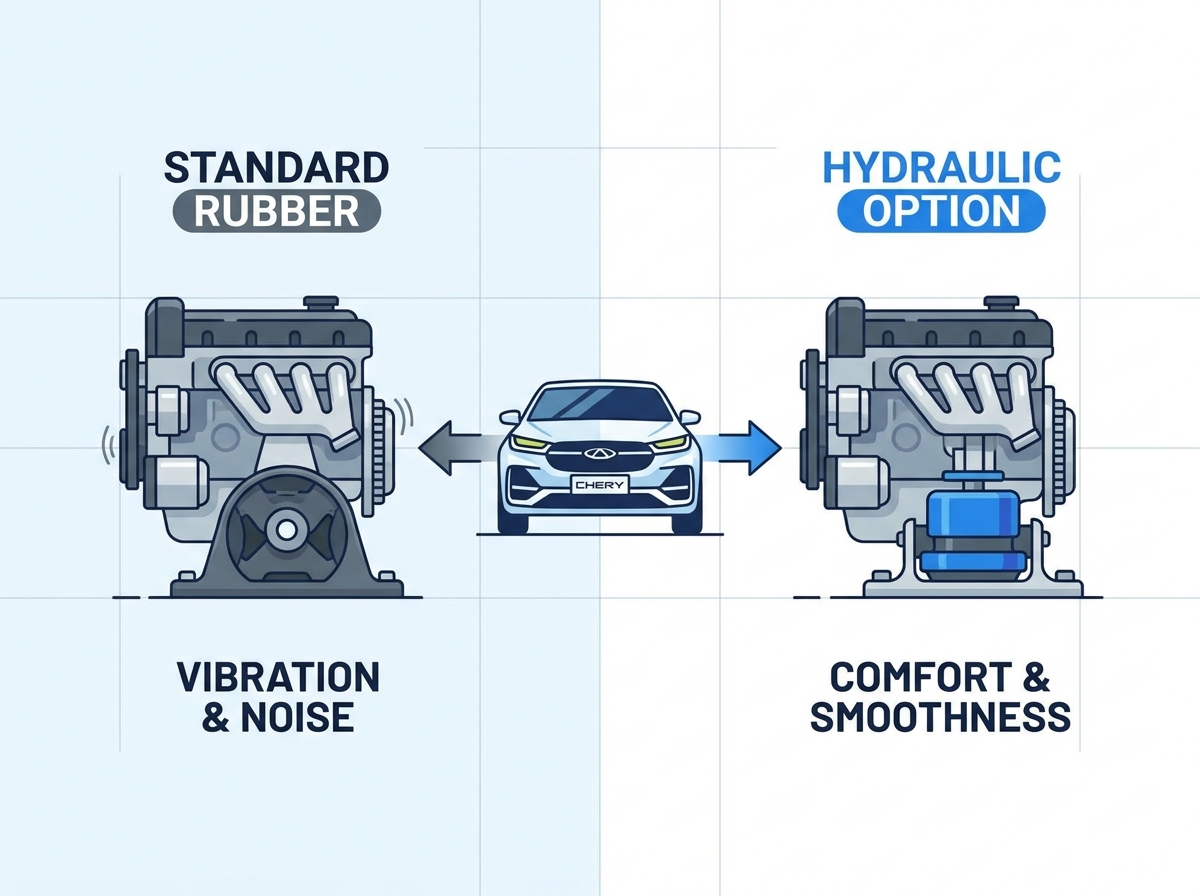
Solid rubber mounts represent the baseline for automotive vibration isolation. Engineers design these components with specific rubber durometers, typically ranging from 50A to 60A on the Shore hardness scale. This specific density allows the rubber to absorb high-frequency engine vibrations while maintaining sufficient rigidity to secure the engine block during normal driving conditions.
The lifespan of standard rubber mounts generally falls between 50,000 to 80,000 miles. This depends heavily on driving habits and environmental factors. They are highly susceptible to environmental degradation. Prolonged exposure to leaking engine oil or power steering fluid rapidly deteriorates the rubber compound. Heat cycling from the engine bay and ozone exposure further contribute to the material hardening and eventually cracking over time.
Hydraulic mounts introduce a layer of mechanical complexity to vibration dampening. Commonly found in modern Chery models, such as the Tiggo Pro series, these mounts feature internal chambers filled with a specialized damping fluid. As the engine vibrates, the fluid forces through internal passages and valves. This dynamically dampens varying engine frequencies. It allows the mount to remain soft at idle for maximum comfort, while stiffening under load to control engine movement.
The primary failure mode of hydraulic mounts is fluid rupture. When the internal rubber bladder tears, the damping fluid escapes. This instantly reduces the component to a hollow, ineffective shell. Because of their complex internal valving and fluid chambers, hydraulic mounts are inherently more expensive to manufacture and replace than their solid rubber counterparts.
Polyurethane mounts offer a distinct alternative to traditional rubber. They focus heavily on structural rigidity and longevity. Polyurethane boasts high resistance to petrochemicals, meaning oil leaks will not degrade the material. The extreme durability of polyurethane drastically reduces engine deflection under heavy load. This ensures maximum power transfer to the wheels and precise throttle response.
The primary trade-off is a significant increase in NVH transfer to the vehicle cabin. Polyurethane isolators utilize higher Shore hardness ratings, typically between 70A to 88A. This dense material transmits engine vibrations directly into the chassis. It makes them less suitable for standard passenger comfort. Mechanics generally reserve them for performance-oriented applications or severe duty cycles where component longevity is the absolute priority.
Selecting Genuine Chery OEM mounts provides the highest level of fitment certainty. These components guarantee dimensional accuracy. They ensure alignment with factory mounting points without modification. The rubber compounds feature exact factory durometer matching. This results in predictable NVH characteristics that restore the vehicle to its original showroom comfort levels.
The drawbacks of OEM components center around procurement logistics. Genuine parts require a higher initial investment compared to aftermarket alternatives. Depending on regional dealership networks and inventory levels, sourcing specific OEM mounts may involve availability delays. This extends vehicle downtime.
Established aftermarket manufacturers provide a viable alternative to dealership parts. Brands such as Corteco, Anchor, Beck/Arnley, Westar, DEA, and A-Premium engineer compatible components for various Chery platforms. These Tier-1 suppliers often manufacture parts that meet or exceed original factory specifications. They offer a balance of reliability and accessibility.
Verifying the quality of a Tier-1 aftermarket brand requires checking for specific manufacturing standards. Look for ISO/TS 16949 certification. This indicates strict adherence to automotive quality management systems. Reputable brands back their components with comprehensive material warranties, providing assurance against premature failure.
Low-cost aftermarket mounts flood the replacement parts market, but they carry substantial operational risks. These budget alternatives frequently utilize inferior rubber compounds that lack the necessary elasticity. They harden prematurely and transmit severe vibrations. Poor weld quality on the metal brackets and misaligned bolt holes complicate installation and compromise structural safety.
Purchasing budget mounts often results in a false economy. The inferior rubber-to-metal bonding techniques used in these parts lead to rapid separation under torque loads. Consequently, these mounts frequently require secondary replacement within 10,000 to 20,000 miles. This negates any initial savings through repeated labor costs and vehicle downtime.
Evaluating mount quality requires inspecting specific physical markers. The tensile strength of the steel brackets must be sufficient to withstand constant engine torque. Weld penetration quality is critical. Welds should be uniform and free of porosity. Zinc-plated anti-corrosion coatings protect the metal components from rust and environmental degradation.
The composition of the isolator material is equally important. High-quality mounts utilize a high percentage of natural rubber. This provides superior elasticity and vibration absorption. Inferior mounts often rely heavily on recycled or synthetic SBR (Styrene-Butadiene Rubber) content. This degrades rapidly under heat cycling and mechanical stress.
| Mount Category | Vibration Isolation (NVH) | Durability / Lifespan | Primary Use Case |
|---|---|---|---|
| Genuine OEM | Excellent | Standard (50k-80k miles) | Factory restoration, daily commuting |
| Tier-1 Aftermarket | Very Good | Standard (50k-80k miles) | Reliable replacement, general use |
| Budget / White-Label | Poor to Fair | Low (10k-20k miles) | Temporary fixes, strict budget constraints |
| Polyurethane | Poor (High Cabin Vibration) | Exceptional (100k+ miles) | Performance builds, heavy-duty applications |
The Chery Tiggo series represents a range of heavier SUV chassis with specific torque demands. These vehicles utilize multi-link suspensions and various turbocharged engine variants, including 1.5T, 1.6TGDI, and 2.0TGDI configurations. The increased mass and higher torque output of these drivetrains place immense stress on the mounting points. This requires robust isolation solutions.
To offset the NVH generated by larger displacement and higher-output engines, Tiggo models rely heavily on complex hydraulic mounts. These fluid-filled isolators are essential for maintaining cabin comfort in premium SUV segments. Replacing a Tiggo hydraulic mount with a solid rubber aftermarket alternative will noticeably degrade the driving experience.
Regional market variations also impact mount selection. Right-hand drive (RHD) configurations found in South Africa and Australia often feature different steering rack clearances compared to left-hand drive (LHD) variants. These spatial differences can alter the design of the engine mount brackets. Precise part matching is critical for international owners.
The Chery Arrizo series and other compact platforms utilize lighter, front-wheel-drive sedan architectures. The torque loads generated by these naturally aspirated or smaller displacement engines are significantly lower than those found in the Tiggo SUV lineup. Consequently, the mounting configurations are generally less complex.
Passenger comfort remains a priority in the sedan segment. These applications standardly use solid rubber isolators tuned to a specific durometer to minimize idle vibrations. Because the engines are lighter, standard rubber provides adequate longevity and vibration dampening without the need for expensive hydraulic systems.
Visual similarity is insufficient when selecting replacement components. Engine mounts often look identical across different model years, yet feature subtle differences in bracket angles, bolt thread pitches, or rubber durometers. Mid-cycle production changes and platform updates frequently alter mount specifications.
Matching the exact OEM part number to the vehicle's Vehicle Identification Number (VIN) is an absolute necessity. This verification process ensures compatibility with the specific engine configuration, transmission type, and regional chassis variations. It prevents costly installation delays and fitment errors.
Replacing a single failed mount while leaving older mounts in place is a flawed mechanical practice. The new, rigid mount will bear a disproportionate amount of the engine's torque. The older, softer mounts will allow excessive movement. This imbalance disrupts proper drivetrain geometry.
The technical necessity of the set replacement protocol cannot be overstated. Replacing engine and transmission mounts simultaneously ensures that torque loads are distributed evenly across all mounting points. This holistic approach restores the factory center of gravity and maximizes the lifespan of the entire mounting system.
Proper installation technique is just as critical as component quality. A mandatory step in the installation process is neutralizing the mounts. This involves installing the mounts and leaving the mounting bolts hand-tight. The engine is then started and allowed to run briefly. This permits the drivetrain to settle into its natural resting position without binding.
Once neutralized, the bolts must be tightened to precise factory torque specifications. Over-torquing the fasteners can crush the metal mount housing or pre-load the rubber isolator. A pre-loaded mount is constantly under stress. This severely limits its ability to absorb vibrations, leading to immediate NVH issues and premature failure.
Follow these steps for proper installation:
A: Under normal driving conditions, OEM engine mounts on a Chery vehicle generally last between 50,000 to 80,000 miles. Exposure to engine oil leaks, extreme heat, or aggressive driving can significantly shorten their lifespan. Regular inspections during routine maintenance are recommended.
A: Rubber mounts absorb engine vibrations, providing a quiet and comfortable cabin experience. Polyurethane mounts are much stiffer, offering superior durability and reduced engine movement under load, but they transmit significantly more vibration and noise into the vehicle interior.
A: While you can replace a single mount, it is highly recommended to replace them as a complete set. A new, stiff mount mixed with older, worn mounts causes uneven load distribution, which accelerates the wear on the new component and compromises drivetrain alignment.
A: The most accurate method is to cross-reference your vehicle's VIN with a parts catalog. Generally, heavier Chery Tiggo models with turbocharged engines utilize hydraulic mounts to manage higher torque and NVH, while lighter models may use solid rubber.
A: It depends on the quality and material. Premium Tier-1 aftermarket mounts designed to OEM specifications will maintain factory comfort. Budget mounts with inferior rubber or stiff polyurethane upgrades will noticeably increase cabin vibration and noise.
A: Labor times vary widely based on the specific mount location and vehicle model. A straightforward upper torque strut mount may take 30 to 45 minutes, while replacing a lower hydraulic mount or transmission mount can take 2 to 4 hours due to required component removal.


