


Views: 0 Author: Site Editor Publish Time: 2026-11-08 Origin: Site


As your factory brake components wear out, maintaining reliable stopping power becomes your primary concern. Rider safety depends entirely on an effective braking system. Finding a compatible, high-quality replacement for Lifan models like the KPR, X-Pect, or KP series can feel overwhelming. You have to navigate varying aftermarket catalogs and complex material types to get the right fit. This guide provides a practical, criteria-based framework for evaluating and matching your options. You will learn how to select the optimal brake pads based on your specific riding style and vehicle specifications.
Motorcycle brakes rely on friction to stop your bike safely. Choosing the right material changes how your bike behaves. Different materials suit different riders. We will look at three main options for your motorcycle.
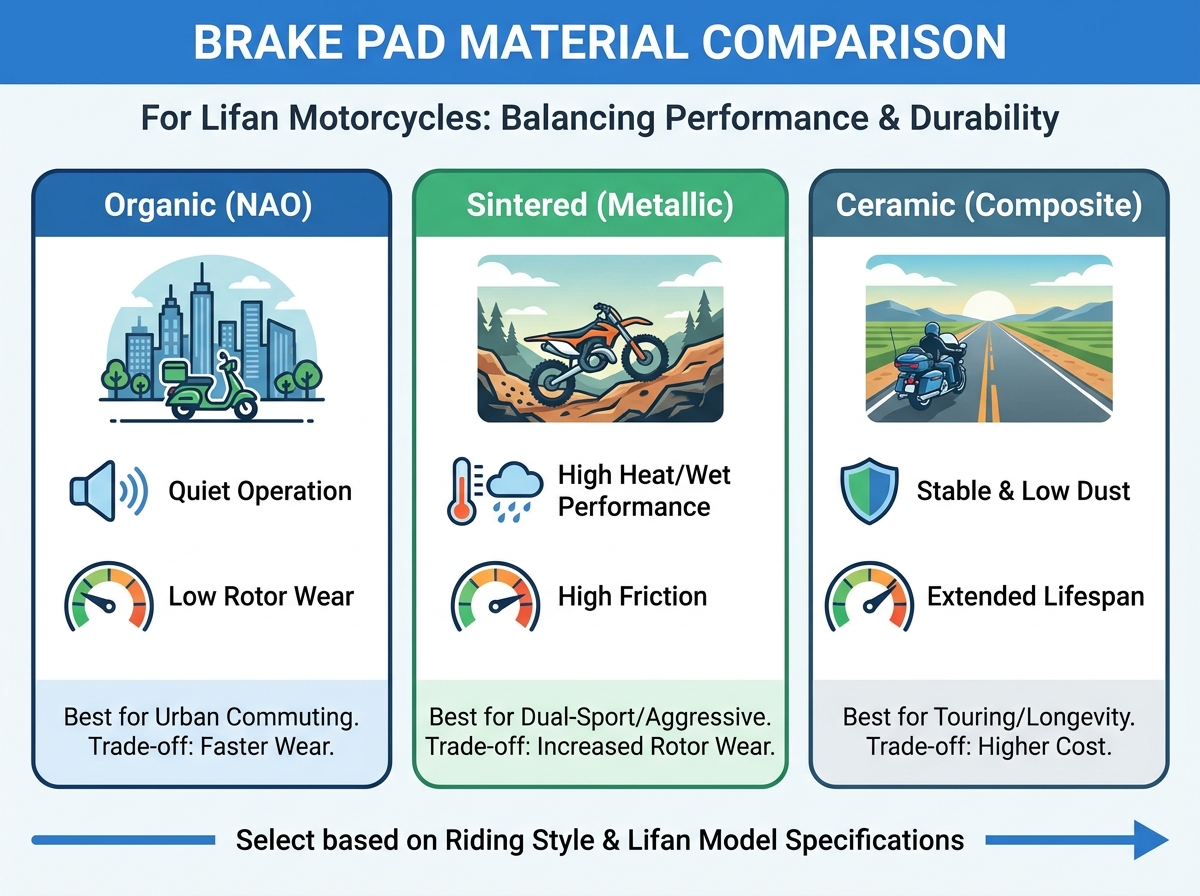
Organic pads use fibers bound together by high-heat resins. They are best for urban commuting and beginner riders. They also suit lightweight models like the KP Mini. You will experience very quiet operation. These pads cause minimal rotor wear. They also offer a progressive initial bite. This makes them highly forgiving for newer riders.
However, you must consider the trade-offs. Organic materials have faster wear rates. You might experience potential brake fade under heavy loads. High heat from aggressive riding can reduce their stopping power quickly.
Manufacturers create sintered pads by fusing metallic particles under extreme pressure. They are best for dual-sport models like the Lifan X-Pect. Riders carrying heavy payloads also benefit from them. Aggressive street riders should choose this material too.
The outcomes are highly favorable for tough conditions. You get superior wet-weather performance. Sintered materials offer rapid heat dissipation. They deliver strong, immediate friction when you pull the lever. The trade-offs include increased noise during low-speed stops. They also cause faster wear on standard brake rotors.
Ceramic pads blend ceramic fibers and non-ferrous filler materials. They are best for touring. Riders seeking longevity often choose this option. You gain stable performance across various temperature ranges. They produce very low brake dust. This keeps your wheels clean. You also get an extended lifespan compared to organic pads.
The main trade-off is a higher initial cost. They also lack the aggressive initial bite of sintered options. They require a brief warm-up period to reach maximum friction.
Brake Pad Material Comparison Chart
| Material Type | Best Riding Style | Key Benefit | Main Drawback |
|---|---|---|---|
| Organic (NAO) | Urban commuting, beginners | Quiet, low rotor wear | Faster wear, prone to fade |
| Sintered (Metallic) | Off-road, aggressive street | High friction, heat resistant | Accelerated rotor wear |
| Ceramic (Composite) | Touring, long-distance | Stable performance, clean | Higher cost, less initial bite |
Selecting the right pad goes beyond basic material categories. You must evaluate specific performance metrics. These metrics determine how the pad behaves in real-world scenarios. Focus on these core safety criteria.
Buying the wrong pad shape is a common frustration. Generic charts often contain errors. Guaranteeing exact fitment requires a proactive approach. Follow these precise steps when replacing your components.
When you seek a reliable Brake Pad for Lifan, verification is your best defense against incompatible parts. Measure twice before ordering.
The aftermarket landscape contains both premium upgrades and dangerous counterfeits. Your safety depends on authentic, well-manufactured components. Knowing how to spot quality saves you from severe accidents. Look for these specific indicators.
Always look for regulatory compliance stamps. The DOT (Department of Transportation) certification is a strong baseline. European ECE R90 certification is even better. ECE R90 proves the pad has passed standardized friction and shear testing. It guarantees the aftermarket pad performs within 15% of the original equipment. Avoid pads lacking these crucial stamps.
Inspect the steel backing plate carefully. It must be thick and warp-resistant. Examine the edges where the friction material meets the metal. High-quality bonding agents leave no visible gaps. If you see cracks or uneven glue lines, discard the pad immediately. Weak bonding causes the friction material to shear off during hard stops.
Warning signs are usually obvious if you know what to look for. Unusually low prices should trigger suspicion. Quality friction materials are expensive to produce. Lack of compound specification is another major red flag. If the box does not state "Organic" or "Sintered," do not buy it. Missing brand packaging or generic white boxes often indicate counterfeit products.
Installing your new components correctly is just as important as buying the right ones. Poor installation ruins high-quality materials. Follow a strict mechanical protocol. This ensures safety and maximizes longevity.
Never just swap the pads and ride away. Check the caliper pistons for dirt and corrosion. Clean them thoroughly using brake cleaner and a soft brush. Inspect the slide pins for smooth movement. Re-grease them using high-temperature silicone paste. Finally, check your brake fluid condition. If it looks dark or cloudy, flush the system before installing the new pad.
You must properly mate the new brake pad to the existing rotor. We call this the bed-in process. It transfers an even layer of friction material onto the rotor face. Accelerate your bike to roughly 30 mph. Apply moderate braking pressure to slow down to 5 mph. Do not come to a complete stop. Repeat this cycle 10 to 15 times. Allow the brakes to cool completely afterward. This prevents glazing and ensures maximum stopping power.
You must know your mechanical limits. Brakes are a critical life-safety system. If you strip a mounting bolt, stop working immediately. If the lever feels spongy after installation, do not ride the bike. Know when to abandon a DIY installation. Seek professional mechanic intervention if you feel uncertain at any step.
Choosing the correct braking components requires balancing material composition against your intended use. You must carefully verify exact physical fitment for your specific model. Avoid relying on generic charts. Instead, use digital calipers and cross-reference factory part numbers. Always visually inspect your current brake pads before ordering replacements. Record your specific model year accurately. Finally, prioritize certified materials over the cheapest available option. High-quality, properly bedded pads ensure your safety on every ride.
A: Mileage varies based on material and riding style. Organic pads typically last between 5,000 and 10,000 miles during normal street commuting. Sintered pads can last 15,000 miles or more due to their harder metallic compound. Aggressive off-road riding or heavy track use will significantly reduce these lifespans.
A: Look directly into the caliper from the front or rear of the wheel. Locate the wear indicator grooves cut into the friction material. If these grooves are no longer visible, or if the material is thinner than 2mm, you need an immediate replacement.
A: Squeaking often results from an improper bed-in process. It can also happen if you forgot to install the anti-rattle clips. Sintered metallic pads naturally produce more noise than organic pads. Ensure you applied a small amount of brake grease to the back of the pad plate.
A: Yes, but you must monitor it closely. Sintered pads create higher friction and generate more heat. This can cause accelerated wear on standard steel rotors. If you notice deep grooving or a distinct lip on the rotor's edge, you may need an upgraded rotor.


