


Views: 0 Author: Site Editor Publish Time: 2026-11-03 Origin: Site


Replacing a failing suspension component is not just about restoring ride comfort; it is a critical safety and handling decision. Weak suspension hardware directly impacts how quickly you can brake and steer during emergencies. Whether maintaining a Chery Tiggo SUV for daily commuting or managing a fleet of Arrizo sedans, selecting the correct aftermarket or OEM-equivalent suspension parts dictates vehicle longevity. Installing substandard parts often accelerates wear across the entire chassis assembly. The right components prevent excess stress from destroying your wheel bearings and shock absorbers. This guide provides a comprehensive framework to evaluate, compare, and select a reliable Coil Spring for Chery vehicles based on material quality, load requirements, and chassis specifications. You will learn how to identify failure symptoms, compare spring designs, and evaluate vendor quality standards.
Coil springs do not just absorb bumps. They support the vehicle's entire gross weight and maintain correct wheel alignment. When they begin to fail, you risk serious drivability issues. Sagging suspension alters the factory steering geometry. You might notice the car pulling unpredictably to one side. Drivers often mistake these symptoms for simple tire alignment issues. However, the root cause usually lies deeper in the suspension assembly.
You can identify metal fatigue by observing a few measurable symptoms of failure. Pay close attention to these indicators during routine inspections:
Delaying replacement causes collateral damage to your tires, struts, and steering linkages. You should replace weakened parts early to prevent catastrophic mechanical breakdowns. Maintaining original chassis geometry keeps your steering responsive. It also ensures your electronic stability control systems function correctly.
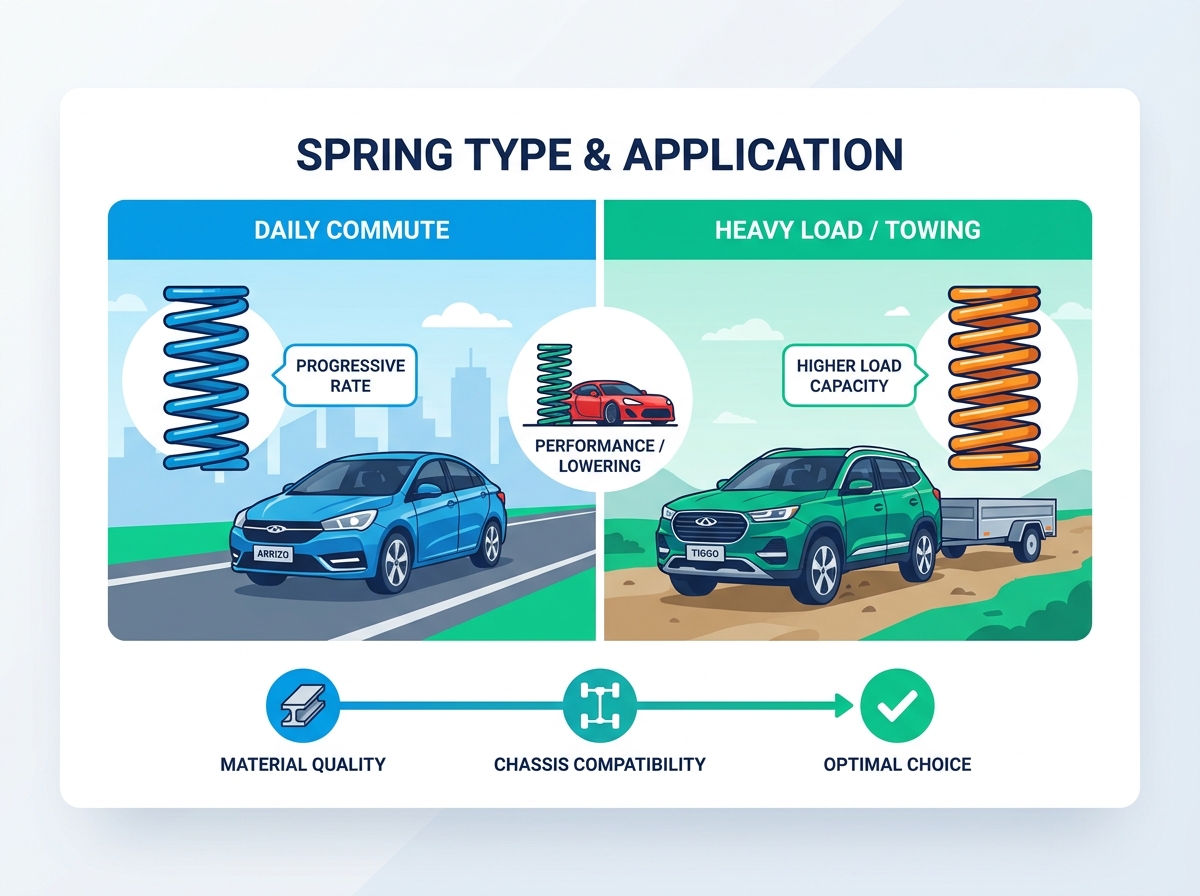
Automotive engineers design different spring profiles for distinct driving environments. You must match the spring type to your primary driving habits. Selecting the wrong profile ruins the driving experience. It can also overload adjacent chassis components. We can categorize the most common replacement options into three distinct groups.
These units replicate factory linear or progressive spring rates. Manufacturers design them to match the exact specifications of the original Chery assembly. They deliver predictable comfort for daily driving. Best for standard commuter use, these springs restore the factory ride height effortlessly. They provide a balanced mix of bump absorption and chassis support. You should choose this option if you primarily drive on paved city roads.
Heavy-duty springs feature a thicker wire diameter. They inherently possess a higher spring rate. They resist sagging under constant, heavy loads. These are best for Chery models frequently used for rideshare services. They also excel in commercial fleet transport or carrying heavy cargo and passengers. A standard spring will bottom out under these harsh conditions. HD variants maintain adequate ground clearance even when fully loaded. The trade-off is a slightly stiffer ride when the vehicle is empty.
Performance springs utilize a shorter free length coupled with a stiffer spring rate. They cater to drivers seeking reduced body roll. They effectively lower the vehicle's center of gravity. This translates to sharper turn-in response and better high-speed stability. However, this upgrade comes at a distinct cost. You will sacrifice ride compliance and precious ground clearance. You must also pair these springs with upgraded, shorter-stroke shock absorbers.
Coil Spring Type Comparison for Chery Models
| Spring Type | Design Characteristics | Best Application | Notable Trade-offs |
|---|---|---|---|
| Standard (OEM) | Matches factory wire diameter and free length. | Daily commuting, restoring original ride quality. | Cannot handle continuous heavy payloads well. |
| Heavy-Duty (HD) | Thicker wire, higher stiffness, taller free length. | Towing, rideshare, full passenger loads. | Stiffer and harsher ride when the vehicle is empty. |
| Performance | Shorter free length, aggressive progressive rate. | Enthusiast driving, reducing cornering body roll. | Reduced ground clearance; requires matched shocks. |
Not all aftermarket suspension parts undergo the same rigorous engineering. A spring might look identical to the factory unit but fail within months. You must evaluate the underlying metallurgy and manufacturing techniques. Understanding these technical criteria separates premium replacement parts from dangerous, inferior copies.
The foundation of any reliable suspension component is its raw material. You must ensure the manufacturer uses high-stress alloy steel. Look for specific industry material codes like SUP9 or 55CrSi. Silicon-chrome alloy steels resist fatigue far better than standard carbon steels. They maintain their elastic memory over millions of compression cycles.
Furthermore, the coiling process dictates structural integrity. Cold-coiling is generally preferred for lighter vehicle springs. The cold-coiling process retains tighter manufacturing tolerances. It also yields a higher tensile strength in the final product. Hot-coiling remains common for massive truck springs, but passenger vehicles benefit greatly from cold-wound precision.
Suspension parts live in a brutal environment. They constantly face water, road salt, and flying gravel. The spring must undergo shot peening before painting. Shot peening bombards the metal surface with tiny steel spheres. This relieves internal surface stress and prevents microscopic cracks from forming.
Following shot peening, the spring requires a high-grade epoxy powder coating. Cheap liquid paint fails quickly in real-world conditions. Poor coating chips easily under road debris. This damage lets salt and moisture attack the bare steel. Rust creates weak points, which is the leading cause of sudden spring breakage.
The physical spacing between the spring coils determines how it reacts to pressure. You will encounter two primary designs:
Best Practices: Always verify the anti-corrosion warranty before purchasing. Ask suppliers if their parts undergo standardized salt-spray testing.
Common Mistakes: Do not buy springs based solely on color or appearance. Brightly painted springs without proper shot peening will inevitably snap after their first winter exposure.
Chery manufactures a diverse lineup of vehicles. Each platform requires vastly different suspension tuning. You cannot apply a universal approach across their entire catalog. Understanding the distinct engineering goals of SUVs versus sedans is paramount.
The Tiggo series features a higher center of gravity. These SUVs also carry a heavier gross vehicle weight rating (GVWR). The suspension must manage significant weight transfers during braking and cornering. They require coil springs with much higher load capacities.
Strict anti-roll characteristics are non-negotiable for SUVs. Tall vehicles risk rolling over during evasive maneuvers if the springs compress too easily. A specialized Coil Spring for Chery Tiggo models incorporates thicker steel wire. This robust design guarantees chassis stability on rough rural roads. It also provides the necessary support for towing light trailers.
The Arrizo lineup utilizes a much lighter chassis. Automotive engineers focus heavily on NVH (Noise, Vibration, Harshness) reduction for these sedans. The goal is a quiet, isolated passenger cabin. Stiff SUV springs would ruin this refined experience.
Arrizo sedans benefit immensely from progressive spring rates. These setups prioritize bump compliance. They absorb minor road imperfections without transferring shock to the passengers. However, they still provide enough structural support to maintain highway stability at high speeds. The engineering focus shifts from payload capacity to passenger comfort.
Finding the right component involves scrutinizing the supplier as much as the product. The aftermarket is flooded with unverified parts. You must implement strict vendor evaluation criteria. This protects your vehicle and ensures long-term safety.
Always shortlist suppliers holding verified international certifications. Look specifically for ISO 9001 or IATF 16949 credentials. IATF 16949 represents the gold standard for strict automotive manufacturing. These certifications ensure the factory utilizes rigorous risk management. They also guarantee complete material traceability. You can trust that every production batch meets identical safety thresholds.
Trustworthy manufacturers do not hide their testing data. They routinely conduct and publish results for rigorous quality assurance tests. Look for documented salt spray tests. These confirm the epoxy coating can survive harsh winters. Furthermore, demand evidence of mechanical fatigue tests. A premium manufacturer tests their springs to a minimum of one million compression cycles without failure.
A credible manufacturer stands behind their metallurgical engineering. They should offer a strong commercial warranty. Look for a minimum 12-to-24-month guarantee. Read the fine print carefully. The warranty must cover premature sagging, not just complete breakage, under normal use conditions. Avoid suppliers offering only 30-day return windows.
Selecting the right replacement spring requires careful attention to detail. You must balance your primary use case with strict manufacturing standards. Whether you need standard comfort for city driving or heavy-duty support for towing, material quality remains paramount. High-tensile alloy steel and proper epoxy coatings guarantee long-term safety. Remember to always replace these components in pairs to maintain perfect chassis balance.
Next steps: Audit your vehicle's current ride height using a measuring tape. Determine if you actually need standard or heavy-duty replacements based on your daily payload. Finally, cross-reference the exact part numbers tailored to your specific Chery chassis and manufacturing year before completing any purchase.
A: Yes. Replacing only one side results in a dangerous suspension imbalance. This leads to unpredictable handling during emergency braking. You will also cause accelerated wear on the older spring. Always replace them in matched pairs to maintain stable steering geometry.
A: Under normal driving conditions, quality coil springs typically last between 80,000 to 100,000 miles. However, severe rust or frequent heavy impacts can significantly shorten this lifespan. Regular visual inspections help you catch metal fatigue early.
A: No. While they might physically fit in some instances, the spring rates are calibrated for vastly different vehicle weights. Using mismatched springs severely compromises shock absorber life. It completely ruins the vehicle's intended safety dynamics.
A: Yes. For MacPherson strut assemblies common in Chery vehicles, a heavy-duty spring compressor is absolutely mandatory. This is a high-risk mechanical procedure. The stored energy in compressed springs can cause severe injury. Always leave this installation to certified technicians.


