


Views: 0 Author: Site Editor Publish Time: 2026-10-31 Origin: Site


Upgrading brake components is crucial for ride safety and operational control. Reliable braking demands precise tension, minimal stretch, and consistent housing compression. Owners often face a dilemma when replacing worn parts. Should you choose exact OEM parts or explore third-party aftermarket alternatives? Finding the right balance between guaranteed fitment and enhanced performance can feel overwhelming. Many riders wonder if premium brands justify their higher price tags. This guide provides an objective, mechanic-focused comparison of stock and competitor options. We will help you make an informed, safety-first purchasing decision. You will learn how materials, housing synergy, and installation practices impact your daily ride. We break down the technical differences between various cable tiers. By the end, you will know exactly which replacement strategy suits your specific riding environment and budget constraints.
Choosing a genuine Brake Cable for Lifan offers one primary advantage. It provides exact dimensional tolerances. You eliminate routing guesswork entirely. Mechanics appreciate this precision during routine maintenance. It ensures the cable head seats perfectly in the lever. The length matches factory specifications exactly. You never struggle with housing segments being too short or too long.
Stock cables typically use standard stainless or galvanized steel. These materials offer solid performance thresholds in typical weather conditions. Galvanized steel resists basic moisture well enough for dry climates. Stainless steel provides much better rust protection. They handle daily commuting demands without fuss. Manufacturers design them to meet strict safety standards.
Standard OEM components offer a highly predictable lifecycle. You know exactly what you pay for. Replacement costs remain stable over time. You avoid the premium markups associated with high-end racing brands. This makes budgeting for routine maintenance straightforward. Commuters appreciate this financial consistency. You can schedule replacements reliably based on mileage.
However, stock options may fall short under heavy, sustained loads. They degrade faster than high-end PTFE-coated alternatives. Smooth actuation diminishes over time. Dirt and grime can increase friction inside the housing. Riders in extreme environments might notice this degradation sooner. The lever feel becomes progressively heavier. You might experience delayed caliper return speeds.
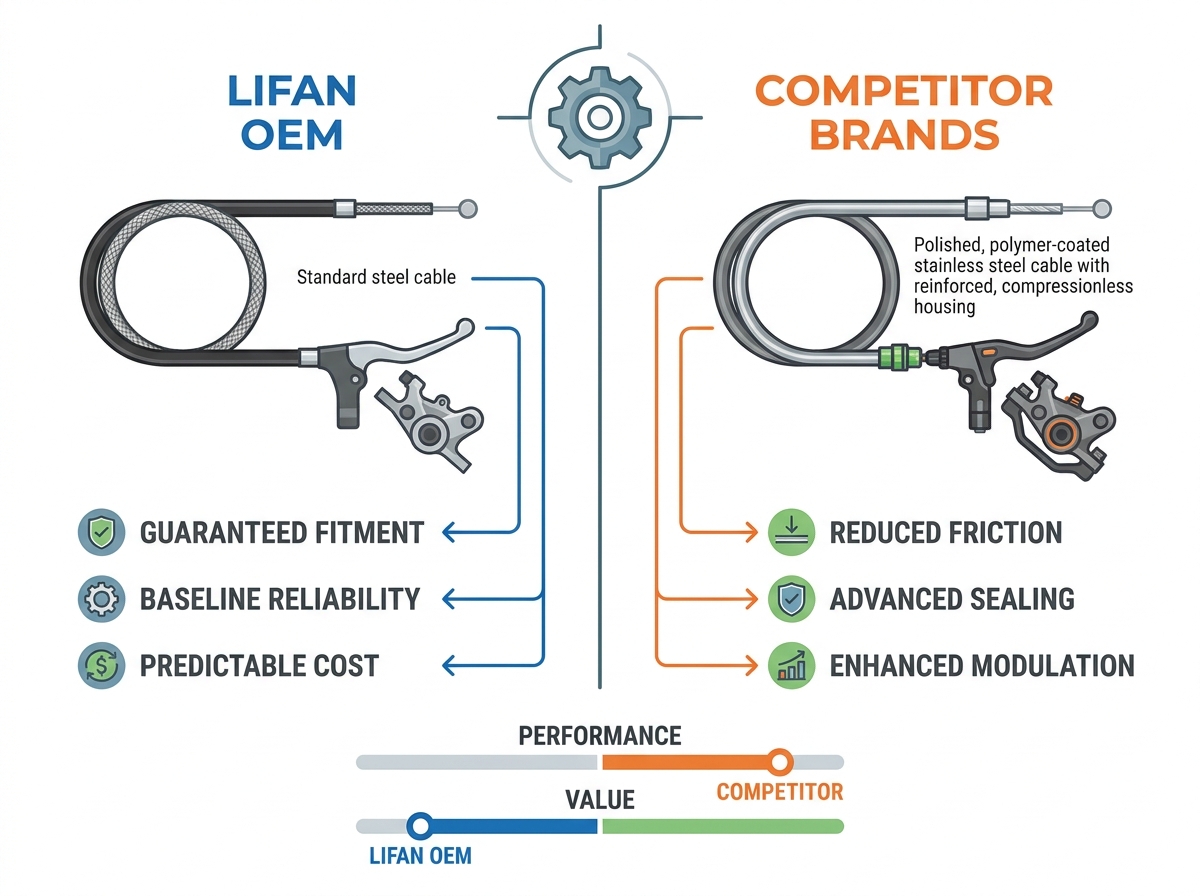
Shimano and SRAM dominate the standard to premium tiers. They offer die-extruded stainless steel options. Their proprietary polymer coatings reduce friction significantly. They deliver standardized reliability across various riding disciplines. You get a incredibly smooth lever feel. These brands invest heavily in research and development. Their cables often set the industry benchmark for shifting and braking performance. Mechanics trust them for consistent quality out of the box.
Jagwire Pro and Elite series are highly popular upgrades. They feature highly polished cables. Their Kevlar-reinforced, compressionless housing systems stand out in the market. This represents a common upgrade path for enthusiasts. Riders seek immediate modulation improvements. The stiffer housing translates lever force directly to the caliper. You lose less energy to housing flex. The braking response feels immediate and sharp.
Brands like Nokon and KCNC offer niche, high-end systems. They utilize segmented aluminum housing pieces. They provide ultra-lightweight setups for weight-conscious riders. These systems look striking and unique. However, you must objectively assess their practical value. The high cost rarely justifies the performance gain for standard riding applications. They require meticulous installation procedures. Dirt can sometimes penetrate the aluminum segments.
Regional cycling communities frequently discuss budget-friendly aftermarket brands. These offer tempting upfront savings. You must balance this against potential premature fraying. Budget cables often use lower-grade steel alloys. They might lack proper pre-stretching treatments. They serve well as emergency spares in your toolkit. We do not recommend them for high-stakes descents or heavy touring.
You must compare raw steel, polished stainless, and PTFE-coated cables carefully. Raw steel creates the most internal friction. Polished stainless offers a superb middle ground for durability. Polymer coatings provide the absolute smoothest pull. However, polymer coatings carry specific trade-offs. The coating can flake off over time. It clogs housing liners if poorly maintained. This eventually creates more friction than standard steel.
Pre-stretched cables differ significantly from standard cables. Manufacturers pull them under high tension during production. This process removes initial structural elongation. It reduces the need for barrel adjuster tweaks post-installation. Your brakes feel crisp for much longer. Standard cables require frequent readjustment during the initial break-in period. You spend more time tuning and less time riding.
Sealed end-caps and rust-resistant alloys are vital components. Riders in wet or highly abrasive environments desperately need them. Mud and grit destroy inner wires rapidly. Proper sealing keeps these contaminants outside the system. It extends the lifespan of your entire braking setup. A well-sealed system requires far less routine maintenance. You save money on replacement parts long-term.
You must match the cable head type correctly. Road levers require different heads than flat bar levers. Wire diameter also matters immensely. A 1.5mm wire might bind in a 1.2mm housing liner. Always verify specifications before purchasing any aftermarket components. Mismatched parts compromise your braking power severely.
Brake Cable Material Comparison Chart
| Material Type | Friction Level | Corrosion Resistance | Best Use Case |
|---|---|---|---|
| Galvanized Steel | High | Low | Budget repairs, dry climates |
| Standard Stainless | Medium | High | Daily commuting, OEM replacements |
| Polished Stainless | Low | Very High | Performance upgrades, frequent riders |
| Polymer-Coated | Very Low | High | Racing, complex internal routing |
Pairing a premium competitor cable with degraded housing neutralizes the upgrade entirely. Easily compressible housing absorbs your lever force. The inner wire cannot move freely through old kinks. You must replace both components simultaneously for optimal results. Reusing old housing is a common and costly mistake. It compromises the performance of your expensive new inner wire.
Internal and external cable routing present very different realities. Stiffer aftermarket housing complicates tight internal bends. It might kink inside the frame during installation. More flexible OEM options navigate these tight bends easily. You need patience when routing stiff Kevlar housing. Taking your time prevents internal snags. Rushing leads to frustrating binding issues.
Common installation errors ruin perfectly good cables. Using improper cutters leads to crushed housing ends. This immediately causes frayed inner cables. You must use dedicated cable shears for clean cuts. Proper ferrules and crimps are absolutely essential. They prevent the housing wire from poking through the end caps. Follow these steps for perfect installation:
Modern lined housings rarely require supplemental lubrication. The wrong lube degrades delicate Teflon liners quickly. It attracts dirt and creates a sticky, abrasive paste. If you use a high-quality coated wire, leave it completely dry. Only lubricate unlined, older-style housings. Adding grease to a polymer-coated cable ruins the low-friction design.
We recommend OEM for riders prioritizing straightforward installation. It guarantees full warranty compliance. You get reliable baseline performance at a highly predictable price. A genuine Brake Cable for Lifan ensures you never worry about compatibility. It fits perfectly every single time. Daily commuters benefit greatly from this reliability. You minimize downtime and maximize riding time.
Upgrade to premium aftermarket brands if you experience frequent cable stretch. Demanding environments easily justify the higher initial cost. Riders requiring hyper-responsive lever feel benefit immensely. The improved modulation enhances technical riding capabilities. Stiffer compressionless housing transforms mechanical disc brakes. It makes them feel almost as powerful as hydraulic systems. Invest here if performance is your top priority.
We advise caution regarding budget aftermarket options. Recommend these only as temporary fixes. They suit highly restricted budgets temporarily. You must accept the explicit assumption of a shorter operational lifespan. Inspect them frequently for signs of fraying or rust. Replace them as soon as your budget allows for higher-quality components.
The best choice balances exact fitment with your specific environmental demands. Performance needs dictate your necessary investment level. OEM parts offer incredible peace of mind and guaranteed compatibility. Premium aftermarket parts deliver marginal but highly noticeable performance gains. Budget cables serve only as temporary placeholders. Understanding these differences helps you spend your maintenance budget wisely.
Inspect your current housing for cracks or wear today. Verify your required cable head standard before ordering parts. Select the corresponding tier of cable based on our evaluation criteria. Invest in proper cutting tools before starting any installation. Doing the job right the first time ensures miles of safe, predictable braking.
A: Replace them every 1,500 to 2,000 miles under standard usage. Riders in harsh, wet, or muddy conditions should replace them annually. Inspect them monthly for fraying near the lever or pinch bolt. Sluggish lever return is a strong indicator they need replacement.
A: Yes, you can mix them. However, you must verify the inner diameter compatibility. Ensure the competitor housing matches the standard wire thickness. Also, ensure the housing ferrules fit securely into your specific frame stops and brake calipers.
A: Spongy brakes usually indicate unseated ferrules or improper housing cuts. If the housing ends are not perfectly flat, they compress under tension. Standard cable stretch during the first few rides also causes sponginess. Re-tighten the cable after the initial break-in period.
A: They offer immediate, noticeable friction reduction. This improves lever feel dramatically. However, the coating can degrade and clog the housing if debris enters the system. They are worth the cost for performance riders who maintain their equipment meticulously.


