


Views: 0 Author: Site Editor Publish Time: 2026-07-26 Origin: Site


Vehicle suspension degradation rarely happens overnight. It is a progressive mechanical failure that compromises vehicle safety, handling predictability, and braking efficiency long before a complete breakdown occurs. Failing to identify early-stage fatigue forces struts, control arms, and tires to absorb kinetic loads they were never engineered to handle. This transforms a standard maintenance item into a multi-component, highly complex repair job.
Addressing suspension issues requires moving far beyond basic symptom recognition. You need a systematic framework to diagnose component health, evaluate replacement options, and navigate the safety and regulatory realities of suspension repair. This guide breaks down exactly how to identify failing components, assess the mechanical damage, and make informed decisions to restore your vehicle's structural integrity and handling dynamics.
The primary function of a suspension spring is supporting the gross weight of the vehicle. It maintains the engineered ride height and keeps the chassis level under varying static loads. When you load cargo or passengers, the high-carbon steel compresses to absorb the weight while fighting to return to its static length. This constant tension ensures the vehicle maintains adequate ground clearance. Without this structural support, the chassis would rest directly on the axles, making the vehicle undrivable. The spring rate, defined as the amount of weight required to compress the spring by one inch, is specifically calculated by engineers to match the vehicle's intended gross vehicle weight rating. Over time, the constant cycling of compression and extension causes the steel to lose its temper, resulting in a gradual loss of ride height even if the metal does not physically break.
Suspension systems rely on a strict division of labor. The spring absorbs the raw kinetic energy of road impacts, compressing rapidly when the tire strikes a pothole or bump. However, a spring alone will continue to oscillate, bouncing up and down until the energy dissipates. The shock absorber, or strut, steps in to dampen this oscillation. It controls the speed at which the spring compresses and rebounds. If the spring loses its tension rate, the strut takes on impact forces it cannot handle. The internal valving of the shock absorber is forced to operate outside its designed stroke range, leading to rapid seal failure, fluid leaks, and a complete loss of dampening capability.
Spring health directly dictates your vehicle's camber and caster angles. The ride height establishes the baseline geometry for the entire steering and suspension system. A sagging spring permanently alters wheel alignment. It shifts the control arms out of their optimal operating range, reducing the tire's contact patch with the road. This geometric shift compromises steering response and drastically increases stopping distances during emergency braking. When the ride height drops, the camber angle typically goes negative, meaning the top of the tire leans inward toward the chassis. This forces the inner edge of the tire tread to bear the majority of the vehicle's weight, leading to rapid and uneven tire wear that cannot be corrected by a standard wheel alignment until the ride height is restored.
Visual inspections often reveal the earliest stages of failure. Start by examining the protective powder coating on the steel wire. Once this coating chips or wears away from road debris, moisture attacks the bare metal. Surface rust quickly leads to deep pitting. These pits create stress risers in the high-carbon steel. Under constant compression and expansion, these weakened areas eventually snap. Pay special attention to the lowest coil seated in the strut mount. Debris, road salt, and moisture accumulate heavily in this lower pocket, making it the most common fracture point. You might also notice heavy flaking or scaling rust, which indicates that the structural integrity of the steel has been severely compromised, even if a full fracture has not yet occurred.
A failing suspension often reveals itself in the vehicle's posture. Park on level ground and measure the ride height from the center of the wheel hub directly up to the fender lip. Compare these measurements across the same axle. A discrepancy of more than half an inch usually indicates a sagging spring. You may also experience bottoming out. This happens when the spring loses its tension rate and fails to support the chassis over large dips. The suspension fully compresses, slamming the chassis directly into the rubber bump stops. Repeated bottoming out not only damages the bump stops but can also cause structural damage to the strut towers and chassis mounting points.
Listen closely when driving over uneven surfaces or navigating low-speed turns. A metallic clunking or rattling sound often points to a fractured spring. Sometimes, a broken piece of steel remains trapped in the lower seat, rattling against the strut body. You might also hear a distinct popping sound when turning the steering wheel. This indicates the spring is binding against a seized strut bearing or a broken coil is shifting under rotational load. Handling symptoms include sudden, unintended swaying, excessive body roll in corners, and severe nose-diving during hard braking. The vehicle will feel unpredictable, requiring constant steering corrections to maintain a straight line on the highway.
A compromised spring fails to control kinetic rebound effectively. This results in a floating, bouncy, or highly unstable sensation over uneven pavement. The vehicle may feel disconnected from the road, wallowing after hitting highway expansion joints. This instability drastically reduces tire traction, especially in wet or icy conditions, as the suspension struggles to keep the tire firmly planted against the asphalt. The lack of proper downward force means the tire can easily hydroplane or lose grip during evasive maneuvers.
Ignoring a bad spring accelerates wear across the entire wheel assembly. Sagging alters the camber angle, causing the tire to lean inward or outward. This leads to cupping or rapid tread degradation on the inner or outer edges of the tire. Furthermore, struts forced to operate outside their engineered stroke range due to a collapsed spring will fail prematurely. The internal valving bottoms out, destroying the hydraulic seals. You will often see oil leaking down the side of the strut body, confirming that the shock absorber has blown out due to the lack of spring support.
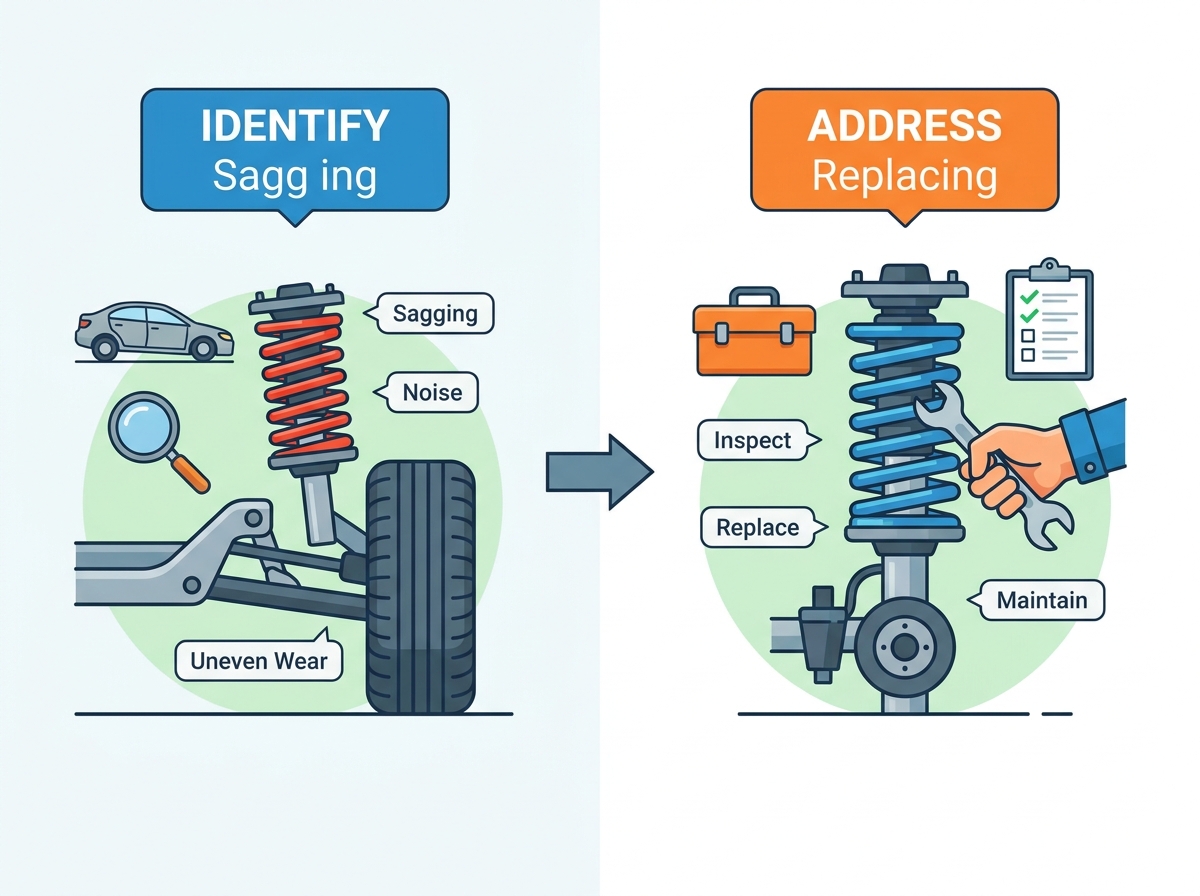
Always prioritize safety when inspecting suspension components. Support the vehicle securely on heavy-duty jack stands. Never rely solely on a hydraulic floor jack, as hydraulic seals can fail without warning. Follow this systematic process to evaluate the suspension:
Run your gloved hand along the lower spring seat and the suspension arm pockets. You must sweep these areas for fractured metal fragments. Often, the very end of the spring snaps off and pools in the lower assembly. Identify any missing pieces of the coil and check the condition of the rubber spring isolators. Degraded or missing isolators cause metal-on-metal contact, leading to noise and accelerated wear. If you find a piece of broken steel, the spring must be replaced immediately, regardless of how the vehicle currently sits or drives.
Many drivers rely on the traditional bounce test, pushing down on the vehicle's bumper to see if it bounces continuously. This test is largely ineffective for modern, stiffly sprung vehicles. It primarily tests for completely dead shock absorbers rather than evaluating spring tension. A vehicle can pass a bounce test perfectly while hiding a fractured lower coil. Visual and measurable diagnostic methods, such as checking ride height and inspecting for physical damage, are far more reliable indicators of spring health.
A compromised, cracked, or excessively corroded spring represents an immediate and severe safety hazard. In jurisdictions that mandate annual or biennial vehicle safety inspections, a broken spring results in an automatic failure. Inspectors actively look for compromised suspension components because a snapped coil can easily dislodge, puncture the inner sidewall of a tire, or sever a hydraulic brake line while the vehicle is in motion. Passing inspection requires replacing the damaged components and providing proof of a proper wheel alignment.
Establish a clear threshold for professional intervention. If you experience handling anomalies, pulling, or metallic clunking, but your visual inspection yields no obvious breaks, escalate the issue. A professional shop can place the vehicle on an alignment rack to check the suspension geometry. They have the specialized tools to measure spring rates and identify subtle structural failures that are invisible to the naked eye. They can also check for bent control arms or worn bushings that might be mimicking the symptoms of a failing spring.
When replacing suspension components, selecting the right parts dictates the future ride quality and longevity of the repair. Here is a breakdown of common replacement strategies.
| Replacement Option | Primary Advantage | Primary Disadvantage | Best Use Case |
|---|---|---|---|
| OEM Springs | Exact factory ride height and engineered spring rate. | Higher initial part cost compared to aftermarket alternatives. | Restoring factory-fresh handling and ride comfort. |
| Aftermarket Standard Springs | Readily available and generally more budget-friendly. | Spring rates may vary slightly, altering ride harshness. | Standard daily driving and budget-conscious repairs. |
| Heavy-Duty (Variable Rate) Springs | Increased load capacity and reduced sagging under weight. | Stiffer, harsher ride when the vehicle is unloaded. | Vehicles used for towing, hauling, or carrying heavy accessories. |
| Complete Strut Assemblies | Reduces labor time and eliminates dangerous manual spring compression. | Higher upfront part cost due to included shock and mount. | Comprehensive suspension overhauls for aging vehicles. |
Original Equipment Manufacturer parts guarantee the exact factory spring rate and ride height. They deliver predictable ride quality and integrate flawlessly with existing suspension geometry. Aftermarket options offer a broader range of choices and are often more readily available. However, you must carefully verify the spring rates. Installing an aftermarket spring with an incorrect tension rate can result in an overly harsh ride or a floating, disconnected steering feel. Always cross-reference the part numbers to ensure compatibility with your specific trim level and engine weight.
If you regularly tow trailers, haul heavy materials, or have added heavy steel bumpers to your vehicle, heavy-duty or variable-rate springs offer a necessary upgrade path. These springs feature thicker wire or tighter coil spacing at one end. They resist sagging under heavy loads, maintaining safe steering geometry. The trade-off is a noticeably stiffer and less comfortable ride when driving the vehicle unloaded. You must weigh the frequency of your heavy hauling against your daily driving comfort requirements before selecting a variable-rate option.
Replacing just the bare spring requires disassembling the existing strut, compressing the old spring, and transferring the top mount and shock absorber. This is labor-intensive and dangerous. Complete strut assemblies arrive pre-assembled with a new spring, shock absorber, bump stop, and upper mount. While the assembly requires a larger upfront parts investment, it significantly reduces labor hours and provides entirely fresh wear components for the wheel corner. This is generally the most efficient route for vehicles with over 80,000 miles, as the shock absorbers are likely nearing the end of their service life anyway.
Do not underestimate the kinetic energy stored in a compressed vehicle suspension spring. It holds thousands of pounds of force. Attempting to compress a heavy-duty spring using cheap, clamp-style rental tools is exceptionally dangerous. These threaded rod compressors frequently slip, bend, or strip their threads under load. If a compressor fails, the spring releases its energy instantly, acting as a heavy steel projectile. This task is best left to professional technicians equipped with caged, wall-mounted hydraulic spring compressors designed to handle extreme loads safely.
When planning a suspension repair, factor in the labor hours required for disassembly and reassembly. Opting for a loaded strut assembly cuts the installation time down dramatically compared to rebuilding a bare strut. Regardless of the method chosen, replacing springs requires disturbing the vehicle's suspension geometry. A mandatory four-wheel alignment must be performed immediately after installation to prevent rapid tire wear and ensure safe handling.
Take advantage of the disassembled suspension to inspect overlapping parts. Check the strut mounts, bearings, bump stops, and sway bar end links. Replacing a worn sway bar link or a grinding strut bearing while the assembly is already apart saves you from paying duplicate labor hours down the road. Integrating a high-quality Coil Spring replacement with fresh mounts ensures a complete restoration of ride dynamics.
Ignoring suspension fatigue guarantees higher downstream repair costs and serious safety risks. Early identification of rust, sagging, debris in spring wells, or handling anomalies is critical for keeping your vehicle safely on the road. By addressing these issues proactively, you protect your tires, struts, and steering components from premature destruction.
For most daily drivers, replacing the entire strut assembly with an OEM-equivalent unit offers the best balance of safety, restored ride quality, and labor efficiency. Remember that suspension components degrade evenly; you must always replace springs in axle pairs to maintain side-to-side balance and predictable emergency handling.
Take the following actions to ensure your suspension is roadworthy:
A: No. Driving with a broken spring is extremely dangerous. The fractured metal can shift unexpectedly, puncturing the inner sidewall of your tire or severing a hydraulic brake line. It severely compromises your vehicle's ability to steer and stop safely.
A: Yes. Any cracked, broken, or severely corroded suspension spring is classified as an immediate safety defect. It will result in an automatic inspection failure in any jurisdiction that mandates vehicle roadworthiness testing.
A: The total repair scope depends on the vehicle make and whether you install bare springs or loaded strut assemblies. The final bill will include the parts for an axle pair, professional labor hours for installation, and the mandatory post-repair wheel alignment.
A: Replacing all four is not strictly necessary unless you are upgrading the entire suspension system. However, you must absolutely replace them in front or rear pairs to maintain side-to-side balance and safe handling geometry.
A: They often last between 80,000 and 100,000 miles. However, their lifespan is heavily dependent on environmental factors like heavy road salt exposure, rough driving conditions, and how frequently the vehicle carries maximum payload.
A: The spring supports the vehicle's weight and absorbs the kinetic energy of bumps. The shock absorber dampens that energy, controlling the speed of the spring's compression and rebound to prevent the vehicle from bouncing continuously.
A: Yes. A sagging spring permanently alters the vehicle's camber and toe angles. This misalignment forces the tire to drag at an improper angle, leading to rapid, uneven degradation of the inner or outer tread blocks.


