


Views: 0 Author: Site Editor Publish Time: 2026-08-08 Origin: Site


Modern internal combustion engines operate under extreme precision, relying on complex control systems and exact metallurgical tolerances to deliver power and efficiency. The air filtration system serves as the primary defense mechanism for the engine's internal components, rather than just a basic consumable. You must balance the need for maximum airflow to support combustion with the necessity of maximum particulate capture to prevent mechanical wear. Sub-standard filters allow microscopic contaminants to bypass the media, leading to Mass Airflow (MAF) sensor degradation, skewed air-fuel ratios, and accelerated internal engine wear.
This guide provides a technical evaluation framework for selecting the optimal Air Filter for Great Wall Motor vehicles. By understanding the science of combustion, the mechanics of contaminant ingestion, and the specific physical attributes that define a high-quality filter, you can make informed decisions that balance OEM specifications with the environmental demands your vehicle faces.
The primary objective of an engine air intake system is delivering a continuous supply of clean, oxygen-rich air to the combustion chambers without restricting volumetric flow. Achieving this requires a mechanical balance between porous media that allows air to pass freely and dense fibers that trap microscopic debris. When this balance fails, engine performance degrades rapidly.
The Mass Airflow (MAF) sensor measures the volume and density of incoming air, allowing the Engine Control Unit (ECU) to calculate the exact stoichiometric point for fuel delivery. The sensor relies on a heated wire element exposed to the incoming airstream. As air flows over the wire, it cools, and the electrical current required to maintain the wire's temperature translates into an airflow measurement.
This heated element is highly vulnerable to contamination. If the air filter fails to capture fine silica, oil vapors, or dust, these particles coat the MAF sensor wire. A coated sensor responds sluggishly to changes in airflow, providing inaccurate data to the ECU. This cascading effect leads to delayed throttle response, incorrect fuel trim adjustments, and heavy strain on the catalytic converter as the engine runs excessively rich or lean.
Optimal combustion requires a precise stoichiometric ratio of air to fuel. Unrestricted oxygen density maximizes power output and fuel economy. When an air filter becomes restricted by trapped dirt, the engine works harder to pull air through the media, creating a pumping loss that negatively impacts volumetric efficiency.
Modern ECUs compensate for restricted airflow by reducing fuel delivery to maintain the correct air-to-fuel ratio. While this prevents immediate catastrophic failure, it masks the physical symptoms of a clogged filter. The engine produces less power, but because it still runs smoothly, the driver may not notice the degradation until the filter is severely compromised.
Filtration failure directly correlates with mechanical wear. Understanding the types of contaminants your vehicle encounters helps clarify why a high-quality filter protects engine longevity.
Great Wall Motor vehicles operate in diverse environments, exposing them to a wide range of airborne hazards. Coarse road dust, fine silica sand, organic pollen, and highway soot all pose unique threats. These particulates vary significantly in hardness and size. A robust filtration barrier must be dynamic enough to capture microscopic soot particles while also trapping larger, highly abrasive sand grains before they enter the intake manifold.
| Contaminant Type | Average Size (Microns) | Primary Engine Threat |
|---|---|---|
| Silica Sand | 50 - 100+ | Severe scoring of cylinder walls and piston rings. |
| Road Dust | 10 - 50 | MAF sensor coating and valve seat wear. |
| Pollen / Organics | 10 - 100 | Filter media clogging and moisture retention. |
| Highway Soot | 1 - 10 | Oil contamination and bearing wear. |
When dirt bypasses the air filter, it enters the combustion chamber. Silica and sand particles are often harder than the metals used in engine construction. As the piston moves up and down, these trapped particles act like sandpaper between the piston rings and the cylinder walls. This process causes micro-abrasions and scoring, degrading the seal between the rings and the cylinder. Over time, this leads to a loss of compression, increased blow-by gases entering the crankcase, and elevated oil consumption.
Ingested particulates that bypass the combustion chamber eventually mix with the engine oil. Once suspended in the lubricant, dirt-contaminated oil acts as a lapping compound. It circulates throughout the engine, accelerating wear on bearings, camshaft lobes, and the oil pump itself. Preventing dirt entry at the intake is far more effective than relying on the oil filter to catch it later.
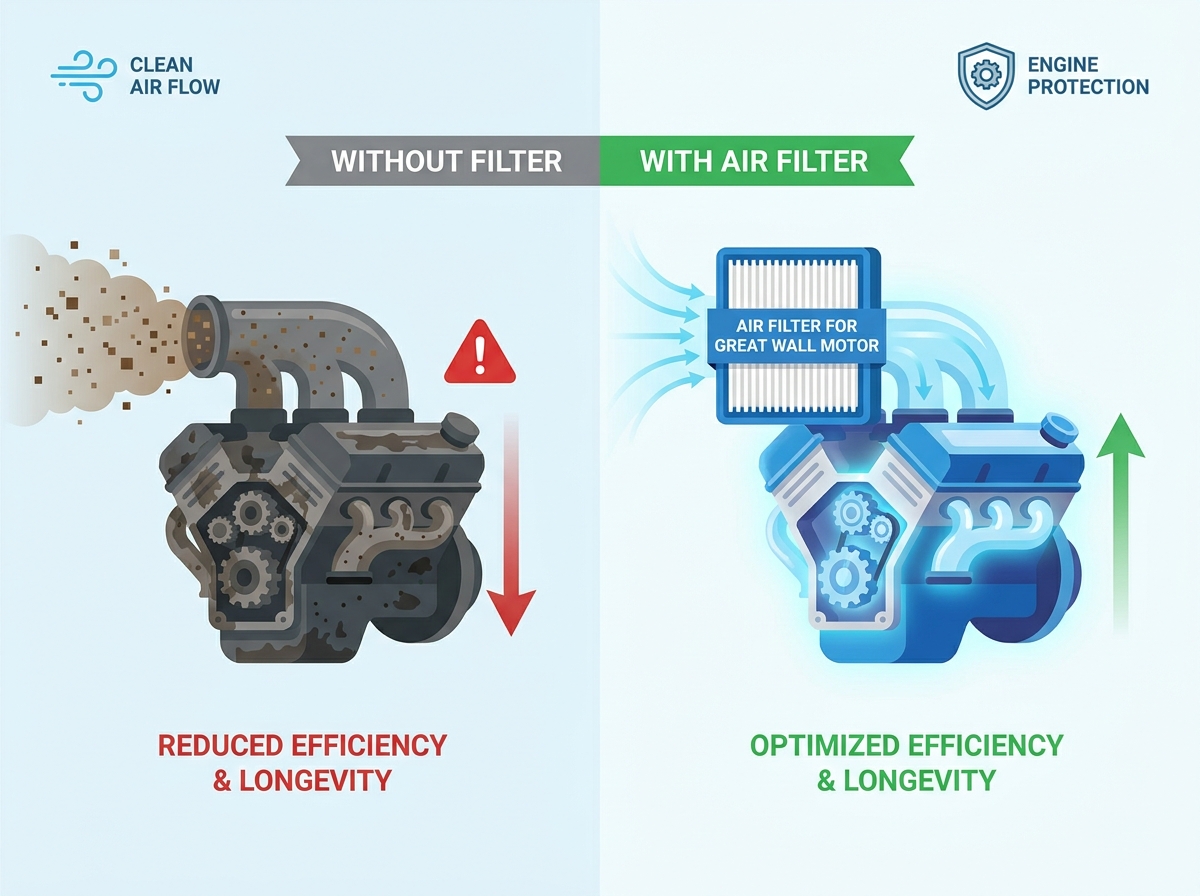
Separating a premium filter from a budget alternative requires examining specific physical attributes. A quality filter features superior materials and construction designed for high-stress environments.
The filtration media is the core component of any air filter. Traditional cellulose paper serves as the standard OEM baseline, offering adequate filtration for normal driving conditions. Synthetic nano-fiber blends provide significant advantages. Synthetic media resists moisture better, preventing the filter from collapsing in humid environments. It also offers superior depth-loading capabilities, trapping dirt throughout the thickness of the media rather than just on the surface, which maintains lower airflow restriction levels over a longer period.
Air filters are evaluated using ISO test standards, such as ISO 5011, which measure efficiency and capacity. The micron rating indicates the filter's ability to capture specific particle sizes, typically ranging from 5 to 20 microns. A lower micron rating means finer particles are trapped.
Dirt-Holding Capacity (DHC) measures the total mass of dirt a filter can capture before airflow restriction reaches an unacceptable level. A high DHC maintains consistent airflow over the filter's entire lifespan, ensuring the engine receives adequate oxygen even as the filter loads with debris.
The structural design of the filter determines its effectiveness in the real world. The perimeter seal, usually made of polyurethane or silicone, prevents unfiltered air from bypassing the media and entering the engine directly. A weak or poorly fitting seal negates the benefits of high-quality media.
Pleat count and depth determine the total surface area available for filtration. More surface area reduces restriction and increases DHC. Exact dimensional fitment for specific GWM airboxes is essential. The filter must maintain structural rigidity under high intake vacuum to prevent collapsing or pulling away from the sealing surfaces.
| Feature | Budget Filter | Premium/OEM Filter |
|---|---|---|
| Media Type | Basic Cellulose | Synthetic Blend / High-Density Cellulose |
| Seal Material | Hard Plastic / Foam | Flexible Polyurethane / Silicone |
| Pleat Count | Low (Less Surface Area) | High (Maximum Surface Area) |
| Dirt-Holding Capacity | Low (Clogs Quickly) | High (Maintains Airflow Longer) |
When selecting a replacement filter, buyers must weigh the advantages of genuine parts against various aftermarket options based on their specific driving conditions.
Sourcing genuine OEM parts provides guaranteed fitment and baseline DHC that meets the manufacturer's exact specifications. Using genuine filters ensures strict adherence to factory warranty requirements, eliminating potential disputes over part failures. Dealership-sourced parts offer peace of mind regarding quality and compatibility.
Standard aftermarket replacements from reputable brands often match or slightly exceed OEM specs. Specialized filters cater to different needs. "High-Flow" washable filters, typically using oiled cotton gauze, increase airflow but present a trade-off: the oil can migrate and contaminate the MAF sensor if over-applied. "Heavy-Duty" or off-road specific filters are designed for high-dust environments, making them ideal for GWM Ute or Cannon models used extensively in agriculture or overlanding, where maximum particulate capture is prioritized over minor airflow gains.
Proper installation and timely maintenance are just as important as selecting the right filter. Neglecting these aspects compromises even the best filtration system.
Because air filters operate out of sight, they are often neglected. Fuel economy and engine performance slowly degrade over thousands of kilometers as the filter loads with dirt. This gradual decline makes the loss of power virtually imperceptible to the driver. By the time physical symptoms become obvious, the engine has already been operating inefficiently for an extended period, and internal damage may have occurred.
Monitoring vehicle performance helps identify a failing filter early. Look for verifiable symptoms such as unexplained drops in fuel economy, rough idling, misfires, or a triggered Check Engine Light (CEL) indicating lean or rich running conditions. Relying solely on a visual inspection is a myth; a filter that looks dirty on the surface might still flow adequately, while a filter that appears clean could be deeply clogged with microscopic particulates.
Factory recommended intervals, often set between 15,000 and 30,000 miles, assume normal driving conditions. Severe-duty realities require adjusted schedules. Vehicles operating on high-dust rural roads, in heavy pollen areas, or enduring constant stop-and-go urban idling ingest significantly more contaminants. In these environments, replacement intervals should be shortened to ensure the filter does not exceed its DHC.
Even a premium filter fails if installed incorrectly. A bypass leak as small as 1% can negate 99% of the filter's efficiency, allowing a concentrated stream of dirt directly into the engine. Follow these steps to ensure proper installation:
A: Under normal driving conditions, replace the filter every 15,000 to 30,000 miles as per the manual. For severe duty—such as driving on dusty roads, off-roading, or heavy urban traffic—inspect it every 10,000 miles and replace it more frequently to prevent restriction.
A: Yes. A severely restricted filter reduces airflow, which alters the data sent by the MAF sensor to the ECU. This causes the engine to run rich or lean, triggering fuel trim codes and illuminating the check engine light.
A: High-flow filters typically use oiled cotton or synthetic media to reduce airflow restriction, increasing power slightly. OEM filters use dense cellulose or synthetic blends prioritizing maximum particulate capture and dirt-holding capacity over marginal airflow gains.
A: A poor-quality filter allows fine dust or oil vapors to bypass the media and coat the MAF sensor's heated wire element. This contamination insulates the wire, skewing airflow readings and causing sluggish engine response and incorrect fuel delivery.
A: Using an aftermarket filter will not automatically void your warranty, provided the part meets or exceeds OEM specifications. However, if an engine failure is directly traced to a defective or improperly fitting aftermarket filter, warranty coverage for that specific damage may be denied.
A: Technical symptoms include reduced volumetric efficiency, altered fuel trims, sluggish acceleration, rough idling, and a noticeable drop in fuel economy as the engine struggles to pull in sufficient oxygen for combustion.
A: No. Using compressed air to blow out a cellulose paper filter damages the delicate fiber matrix, increasing the micron pore size. This allows larger, more abrasive particles to pass through the filter and enter the engine during subsequent use.


