


Views: 0 Author: Site Editor Publish Time: 2026-11-01 Origin: Site


Riding a motorcycle demands absolute confidence in every single component. Your braking system serves as the ultimate failsafe between an exhilarating ride and a critical emergency. A well-maintained hydraulic setup directly correlates to rider safety, especially given the diverse operational demands of Lifan motorcycles, from daily commuters to nimble entry-level sportbikes. Unfortunately, the aftermarket accessories market overflows with generic replacement parts. Riders frequently struggle to distinguish between purely cosmetic upgrades and genuine performance enhancements. Subpar generic cables might look appealing but often fail to deliver reliable hydraulic pressure when you need it most. This comprehensive guide delivers a vendor-neutral framework to help you navigate these choices. You will learn how to diagnose system wear accurately and objectively. We will help you select the precise Brake Cable for Lifan required for your exact model. Finally, you will discover crucial technical specifications and implementation protocols to guarantee consistent, safe stopping power.
Every rider must understand the baseline performance of a healthy braking system. When functioning optimally, your motorcycle should provide a firm lever feel. The hydraulic engagement should feel linear and predictable. You should sense immediate caliper response the moment you apply pressure to the lever. This baseline serves as your primary reference point for identifying future degradation.
Over time, standard factory setups naturally degrade. Identifying the symptoms of this decline prevents catastrophic failures. Watch for these primary indicators of impending cable failure:
Ignoring these symptoms compounds your risks on the road. Localized cable bulging absorbs the hydraulic force intended for your brake pads. This absorption creates dangerous latency in caliper engagement. During an emergency maneuver, a fraction of a second in brake delay dramatically increases your stopping distance. Replacing a compromised line restores immediate force transfer, directly enhancing your safety margin.
Choosing the correct material architecture heavily influences your motorcycle's long-term safety. Manufacturers primarily utilize two distinct materials for hydraulic lines. Understanding their fundamental differences helps you make an informed upgrade decision.
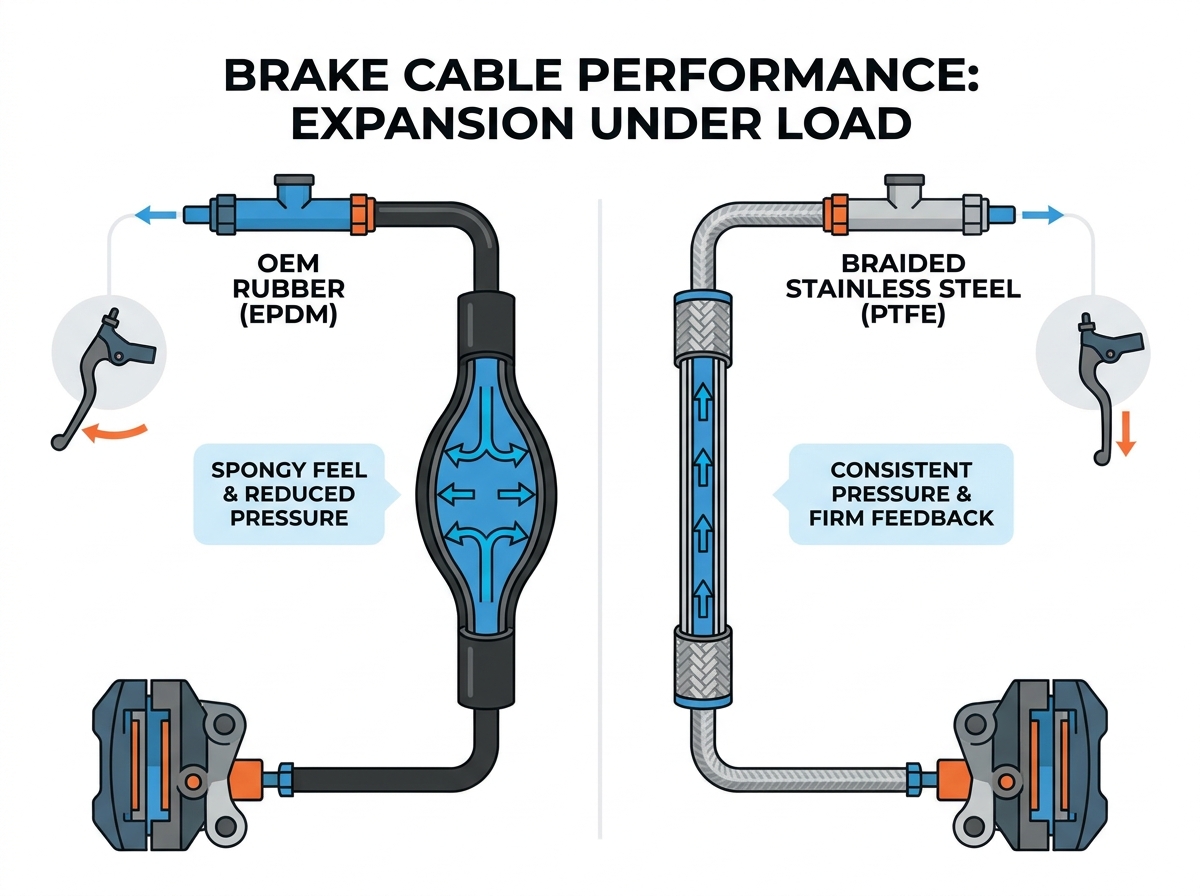
Standard Original Equipment Manufacturer (OEM) lines typically use EPDM rubber. This material is highly cost-effective and extremely flexible. EPDM easily accommodates complex routing paths around the steering stem. It provides entirely adequate performance for low-stress commuting. However, rubber has inherent vulnerabilities. It remains highly susceptible to UV degradation and environmental ozone. Over several years, moisture can permeate the rubber matrix. More critically, rubber stretches outward under intense hydraulic pressure, dulling your braking feedback.
Conversely, premium upgrades utilize a Polytetrafluoroethylene (PTFE) core wrapped in braided stainless steel. This architecture offers near-zero volumetric expansion. When you pull the lever, the pressure transfers directly to the brake pads without energy loss. You gain superior abrasion resistance and a vastly extended lifecycle. The drawbacks include a higher initial cost. Furthermore, the rigid nature of braided steel requires stricter routing protocols. You must prevent the abrasive outer braid from chafing against your motorcycle frame or delicate fairings.
Use the following comparison to weigh the cost-to-benefit ratio based on your specific riding style.
Table 1: Material Comparison Matrix for Motorcycle Brake Lines
| Material Type | Expansion Resistance | Lifespan | Best Suited For | Primary Drawback |
|---|---|---|---|---|
| OEM EPDM Rubber | Low (expands under load) | 4-5 Years | LF series utility, daily commuting | Spongy lever feel over time |
| Braided Stainless Steel | High (near-zero expansion) | 10+ Years | KP series sport riding, track use | Higher cost, strict routing needs |
Securing reliable stopping power requires strict adherence to physical dimensions. Generic "universal" cables frequently fail because they ignore specific chassis geometry. You must secure exact length measurements for your specific model. The line must accommodate full suspension travel without ever pulling under tension. A line too short will bind when the front forks fully extend. A line too long will loop dangerously and snag on passing debris.
End fittings, commonly known as banjo configurations, dictate how safely the line attaches to the master cylinder and caliper. You must evaluate the angles of these fittings carefully. Some setups require straight banjos, while others need precise 45-degree or 90-degree bends to clear the motorcycle bodywork. Selecting an improper angle forces the line into unnatural twists, stressing the crimp joints.
Material choice for these fittings also warrants close attention. Chrome-plated steel looks attractive but carries significant corrosion risks if the plating chips. Aluminum fittings save a fraction of weight but compromise long-term durability. Stainless steel fittings represent the gold standard, offering unmatched strength and corrosion resistance.
Finally, verifying thread pitch standards prevents catastrophic assembly errors. A dedicated Brake Cable for Lifan must match the exact threading of your master cylinders and calipers. Forcing a mismatched thread pitch causes irreversible cross-threading. This ruins expensive calipers and guarantees dangerous fluid leaks. Always consult your service manual to confirm whether your system requires an M10x1.0 or M10x1.25 bolt.
Trusting your life to a hydraulic component requires objective verification. You should never rely solely on marketing claims. Instead, evaluate standardized testing results to establish trust. Reputable manufacturers publicly document their burst pressure ratings. A high-quality braided line should comfortably exceed 10,000 PSI in laboratory environments. This massive overhead ensures the line will never rupture under the hardest human-generated braking forces.
Beyond static pressure, dynamic stress resistance matters immensely. Evaluate the cable's documented whip and tensile strength. Motorcycle suspensions move continuously. The hydraulic lines endure relentless vibration fatigue and rapid flexing. Premium lines undergo rigorous whip testing. Laboratories bend the pressurized hoses thousands of times a minute to simulate years of harsh riding conditions.
External protection plays a vital role in longevity. Bare braided steel acts like a saw blade against soft aluminum frames. Therefore, premium lines incorporate a protective jacketing. Manufacturers extrude a clear or colored PVC or polyurethane outer coating directly over the steel braid. This smooth barrier protects the chassis from abrasion. It simultaneously shields the internal steel wires from environmental debris, corrosive road salt, and harsh weather.
Regulatory compliance remains the ultimate baseline for trustworthiness. You should actively demand components carrying official certifications. Look for DOT FMVSS-106 compliance in North America. European riders should look for strict TUV or ADR certifications. These independent frameworks ensure the manufacturer adhered to rigid quality control processes during assembly and crimping.
Purchasing a premium component only solves half the equation. Incorrect installation neutralizes every material advantage. Proper implementation requires patience, precise tools, and a methodical approach. Focus heavily on these critical rollout phases to ensure your braking system operates flawlessly.
Routing protocols demand strict attention to detail. Follow these numbered steps to guarantee a safe installation:
The bleeding process represents a significant implementation reality. Installing a new Brake Cable for Lifan requires a complete fluid flush. Air entrapment inside the new line renders the brakes useless. You must purge every single air bubble from the master cylinder down to the caliper bleeder valve. If your motorcycle features an ABS module, consult the factory manual. Some ABS systems require electronic dealer tools to cycle the pump and purge trapped air effectively.
Finally, respect factory torque specifications. Fastening the banjo bolts requires a calibrated torque wrench. You must install brand-new, single-use crush washers on both sides of every banjo fitting. Over-torquing the bolt crushes these washers beyond their sealing capacity, destroying the threads. Under-torquing leads to slow fluid weeping. Both scenarios compromise system integrity and endanger the rider.
Choosing the correct hydraulic components requires balancing advanced material benefits with precise geometric fitment. You cannot compromise on either front. A mathematically perfect fit means nothing if the materials degrade rapidly. Conversely, indestructible materials fail immediately if the fittings align poorly.
When shortlisting vendors, always apply a rigid filtering logic. First, demand proof of strict regulatory compliance like DOT or TUV standards. Second, insist on explicit fitment guarantees for your exact motorcycle model and production year. Third, prioritize braided stainless steel materials for long-term reliability and superior feedback.
Your next steps are straightforward and actionable. Inspect your current setup today for signs of weeping, dry rot, or spongy engagement. Measure your physical routing paths carefully. Before purchasing any replacement parts, secure a factory service manual to verify exact torque specifications and thread pitches. Taking these proactive measures guarantees a safer, more responsive ride.
A: Industry standards dictate replacing rubber brake lines every four to five years. This timeline depends heavily on your local climate and daily UV exposure. Constant heat cycles and environmental ozone break down the rubber matrix, leading to dangerous volumetric expansion and structural weakness over time.
A: It does not increase the actual friction at the brake pads. Instead, braided steel reduces hydraulic loss. Because the line does not expand under pressure, it transfers your lever force much more efficiently to the caliper. This creates a firmer feel and provides highly consistent braking feedback.
A: Using universal lines carries severe risks. Incorrect lengths easily lead to suspension binding or dangerous looping. Furthermore, improper banjo angles force the line to twist, which strains the crimps and causes fluid leaks. Always use model-specific lines designed for your motorcycle's unique geometry.
A: Yes, absolutely. You must use brand-new crush washers during every installation. These copper or aluminum washers are designed for single-use only. They physically deform under specific torque to create a watertight hydraulic seal. Reusing old, already-crushed washers guarantees dangerous fluid leaks.


