


Views: 0 Author: Site Editor Publish Time: 2026-11-18 Origin: Site


Replacing or upgrading a fender is a precision-driven task. Even minor fitment errors quickly lead to costly return shipping and major installation delays. A poorly fitting panel disrupts your repair timeline and stresses your budget. The current market overflows into a confusing mix of aftermarket and OEM components for Chery models. Buyers particularly struggle when evaluating parts for popular Tiggo and Arrizo lines. It becomes difficult to distinguish genuine direct-fit replacements from low-quality alternatives.
We created this guide to solve that exact problem. We provide a technical, criteria-driven framework for your evaluation process. You will learn how to verify materials, check fitment specifics, and choose reliable suppliers. Taking these steps minimizes compatibility risks entirely. This approach also guarantees long-term structural integrity for your vehicle.
Automotive part terminology often confuses both seasoned mechanics and everyday drivers. Suppliers frequently use overlapping terms for entirely different vehicle components. You might search for a fender and find search results flooded with plastic wheel arches. The industry suffers from a common confusion between structural quarter panels and add-on accessories. Defining your exact need filters out irrelevant suppliers immediately. It saves hours of frustrating searches.
Structural fenders are primary body panels forming the metal framework around your wheel wells. They integrate directly into the vehicle chassis. These parts demand a focus on collision repair and structural integrity. A replacement requires exact OEM specifications. Crash safety relies heavily on these panels absorbing impact energy correctly. Proper aerodynamic alignment also matters. Misaligned panels create wind noise and reduce fuel efficiency at highway speeds. When repairing collision damage, you must source a true metal or composite structural body panel.
Fender flares and mudguards serve an entirely different purpose. These components function as add-on accessories rather than core body panels. They focus heavily on styling modification and off-road protection. Many drivers install them to prevent paint damage from flying road debris. Flares extend the wheel arch width, allowing for larger off-road tires. Anti-splash mudguards sit behind the wheel to block mud and rocks. You do not need collision-grade specifications for these parts, but you still need exact mounting alignment.
You must align your purchase intent directly with the specific product category. Ask yourself if you are performing a collision repair or a cosmetic upgrade. If you need collision repair, immediately discard any suppliers focusing on plastic flares or decorative trims. If you want to protect your paint, ignore heavy structural panels. This simple decision criterion narrows your options effectively. It ensures you only evaluate suppliers capable of meeting your exact vehicle needs.
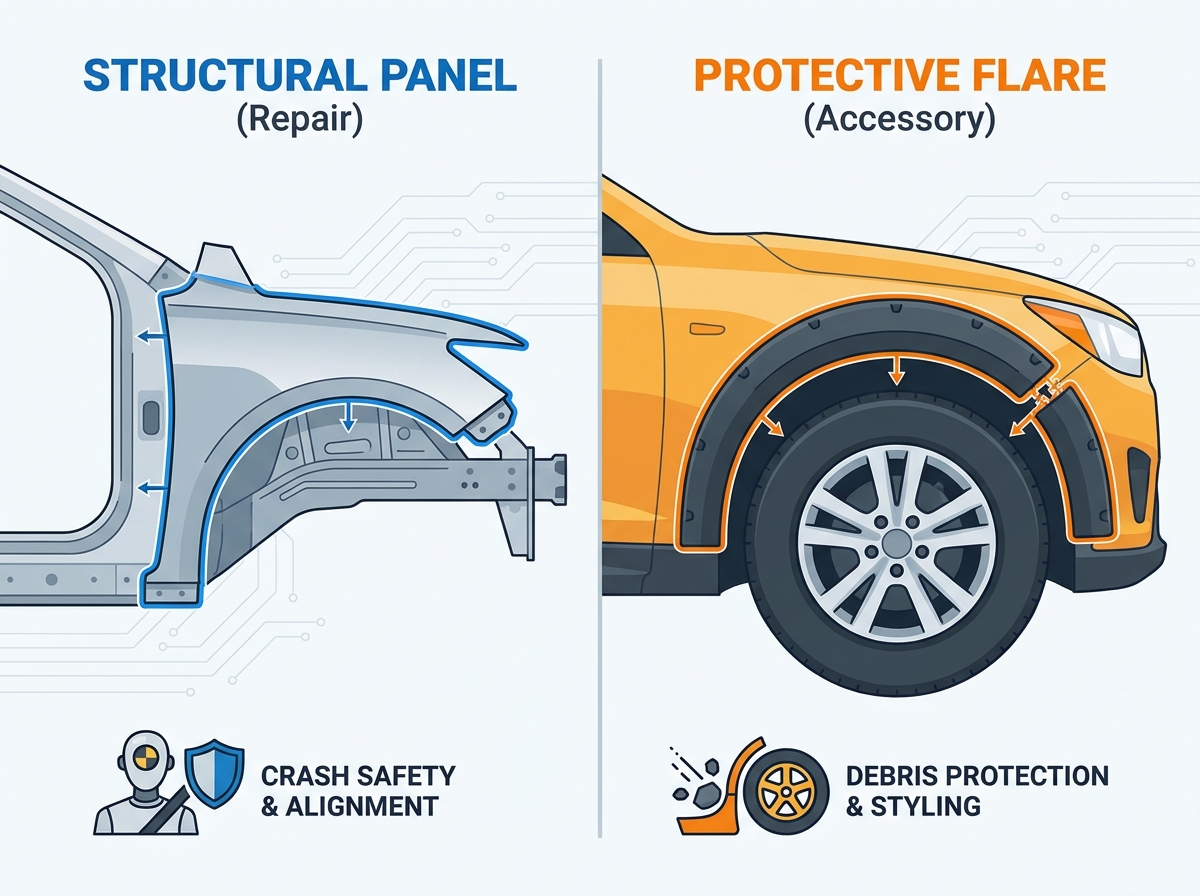
When selecting a structural panel, material thickness dictates quality. You should always evaluate the gauge thickness against Chery OEM standards. Thinner aftermarket metals warp easily during installation and vibrate at high speeds. You must also acknowledge the critical risk of premature rust. High-quality panels undergo a rigorous electrophoretic coating process known as e-coating. This black primer seals the metal against moisture. If a supplier uses subpar e-coating, the panel will rust from the inside out within a year.
Accessory components typically utilize advanced automotive plastics. The two most common materials are Polypropylene (PP) and ABS plastic. Understanding their chemical differences helps you make a better purchase decision.
Marketing brochures often exaggerate material strength. You should advise your body shop to look for CAPA certification or regional equivalents. These certifications prove the part meets strict quality control standards. For unpainted exterior plastics, demand explicit mentions of UV-resistant coatings. Unprotected plastics fade to a chalky gray after a single summer of sun exposure. Quality suppliers gladly provide material spec sheets upon request.
Fender Material Comparison Chart
| Material Type | Primary Use Case | Key Advantage | Main Vulnerability |
|---|---|---|---|
| Stamped Steel | Structural body panels, collision repair | Maximum crash safety and OEM structural rigidity | Susceptible to rust if e-coating is inferior |
| Polypropylene (PP) | Unpainted flares, rugged off-road mudguards | High flexibility; resists cracking in freezing weather | Difficult to paint; softer surface scratches easily |
| ABS Plastic | Color-matched trims, decorative flares | Excellent paint adhesion and smooth surface finish | Brittle structure can shatter under direct impact |
Relying solely on basic details like "Chery Tiggo 2023" poses a massive risk. Automotive manufacturers constantly update their production lines mid-year. Trim variations create entirely different front-end geometries. For example, a standard Tiggo 7 features different bumper-to-fender mating lines than the Pro, Max, or Plus variants. A panel built for a standard trim will leave ugly panel gaps on a Pro model. Sourcing a precise Fender for Chery demands looking past basic model names.
You need a foolproof method to ensure compatibility. We detail the necessity of cross-referencing the Vehicle Identification Number (VIN). Your VIN acts as a genetic fingerprint for your exact car. It contains data regarding the specific factory, production week, and regional chassis code. You must take this VIN to an authorized dealer or use an OEM parts database to find the official part number. Once you have this 10-digit or 12-digit code, you can safely purchase aftermarket alternatives matching that exact number.
Even with correct part numbers, physical verification remains crucial before buying. We instruct buyers to closely inspect product photos provided by the supplier. Compare these images directly against your current damaged panel.
Business-to-business platforms serve as excellent resources for specific scenarios. They work best for bulk purchasing or sourcing rare components for older Chery models. Export-specific models often require parts unavailable in local retail markets. However, B2B sourcing carries distinct risks. You will often face high minimum order quantities (MOQs). A supplier might require you to buy ten panels instead of one. You also deal with extended shipping times via ocean freight. Furthermore, complex dispute resolution processes make returning a damaged panel extremely difficult.
Direct-to-consumer marketplaces provide a much friendlier experience for everyday vehicle owners. These platforms operate best for single-unit accessory purchases like mudguards or flares. They offer standardized return policies and strong buyer protection programs. If a part arrives damaged, you usually get a refund quickly.
However, you must watch out for red flags. Beware of generic fitment claims claiming one part fits ten different Chery models. Prioritize sellers who provide exact model compatibility charts. Look for listings displaying detailed dimensional schematics rather than stock marketing photos.
Many buyers focus entirely on the base price of the item. This mistake destroys repair budgets. You must calculate the total landed cost before finalizing any purchase. Factor in dimensional weight shipping, which penalizes oversized but lightweight items like structural panels. You must also account for unpredictable import duties. Finally, check the seller's policy on restocking fees. Returning a massive metal panel often incurs a 20% restocking fee plus return freight costs. Evaluating these hidden expenses ensures you stay within budget.
Securing a new body panel requires specialized hardware. You should note that aftermarket fenders frequently ship completely bare. They arrive without the proprietary Chery mounting clips, plastic brackets, or specialized bolts. Retaining your original hardware during disassembly is critical. Mechanics often break brittle factory clips during removal. You must proactively source a bag of OEM-spec replacement clips. Installing a new panel using zip-ties or incorrect screws causes vibration, panel gaps, and eventual paint damage along the adjacent doors.
We must establish the absolute golden rule of auto body repair. Always test-fit the unpainted component to verify gap alignment. You must bolt the bare metal panel onto the car, check the gaps against the hood and door, and adjust the hinges. Only after confirming perfect fitment should you send it to the paint booth. Modifying a painted part by drilling new holes or bending edges instantly voids the supplier warranty. Once you spray paint on an aftermarket part, you own it permanently.
Accessory installation presents its own set of unique risks. We strongly warn against using "universal fit" mudguards. These generic accessories often require drilling new holes directly into the vehicle's metal body. Drilling pierces the factory e-coating and introduces severe rust vulnerabilities. Over time, moisture creeps under the paint, causing massive structural decay behind the wheel well. You must prioritize direct-fit options. These premium accessories utilize your vehicle's factory mounting holes and existing OEM screws, completely avoiding the need for destructive drilling.
Choosing the correct replacement or upgrade for your Chery vehicle demands careful planning and technical awareness. You must prioritize exact dimensional fitment and suitable materials over baseline pricing. A cheap panel that requires hours of modification by a body shop ultimately costs more than a premium direct-fit part. Understanding the difference between structural components and cosmetic accessories ensures you target the right suppliers immediately.
Your next action is straightforward. Before initiating a search on any parts marketplace, locate your vehicle's exact OEM part number. Open your driver-side door, find your VIN, and call a local dealer parts department for the corresponding code. Armed with precise data, you can navigate supplier catalogs confidently, avoid costly return shipping, and restore your vehicle to its optimal factory condition.
A: No. Even pre-painted parts may differ due to factory paint fading caused by UV exposure. The new paint will look brighter than the surrounding panels. Blending by a professional auto body shop is usually required to ensure a seamless color transition across the adjacent doors and hood.
A: The fender is the actual metal or composite structural body panel housing the wheel well. The mudguard is a smaller plastic or rubber accessory attached behind the wheel. Mudguards serve solely to block dirt and debris from scratching the lower body panels.
A: Review the supplier's product manifest carefully. Standard industry practice is to sell replacement body panels entirely bare. This means mounting clips, specialized bolts, and inner plastic liners must be purchased separately or salvaged from your old damaged panel.


