


Views: 0 Author: Site Editor Publish Time: 2026-08-04 Origin: Site


Selecting the right friction material for your vehicle dictates stopping distance, safety, and the overall driving experience. There is no universal best compound, only the optimal choice for specific driving conditions. Chery owners frequently navigate a saturated aftermarket filled with conflicting claims regarding durability, noise levels, and stopping power. Installing the wrong compound can lead to premature rotor wear, excessive brake dust, or dangerous brake fade during heavy use.
This article establishes a clear framework for evaluating a replacement Brake Pad for Chery vehicles. We will compare the structural realities, friction coefficients, and performance trade-offs of Organic, Semi-Metallic, and Ceramic options so you can make an informed maintenance decision based on mechanical facts rather than marketing hype.
Modern Chery vehicles require specific baseline standards for safe and effective braking. Understanding these mechanical requirements helps filter out substandard aftermarket components that compromise vehicle safety.
Braking systems convert kinetic energy into heat through friction. A pad's ability to dissipate this heat prevents brake fade, a dangerous condition where stopping power diminishes rapidly under sustained use. Standard commuter driving generates moderate temperatures, usually staying below 400 degrees Fahrenheit. However, heavy-load driving, towing, or descending steep grades pushes temperatures significantly higher, often exceeding 800 degrees Fahrenheit. Effective thermal management ensures consistent performance across these varying loads. When a pad exceeds its maximum operating temperature, the binding resins begin to vaporize, creating a layer of gas between the pad and the rotor. This phenomenon, known as outgassing, drastically reduces friction and causes the brake pedal to feel spongy.
Friction performance varies depending on the operating temperature of the brake assembly. "Cold bite" refers to stopping power before the brakes warm up, which is crucial for sudden stops early in a drive or in freezing weather. High-temperature stability ensures the brakes still grip when hot. Industry-standard DOT edge codes measure these friction levels, providing a standardized way to evaluate a pad's grip characteristics.
| DOT Edge Code | Cold Friction (250°F) | Hot Friction (600°F) | Typical Application |
|---|---|---|---|
| EE | 0.25 - 0.35 | 0.25 - 0.35 | Standard OEM Commuter |
| FF | 0.35 - 0.45 | 0.35 - 0.45 | Upgraded Street / Light SUV |
| GG | 0.45 - 0.55 | 0.45 - 0.55 | Heavy Duty / Towing |
Pad material interacts with the rotor to create resonance, which drivers perceive as noise or vibration. Shims, chamfers, and slots mitigate NVH in both OEM and aftermarket applications. Shims act as dampening cushions on the backing plate. Chamfers are angled cuts on the leading and trailing edges of the pad material that prevent the edge from digging into the rotor and causing high-frequency squeals. Slots are vertical grooves cut into the center of the pad that allow hot gases and dust to escape, preventing glazing and further reducing vibration.
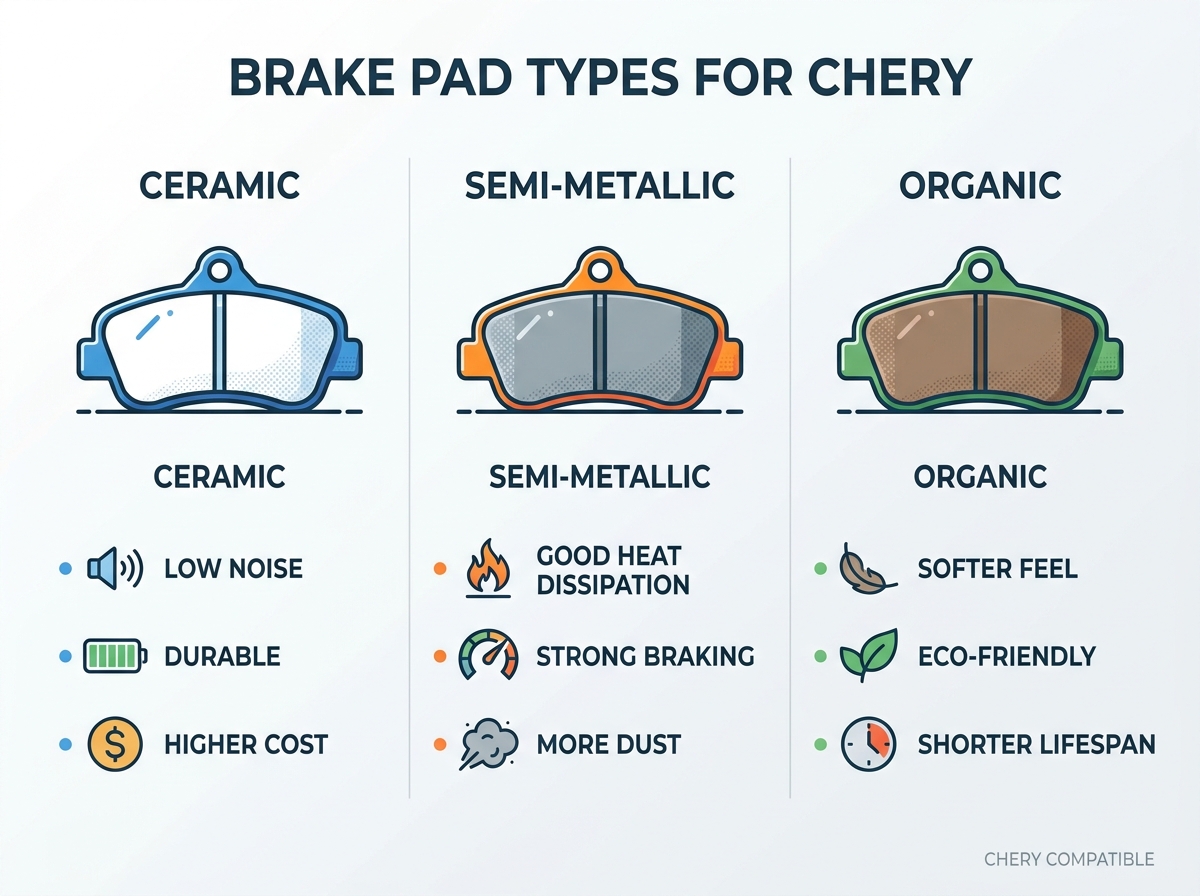
Understanding the three primary brake pad compounds available for Chery models allows for accurate application matching based on structural variations and driving demands.
Non-asbestos organic materials utilize glass, rubber, and Kevlar bound with high-heat resins. These are often marketed interchangeably as resin or organic pads. They provide quiet operation, minimal rotor wear, and good initial cold bite. Because they are softer, they conform quickly to the rotor surface during the initial break-in period.
However, they wear rapidly under high heat, produce a high volume of dark brake dust, and are highly susceptible to fade on steep descents. The softer compound simply cannot withstand the thermal stress of heavy braking. They are ideal for lightweight models like the Chery QQ or Arrizo 5 used strictly for light city commuting where speeds remain low and braking events are brief.
Semi-metallic pads consist of 30% to 70% metals, including copper, iron, and steel, mixed with graphite lubricant, fillers, and binders. Passenger Chery vehicles require semi-metallic pads rather than 100% fully metallic or sintered pads, which are reserved for extreme racing or heavy machinery and are far too abrasive for standard cast-iron rotors.
Semi-metallic pads offer exceptional high-temperature performance, rapid heat dissipation, and high durability under heavy loads. The metal content conducts heat away from the rotor surface efficiently. The trade-offs include increased NVH, higher abrasiveness to rotors, and the production of corrosive iron dust. They are recommended for heavier SUVs like the Chery Tiggo 8 Pro or vehicles frequently used for towing in mountainous regions.
Ceramic pads are composed of dense ceramic clay and porcelain mixed with copper flakes for heat conductivity. They boast the longest lifespan, produce fine, light-colored dust that does not stick to wheels, operate nearly silently, and maintain stable friction across moderate temperatures.
Conversely, they exhibit poorer cold bite in extreme winter climates and act as an insulator, pushing heat into the rotor and caliper rather than absorbing it. Ceramic is the optimal upgrade for premium daily driving and standard highway commuting across most Chery sedans and crossovers, provided the vehicle is not used for heavy towing.
Translating material specifications into real-world driving outcomes is essential for selecting the correct pad for your specific routine.
In high-frequency, low-speed braking scenarios, organic pads wear faster than ceramic pads. The constant friction without adequate cooling airflow degrades the organic resins. Over a 50,000-mile lifecycle, ceramic pads often provide better longevity due to their extended durability. Highway commuting, which involves infrequent but higher-speed stops, benefits from the thermal stability of ceramic or semi-metallic compounds.
Sub-zero temperatures negatively impact the initial stopping distance of ceramic pads compared to semi-metallic compounds, which retain strong cold bite. If you live in a region with harsh winters, the first stop of the morning with ceramic pads may require more pedal pressure. Additionally, wet and humid environments accelerate metallic pad oxidation, potentially leading to surface rust on the pads and rotors, causing temporary noise until the rust is scraped off during the first few braking events.
Ceramic dust is non-adhesive and light-colored, keeping wheels cleaner and reducing the need for harsh wheel cleaners. Metallic iron dust from semi-metallic pads is highly corrosive. When metallic dust interacts with moisture, it causes pitting on factory alloy and diamond-cut wheels, significantly increasing wheel maintenance frequency and potentially ruining the wheel finish over time.
Addressing the technical realities of replacing brake pads ensures safety and maximizes the lifespan of the new components.
Bedding-in transfers an even layer of friction material onto the rotor, known as the transfer film. Skipping this step leads to uneven pad deposits, causing vibration and reduced stopping power. Follow these steps for proper bedding:
Pairing an aggressive semi-metallic pad with a worn or economy-grade rotor accelerates wear and risks catastrophic failure. Always measure rotor thickness with a micrometer during a pad change. Compare the measurement to the minimum thickness specification stamped on the rotor hat. If the rotor is below the minimum thickness, it must be replaced. If it is above the minimum but has deep grooves or runout, it should be resurfaced.
Unverified, white-label brake pads pose severe safety risks. They often use inferior binders that fail under heat. Verify OEM Chery parts or select reputable Tier-1 aftermarket brands by checking for ISO/TS 16949 certifications and ECE R90 approval markings on the packaging and the pad backing plate.
The best brake pad for a Chery is an application-specific choice based on vehicle weight, driving environment, and performance expectations. To ensure your brake system operates safely and effectively, follow these next steps:
A: Mileage ranges depend heavily on the friction material and driving habits. Organic pads typically last 20,000 to 40,000 miles. Semi-metallic pads last 30,000 to 50,000 miles. Ceramic pads offer the longest lifespan, generally lasting 50,000 to 70,000 miles under normal driving conditions.
A: Mixing compounds on the same axle is dangerous and causes unpredictable braking. Running different compounds on front versus rear axles is technically possible but generally not recommended for daily drivers, as it alters the vehicle's designed brake bias.
A: Squeaking often results from a lack of proper bedding-in, missing anti-rattle clips, or insufficient caliper grease on the sliding pins and pad backing plates. Improper installation is the most common cause of new brake noise.
A: OEM pads provide baseline reliability and guaranteed fitment. Premium aftermarket upgrades can offer superior performance or less dust, while cheap aftermarket downgrades compromise safety and increase noise.
A: No, this is a misconception. Ceramic pads are generally gentle on rotors. Semi-metallic pads, due to their higher metal content, are more abrasive and cause faster rotor wear.
A: Semi-metallic pads use binders and fillers suitable for street-driven passenger cars. Fully metallic or sintered pads are strictly for racing or heavy-duty industrial vehicles and will quickly destroy standard passenger rotors.
A: Yes. Resin-based and organic (NAO) refer to the same category of soft, non-asbestos friction materials bound together with synthetic resins.


