


Views: 0 Author: Site Editor Publish Time: 2026-08-15 Origin: Site


Heavy-duty braking presents a direct engineering conflict. The immense friction required to halt high-mass vehicles naturally generates high-frequency vibrations, resulting in harshness and brake squeal. Fleet managers and heavy-vehicle owners often cycle through brake pads trying to eliminate this noise, inadvertently compromising on stopping power, thermal capacity, or rotor longevity. Selecting a Low-Noise brake pad for a heavy vehicle requires looking past marketing claims. You must evaluate material science, NVH (Noise, Vibration, and Harshness) dampening technologies, and specific payload requirements to find the right balance. We see trucks roll into the shop every week with glazed rotors and screaming brakes because someone installed the wrong friction compound for their towing load. Fixing this means understanding the mechanics of brake resonance and matching the pad architecture to the actual gross vehicle weight rating.
Brake noise is fundamentally a physics problem. When you press the brake pedal, kinetic energy converts into thermal energy through friction. This process creates high-frequency vibrations between the pad backing plate and the caliper piston. Heavy vehicle mass exacerbates this issue. Higher kinetic energy requires higher clamping force, which increases vibration amplitudes. If you are hauling a 10,000-pound trailer, the caliper pistons are applying massive pressure to the backing plate. That pressure forces the friction material against the cast-iron rotor, generating microscopic stick-slip oscillations. These oscillations travel through the caliper bracket and into the steering knuckle, broadcasting as a high-pitched squeal.
Rotor glazing and thermal mass issues specific to trucks, 4x4s, and commercial vehicles further complicate matters. A heavy truck descending a grade builds heat rapidly. If the pad material exceeds its maximum operating temperature, the resins bind and smear across the rotor face. This creates a glassy, ultra-smooth surface. The next time you apply the brakes, the pads skip across this glazed surface instead of biting into it, creating severe vibration and noise. We also need to distinguish between cold brake squeal and hot brake squeal. Cold squeal happens in the morning before components warm up and expand to their operating tolerances. Hot squeal results from thermal stress under heavy load, where the backing plate actually warps slightly, breaking the flush contact with the shim.
Heavy vehicles demand high friction coefficients to stop safely. This creates a direct trade-off. Aggressive bite, often achieved with high metallic content, inherently produces more rotor wear and noise. Steel and iron fibers dig into the rotor to generate stopping power, but metal-on-metal contact is loud. Conversely, softer, quieter materials risk accelerated pad wear or thermal fade under load. Finding the right compromise is essential for safe and quiet operation.
| Friction Material Type | Initial Bite | Noise Level (NVH) | Thermal Fade Resistance | Ideal Heavy Vehicle Use Case |
|---|---|---|---|---|
| Standard Ceramic | Low to Medium | Very Low | Moderate | Unloaded daily driving, light hauling |
| Semi-Metallic | High | High | Excellent | Maximum payload, steep grades |
| Carbon-Fiber Ceramic | Medium to High | Low | High | Frequent towing, lifted 4x4s |
| Aramid/Kevlar Blend | High | Low to Medium | High | Commercial hauling, fleet use |
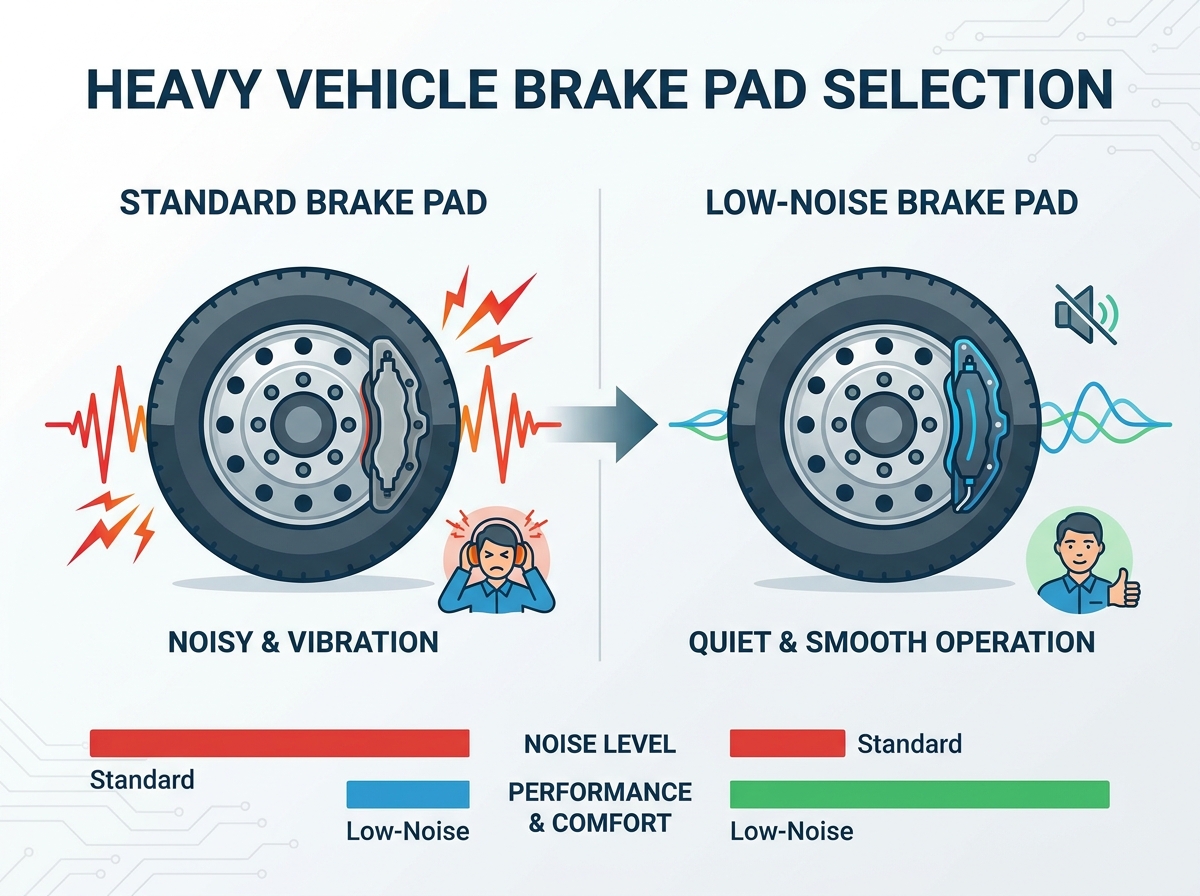
Ceramic pads are composed of dense ceramic clay combined with copper or brass fibers. They are widely considered the quietest option because they generate vibrations outside the human hearing range. The specific gravity and density of the ceramic matrix absorb acoustic waves rather than reflecting them. Additionally, ceramic compounds produce minimal, light-colored brake dust that does not easily cling to wheels. However, when evaluating them for heavy vehicles, caution is needed. While ideal for daily driving and light hauling, standard ceramics carry a risk of thermal fade on steep downgrades with maximum payloads. The material simply cannot dissipate heat as fast as iron-based compounds.
Traditional semi-metallics are notoriously noisy. However, modern formulations are designed specifically for heavy-duty use. Manufacturers manipulate the iron, steel, and copper ratios to lower the acoustic baseline while maintaining the high thermal threshold required for extreme towing. By reducing the size of the steel fibers and increasing the graphite content, engineers can create a semi-metallic pad that lubricates the rotor face slightly. This micro-lubrication prevents the harsh stick-slip action that causes squeal, giving you the heavy-duty stopping power without the ear-piercing noise.
Hybrid materials, such as carbon-infused ceramics, offer an optimal middle ground for heavy vehicles. Carbon fibers increase the thermal conductivity of the ceramic. This allows for low-noise operation without sacrificing heavy-duty stopping power. The carbon acts as a heat sink, pulling thermal energy away from the friction boundary layer and transferring it to the backing plate and caliper. This keeps the pad surface cooler, preventing the resin from boiling and glazing the rotor.
Organic and synthetic fiber formulations, like those using Kevlar or aramid fibers, are increasingly used in heavy-duty pads. These high-strength fibers absorb sound-producing vibrations while maintaining high-temperature integrity. Aramid fibers have incredible tensile strength and thermal stability. When woven into the friction matrix, they act like microscopic shock absorbers. As the pad engages the rotor, the aramid fibers compress slightly, dampening the initial impact and preventing the high-frequency resonance that leads to squeal.
The backing plate shim plays a vital role in absorbing vibrations before they reach the caliper. Basic steel shims offer limited dampening. Premium multi-layer constrained-layer dampening (CLD) shims, such as rubber-core or vulcanized designs, are far superior at preventing noise. A CLD shim sandwiches a layer of viscoelastic nitrile rubber between two layers of cold-rolled steel. When vibration hits the shim, the rubber layer shears slightly, converting the kinetic vibration energy into low-level heat. This stops the noise from transferring into the caliper piston.
Vertical slots in the friction material allow brake gas and dust to escape. This prevents the pad from hydroplaning on its own debris, a major cause of squeal. When resins heat up, they outgas. If that gas cannot escape, it creates a microscopic pneumatic barrier between the pad and rotor. Slots give that gas an exit route. Chamfers, or angled edges on the pad, prevent the leading edge from digging into the rotor. This smooths the initial engagement and alters the pad's natural frequency. By removing material at the edges, engineers change the mass of the pad, which directly shifts its resonant frequency away from the audible spectrum.
Brake fade occurs when pads lose friction capacity due to excessive heat. A reliable low-noise pad must maintain a consistent friction coefficient at temperatures exceeding 600°F (315°C). Edge-coded DOT friction ratings indicate how cold and hot friction coefficients impact stopping power and NVH under load. You will find these two-letter codes stamped on the edge of the backing plate.
| DOT Code | Cold Friction (250°F) | Hot Friction (600°F) | Common Application |
|---|---|---|---|
| EE | 0.25 - 0.35 | 0.25 - 0.35 | Light passenger cars, low dust |
| FF | 0.35 - 0.45 | 0.35 - 0.45 | Standard SUVs, half-ton trucks |
| GG | 0.45 - 0.55 | 0.45 - 0.55 | Heavy towing, 3/4 ton trucks |
| HH | 0.55+ | 0.55+ | Extreme duty, commercial hauling |
Different compounds interact differently with cast-iron rotors. A pad that is quiet but aggressively scores the rotor leads to premature rotor replacements. You want a pad that establishes a smooth transfer layer of friction material onto the rotor face. This transfer layer is what actually stops the truck—pad material rubbing against pad material. Furthermore, excessive brake dust accumulation in caliper channels can cause pad binding. If the pad cannot slide freely away from the rotor when you release the pedal, it will drag, overheat, and eventually squeal.
Many brands utilize application-specific friction formulations and premium integrally molded shims. These pads often feature copper-free compliance and low-dust signatures. They are best suited for unloaded daily driving, light-to-medium payload transport, and maximum acoustic comfort. The integrally molded shims are mechanically attached to the backing plate during the pressing process, ensuring they never shift or delaminate under heavy braking shear forces.
Performance-oriented truck pads often use thermal scorching processes to reduce break-in time and initial noise. Scorching involves running the finished pad under intense heat lamps to burn off the top layer of uncured resins. Their high-friction carbon-ceramic blends are designed for larger rotating masses. These are ideal for frequent towing, lifted 4x4s with oversized tires, and fleet vehicles requiring a balance of low NVH and high safety margins.
High-end heavy-duty performance formulations use synthetic fiber reinforcement and application-specific edge-codes (GG or HH) to prevent fade while actively dampening vibration. These are best for commercial hauling, maximum payloads, mountainous driving, and drivers willing to trade minor dust for absolute fade resistance without harsh squeal. The aramid fibers keep the pad structurally sound even when rotor temperatures exceed 1000°F during long mountain descents.
Reusing old abutment clips and anti-rattle springs almost guarantees noise, regardless of pad quality. Old clips lose their spring tension due to heat cycling. When they lose tension, the pad rattles in the caliper bracket. Precise application of high-temperature silicone or ceramic brake paste on caliper slide pins, pad ears, and shim backs is essential for quiet operation. Never use standard chassis grease; it will melt, run onto the rotor, and ruin the friction material.
A: Yes, ceramic pads generally produce the lowest noise levels because their vibrations fall outside human hearing. However, for extreme heavy towing, they may suffer from thermal fade compared to semi-metallic options.
A: New pads can squeal if installed on glazed rotors, if old hardware was reused, or if proper lubrication was not applied to the caliper slide pins and pad ears.
A: DOT friction codes, like FF or GG, indicate the pad's friction coefficient at cold and hot temperatures. Higher letters mean higher friction, which affects both stopping power and potential noise.
A: Yes. Slots allow gas and dust to escape, preventing hydroplaning, while chamfers smooth initial rotor engagement, altering the pad's natural frequency and reducing squeal.
A: Modern semi-metallic pads use advanced formulations and premium shims to reduce noise, but they may still produce more sound than ceramic pads under light braking conditions.
A: Excessive lateral runout causes the rotor to wobble slightly, striking the pads unevenly as it spins. This constant tapping creates vibration, leading to squeal and premature pad wear.


