


Views: 0 Author: Site Editor Publish Time: 2026-08-03 Origin: Site


Automotive enthusiasts and daily drivers constantly debate the reliability of Chinese-manufactured aftermarket parts. Historically, these components carried a reputation for being cheap copies with questionable longevity. Today, the reality of globalized OEM supply chains tells a vastly different story. Many leading automotive brands rely heavily on advanced manufacturing facilities based in China to produce their factory-fitted components.
Chery vehicle owners driving models like the Tiggo or Arrizo series eventually require replacement friction components. When that time comes, they face a highly fragmented market. On one side sit expensive dealership OEM parts. On the other, a sea of highly variable aftermarket alternatives. This dynamic creates understandable anxiety around vehicle safety, braking performance, and warranty preservation. Drivers need to know if they can trust aftermarket options without compromising their daily commute.
Evaluating these aftermarket options requires a clear framework. By analyzing material specifications, manufacturing standards, and warranty compliance, you can separate certified, high-performance manufacturers from low-tier producers. Understanding these factors ensures you maintain optimal stopping power while avoiding substandard components.
The Chinese friction material industry underwent a massive transformation over the past two decades. Initially known for producing low-cost, unbranded replacements, the sector matured into a powerhouse manufacturing hub for major global automotive brands. Factories that once focused solely on volume pivoted toward precision engineering. They invested heavily in research and development to meet stringent international safety standards.
Automated production lines and standardized testing facilities played a massive role in closing the quality gap between domestic Chinese parts and Western imports. Modern facilities utilize computer-controlled mixing, pressing, and curing processes to eliminate human error. This technological leap means the friction materials rolling off today's top-tier assembly lines offer consistent density and performance. They match or exceed the specifications required by major automakers.
I have toured several of these modern facilities. The level of automation is staggering. You see robotic arms handling the hot pressing phase, ensuring every single backing plate receives the exact same pressure and temperature. This eliminates the batch-to-batch inconsistency that plagued older, manual manufacturing methods. The focus has shifted entirely from making the cheapest part to making a part that passes global homologation standards.
Browse any popular automotive forum, and you will quickly find drivers expressing anxiety over aftermarket parts. Real-world concerns typically center around poor quality control, premature wear, and structural failures. These fears are not entirely unfounded. The market was historically flooded with inferior products that prioritized cost over safety.
An analytical look at these historical forum complaints reveals a distinct pattern. The vast majority of failures stem from purchasing bottom-tier, unbranded white-label parts. When drivers buy the absolute cheapest component available, they bypass certified, professionally manufactured components. Blaming the country of origin rather than the specific tier of the manufacturer obscures the real issue. The problem is a lack of proper vetting and quality certification.
Mechanics see this daily in the shop. A customer brings in a set of pads they bought online for a fraction of the normal price. The backing plates are rough, the friction material smells like cheap resin, and there are no shims. When those pads squeal or wear out in 10,000 kilometers, the customer blames the manufacturing country. In reality, they just bought a bottom-tier product.
Understanding the aftermarket requires recognizing the difference between Tier 1 suppliers and lower-tier factories. Tier 1 suppliers produce components directly for automakers like Chery. They operate under strict oversight, utilizing premium raw materials and rigorous testing protocols. These are the same factories that often produce high-end aftermarket brands under different labels.
Lower-tier aftermarket factories operate with minimal quality control. They often use outdated molds and inferior friction mixtures. Treating all Chinese brake parts as a single quality category is a fundamental analytical error. This misconception leads to poor purchasing decisions. Drivers either overpay at the dealership or risk their safety on unverified budget parts.
To navigate this, you must look for specific factory marks. A reputable manufacturer stamps their batch numbers, certification codes, and material friction edge codes directly onto the pad. If you pull a pad out of the box and the backing plate is completely blank, you are holding a low-tier product.
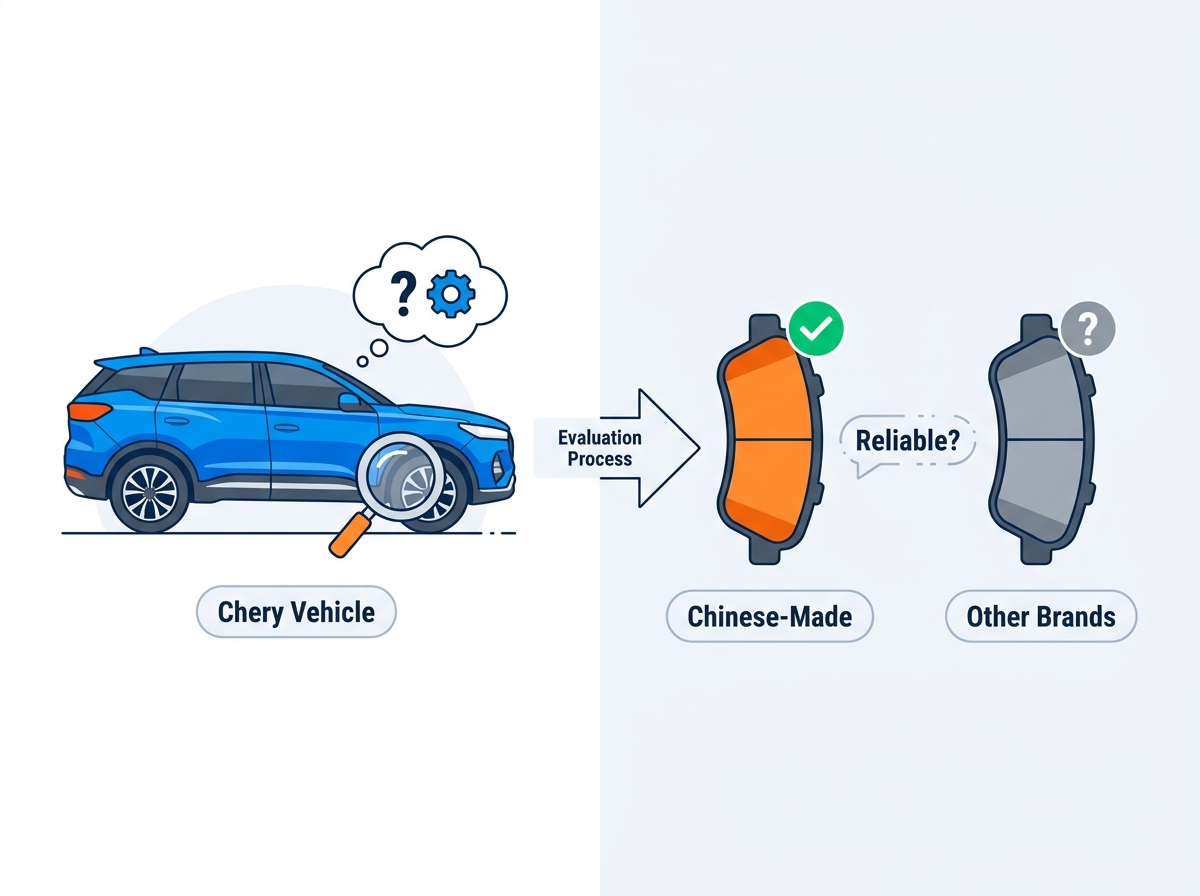
Factory-fitted Chery pads establish the baseline success criteria for any replacement part. These components are engineered to deliver a specific expected mileage, a verified baseline stopping distance, and strict adherence to NVH (Noise, Vibration, and Harshness) standards. When you drive a new Tiggo or Arrizo off the lot, the braking system is optimized for a quiet, smooth, and predictable experience.
Acquiring genuine replacements directly from the dealership guarantees this exact performance profile. This peace of mind comes with a significant markup. Dealerships mark up these components to cover overhead and brand licensing. For many drivers, the question becomes whether this premium is necessary when identical or superior materials are available through certified aftermarket channels.
OEM pads are designed as a middle-ground solution. They need to work well in freezing temperatures, scorching heat, and everything in between. They prioritize low noise over aggressive stopping power. This makes them great for the average driver, but it also leaves room for aftermarket improvements if you have specific driving needs.
High-end Chinese aftermarket pads offer an exceptional cost-to-performance ratio. By sourcing components from certified manufacturers, drivers access OEM-level quality without the dealership markup. When you select a verified Brake Pad for Chery, you often purchase a product manufactured on the same automated lines as the factory originals.
The aftermarket provides opportunities for material upgrades. Drivers can transition from factory semi-metallic compounds to advanced aftermarket ceramic formulations. These upgraded materials frequently offer lower brake dust accumulation, quieter operation, and improved longevity. This enhances the overall driving experience beyond the factory baseline.
For fleet operators or drivers who spend hours in stop-and-go traffic, upgrading to a premium aftermarket ceramic pad reduces maintenance intervals. Less dust means cleaner wheels, and better heat dissipation means less chance of rotor warping during heavy use.
The proliferation of unbranded, uncertified pads built to a strict price point rather than a safety standard remains the root cause of negative aftermarket reviews. These white-label products skip essential quality control steps to undercut legitimate manufacturers. They are a liability on the road and should be avoided entirely.
Physical indicators of low-quality pads are often visible before installation. Look for inconsistent friction material mixing, which appears as uneven textures or large metallic chunks. Poor backing plate stamping with rough edges indicates degraded manufacturing molds. The lack of integrated shims or the use of cheap, single-layer metal shims guarantees excessive brake squeal and vibration.
I always tell my technicians to inspect the edges of the friction material. If it looks crumbly or flakes off when you run your thumb across it, throw it in the trash. A quality pad has a dense, uniform structure that feels solid to the touch.
Choosing the right friction material is paramount for vehicle safety and comfort. Semi-metallic pads offer excellent cold bite and superior heat dissipation under heavy loads. This makes them highly effective for aggressive driving. They tend to generate more noise, produce heavier black brake dust, and cause higher rotor wear over time.
Ceramic pads utilize dense ceramic clay and copper fibers. They provide exceptionally low dust, quiet operation, and high temperature resistance up to 600°C. Matching the friction material to specific Chery models optimizes performance. Heavy-duty ceramic pads are ideal for the heavier Tiggo 8 and Tiggo 7 Pro SUVs, handling the increased kinetic energy. Standard ceramic or semi-metallic options work perfectly for the lighter Tiggo 3 and Arrizo sedans.
| Feature | Semi-Metallic Pads | Ceramic Pads |
|---|---|---|
| Cold Bite | Excellent immediate response | Good, requires slight warming |
| Operating Noise | Moderate to High | Very Low (Quiet) |
| Dust Production | High (Dark dust) | Low (Light-colored dust) |
| Rotor Wear | Higher wear rate | Gentle on rotors |
| Best Suited For | Aggressive driving, towing | Daily commuting, luxury driving |
A common technical failure point noted in enthusiast forums is the lack of protective coatings on non-friction surfaces. The backing plate is the structural foundation of the brake pad. If a manufacturer cuts corners by leaving the raw steel untreated, environmental exposure rapidly degrades the component.
Untreated steel leads to rusty edges and hub corrosion. This rust expansion causes the pad to seize within the caliper bracket. When a pad cannot move freely, it results in uneven wear, caliper binding, and continuous brake drag. High-quality aftermarket options require high-durability powder-coated, electro-coated, or galvanized backing plates to ensure long-term structural integrity and smooth caliper operation.
In regions with heavy rain or salted winter roads, a bare steel backing plate will rust to the caliper bracket within a few months. I have had to use a hammer and punch to remove seized pads from neglected calipers. Always verify the coating quality before installation.
The friction material only tells half the story. Hardware quality dictates the acoustic comfort of your braking system. Multi-layer constrained shims, such as rubber-steel-rubber configurations, are essential. These shims act as acoustic dampeners, absorbing microscopic vibrations and preventing the high-frequency brake squeal that plagues cheap replacements.
High-quality aftermarket kits must include replacement OE-style abutment clips and wear sensors. Reusing old, heat-cycled hardware compromises the new installation. Fresh abutment clips ensure the pad slides smoothly within the bracket, maintaining proper caliper function and preventing premature, tapered pad wear.
When shortlisting a supplier, IATF 16949 certification is a non-negotiable requirement. This is the premier global quality management standard specifically developed for the automotive industry. It mandates rigorous continuous improvement, defect prevention, and the reduction of variation and waste in the supply chain.
Coupled with ISO9001, these certifications guarantee batch-to-batch consistency across high-volume production lines. A factory holding these credentials operates under strict international audits. They document every step of the manufacturing process, ensuring that the pad you purchase today performs identically to the one tested during the certification phase.
You can usually find these certification numbers printed on the product packaging or listed on the manufacturer's technical specification sheet. If a supplier cannot produce proof of IATF 16949 compliance upon request, walk away. It is not worth the risk.
The European ECE R90 standard is one of the most stringent regulations in the global aftermarket. It requires aftermarket pads to perform within 15% of the original OEM pad's specifications regarding speed sensitivity, cold performance, and friction stability. Achieving this certification requires extensive independent laboratory testing.
Finding the "E-mark" stamped on a Chinese-manufactured brake pad is a definitive indicator of verified stopping power and safety. It proves the component has been legally certified to match factory safety margins. This provides absolute confidence that the part will perform reliably during emergency braking maneuvers.
The E-mark is usually followed by a series of numbers indicating the country of certification and the specific approval number. This traceability is exactly what you want when evaluating aftermarket safety components.
Professional Chinese manufacturers go beyond paper certifications by employing rigorous in-house testing protocols. They inspect, verify, and approve products long before distribution. This internal quality control separates premium suppliers from budget exporters who merely act as middlemen.
Key evaluations include dynamometer testing to simulate real-world driving conditions and thermal loads. Shear strength testing is critical. It ensures the friction material does not shear or detach from the backing plate under extreme mechanical stress. Compressibility testing guarantees the pad maintains a firm pedal feel without becoming spongy when subjected to high hydraulic pressure.
I have reviewed dynamometer test charts from top-tier Chinese factories. They run the pads through simulated mountain descents, high-speed autobahn stops, and urban stop-and-go cycles. The data they collect is identical to what the OEM engineers look at when designing the original vehicle.
Many drivers hesitate to use aftermarket parts due to fears of voiding their vehicle warranty. Legal protections exist to ensure consumer choice. Frameworks like the Right to Repair guidelines in South Africa and Australia, or the Magnuson-Moss Warranty Act in the US, explicitly protect vehicle owners who choose non-OEM components.
Fitting a certified aftermarket brake pad will not void the overarching Manufacturer's Vehicle Warranty (MVW) or your active service plans. Automakers cannot legally cancel your entire powertrain or electrical warranty simply because you utilized an aftermarket friction component for routine maintenance.
Dealership service advisors sometimes use scare tactics to keep you buying their parts. Knowing your local consumer protection laws gives you the confidence to push back and make the best financial decision for your vehicle maintenance.
There is an important caveat regarding warranties: the consequential damage clause. If a sub-standard aftermarket pad directly causes damage to the OEM brake rotor or caliper, that specific repair will not be covered by Chery. If a cheap pad suffers from excessive heat transfer that warps the rotor, or physically disintegrates and damages the caliper piston, the liability falls on the aftermarket part.
This highlights the critical importance of selecting highly certified components. By using ECE R90 or IATF 16949 certified pads, you eliminate the risk of catastrophic failure. This protects both your vehicle's mechanical integrity and your warranty status.
If you install a premium pad and the caliper fails due to a defective factory seal, the dealership must still honor the caliper warranty. The aftermarket pad did not cause the seal failure.
To fully protect your warranty and ensure safety, aftermarket pads must be fitted by an accredited or RMI-approved workshop. Professional installation guarantees that caliper slide pins are properly lubricated, hardware is correctly seated, and the hydraulic system is inspected for integrity.
Always retain your fitment invoices and the part specification sheets. In the rare event of a warranty dispute with the dealership, having documented proof that a certified mechanic installed components meeting OEM specifications will swiftly resolve the issue in your favor.
A: OEM pads generally last between 30,000 and 50,000 kilometers depending on driving habits. Certified high-end Chinese aftermarket ceramic pads often match or exceed this lifespan due to advanced friction formulations that reduce overall wear.
A: Yes. Ceramic pads handle the heavier curb weight of SUVs exceptionally well. They provide consistent stopping power, resist brake fade at high temperatures, and keep wheels cleaner by producing significantly less brake dust.
A: No. Under Right to Repair laws, using certified aftermarket parts for routine maintenance does not void your overarching warranty, provided the parts meet OEM specifications and are installed professionally.
A: Cheap pads often skip the essential step of applying anti-corrosion coatings to the raw steel backing plate. Exposed steel quickly rusts when subjected to road moisture and salt, leading to caliper binding.
A: ECE R90 is a strict European standard verifying that the aftermarket brake pad performs within 15% of the original factory pad. It guarantees the part has passed independent safety, speed, and temperature tests.
A: Squealing is usually caused by high-frequency vibrations. Ensure your new pads feature multi-layer constrained shims, use high-quality brake grease on the abutment points, and replace all old mounting hardware.


