


Views: 0 Author: Site Editor Publish Time: 2026-07-27 Origin: Site


Vehicle suspension design demands a strict engineering trade-off. You must balance maximum load-carrying capacity against dynamic articulation and ride comfort. Selecting the wrong suspension architecture introduces severe operational risks. A mismatched system can cause dangerous load sagging, compromised handling, structural fatigue, or severely limited off-road capability. Understanding the mechanical realities of these systems prevents costly modification errors and unsafe driving conditions.
This technical evaluation provides an objective comparison between coil and leaf spring architectures. We evaluate both systems based on mechanical design, load deflection rates, and primary duty-cycle requirements. By analyzing how each setup manages axle control and weight distribution, you can make informed decisions regarding vehicle purchasing, aftermarket modifications, or fleet specifications. The goal is to match the mechanical hardware directly to your specific performance requirements without relying on guesswork.
Suspension systems face an inverse relationship between resisting heavy vertical loads and flexing over uneven terrain. A system designed to carry massive weight requires high spring rates. These stiff rates naturally resist compression. This resistance limits the suspension's ability to articulate when driving unladen over obstacles. Conversely, a highly flexible suspension will compress too easily under a heavy static load, leading to bottoming out on the bump stops.
You must establish baseline metrics before evaluating suspension types. The Gross Vehicle Weight Rating (GVWR) dictates the maximum safe operating weight. The Gross Vehicle Mass (GVM) upgrade requirements determine how much additional payload capacity you need for tools, equipment, or passengers. You must weigh these static load figures against your required wheel travel. Wheel travel consists of droop (downward movement) and compression (upward movement). High payload demands reduce available compression travel. High articulation demands often compromise static load stability.
| Suspension Priority | Primary Metric | Trade-off Consequence |
|---|---|---|
| Maximum Payload | High Spring Rate (Stiffness) | Harsh unladen ride, limited off-road flex |
| Maximum Articulation | Extended Droop/Compression | Severe rear-end squat under heavy loads |
| Balanced Touring | Progressive Spring Rates | Moderate performance in both categories, excels in neither |
The suspension system must locate the axle relative to the vehicle frame. It controls lateral (side-to-side) and longitudinal (front-to-back) movement. Different spring designs achieve this control through vastly different mechanical pathways. Some systems require complex supplementary linkages. Other systems use the spring itself to hold the axle in place.
Axle control directly impacts driving dynamics. A successful suspension design manages multiple geometric factors while supporting the vehicle's weight. You must account for the following elements when evaluating axle control:
A Coil Spring utilizes a helical design manufactured from heavy-duty steel wire. It functions by storing and releasing energy through torsion. As the suspension compresses, the coiled wire twists. This twisting action absorbs the impact energy. Because the spring only handles vertical load support, it cannot locate the axle independently. It requires a robust framework of control arms to keep the axle from shifting under the vehicle.
Coil systems require multi-link setups to maintain axle position. Radius arms or trailing arms control longitudinal movement. A Panhard rod (or track bar) controls lateral movement. These linkages connect the axle to the chassis using pivot points. Manufacturers utilize either progressive-rate or linear-rate coil designs. Linear springs offer a constant resistance rate throughout their compression cycle. Progressive springs increase their resistance as they compress, offering a softer initial ride with firmer bottom-out protection.
Coil setups deliver superior ride quality. They operate with lower unsprung weight compared to heavy stacked leaf designs. Coils also eliminate the internal mechanical friction found between sliding leaf plates. This lack of friction allows the suspension to react instantly to small road imperfections like washboards or expansion joints. The result is a smoother, more controlled ride on paved surfaces and high-speed dirt tracks.
These systems excel in 4x4 off-road agility. The multi-link geometry allows considerably more movement. Wheel travel remains largely uninhibited by the spring itself. This design improves approach and departure angles by keeping suspension components tucked higher up near the chassis. It also facilitates extreme independent wheel articulation, keeping tires in contact with uneven terrain during technical rock crawling or deep rut traversals.
Coil setups remain highly vulnerable to dangerous load sagging. When subjected to heavy, sustained weight, the springs compress significantly. Without electronic or mechanical load-leveling assistance, this sagging alters steering geometry and reduces ground clearance. It severely compromises vehicle handling, increases braking distances, and shifts weight off the front steering tires.
Mechanical complexity introduces higher manufacturing and replacement costs. The required linkages and control arms take up significant space under the chassis. These links rely on rubber or polyurethane bushings at every pivot point. These bushings act as high-wear items. Worn bushings lead to axle shifting, steering wander, and unpredictable handling characteristics. Replacing a full set of control arm bushings requires specialized press tools and significant labor time.
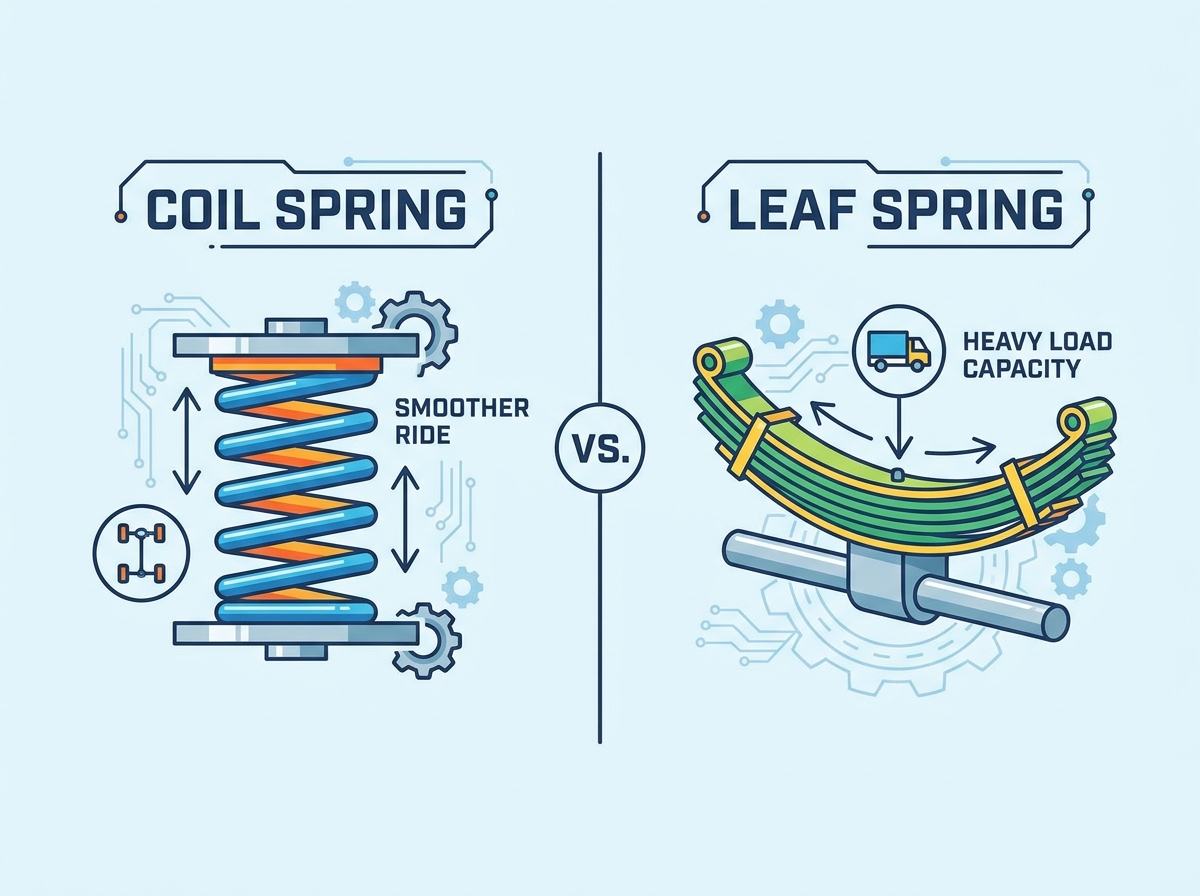
Leaf springs utilize a semi-elliptical stacked plate design. Manufacturers stack varying lengths of steel or composite leaves together. This pack mounts longitudinally along the chassis. The longest leaf, known as the main leaf, features mounting eyes at both ends. This design distributes the vehicle's weight across multiple widely spaced chassis attachment points, creating a massive footprint for load transfer.
These springs act as a dual-purpose mechanism. They serve as the dampening medium to absorb bumps. Simultaneously, they act as the structural component that locates the axle to the chassis. This eliminates the need for complex control arms. Shackles connect the rear of the spring to the frame, allowing the pack to lengthen as it compresses. Center pins align the stacked leaves and locate the axle housing securely on the spring pack.
Leaf packs provide exceptional load distribution capabilities. They handle maximum payloads with significantly less deflection than coil setups. The wide mounting points spread the heavy static load over a larger section of the frame. This structural layout inherently resists lateral sway, keeping heavy loads stable during cornering or crosswind situations. When you drop a heavy fifth-wheel trailer onto a truck bed, the leaf pack absorbs the weight without bottoming out.
The design offers sheer durability and mechanical simplicity. With fewer moving parts and pivot points, maintenance remains straightforward. Leaf packs are highly cost-effective to manufacture and replace. They also resist catastrophic breakage under extreme overloading. Even if a secondary leaf cracks under stress, the main leaf usually keeps the axle attached to the vehicle, allowing you to limp to a repair facility.
Leaf suspensions suffer from axle wrap under high torque loads. When accelerating heavily, rotational force from the tires transfers to the axle housing. This force twists the leaf spring into an S-shape. When the spring snaps back, it causes violent wheel hop. Axle wrap destroys traction and places severe stress on driveshaft u-joints, pinion bearings, and the leaf springs themselves.
Ride quality presents a severe trade-off. To support heavy payloads, the spring pack must be exceptionally stiff. When the vehicle is unladen, this stiffness translates to excessive harshness over bumps. The inherent design also limits suspension flex. The tightly clamped plates resist twisting, which severely restricts off-road articulation and dynamic wheel travel. You will often lift a tire off the ground when navigating cross-axle ditches.
Deflection rates under maximum static loads strongly favor leaf designs. When you drop a heavy trailer onto the hitch, dynamic tongue weight pushes down on the rear chassis. A coil setup will compress rapidly, causing the rear end to squat. This squat unloads the front tires, ruining steering geometry and braking efficiency. It also blinds oncoming traffic by aiming your headlights upward.
Heavy-duty trucks default to leaf springs to prevent this chassis squat. The stiff leaf pack maintains correct steering geometry under massive loads. The wide mounting stance naturally controls lateral sway, keeping the trailer stable at highway speeds. Many trucks also utilize helper leaves. These overload springs sit above the main pack and only engage when the vehicle squats under a heavy payload, providing progressive load management without stiffening the initial ride.
| Performance Category | Coil Spring Performance | Leaf Spring Performance |
|---|---|---|
| Static Load Deflection | High (Prone to sagging) | Low (Maintains ride height) |
| Lateral Sway Control | Requires heavy sway bars | Inherent to the wide mounting design |
| Tongue Weight Management | Poor without airbags | Excellent, often uses overload leaves |
Wheel travel limits define off-road capability. A leaf pack inherently restricts extended droop and compression. The physical binding of the steel plates limits how far the axle can drop or tuck into the wheel well. Coil setups allow massive extended droop and deep compression, limited primarily by shock absorber length and control arm binding. This allows the tires to track the ground over severe terrain.
Coil systems handle uneven camber and cross-axle obstacles much better in 4x4 applications. When traversing deep ruts, a coil setup allows one wheel to drop into a hole while the opposite wheel compresses fully. This keeps the vehicle cabin relatively level. A leaf-sprung vehicle will often lift a tire off the ground in the same scenario, losing forward traction and increasing the risk of a rollover.
Fatigue lifespans differ significantly based on operating conditions. Coil springs subjected to constant heavy loads will eventually suffer metal fatigue and permanently sag. They lose their free height and require replacement. Leaf packs exposed to heavy loads, moisture, and road salt will rust, crack, or flatten out over time. The friction between the leaves accelerates wear in gritty environments.
Critical failure modes present different safety risks. If a coil spring fractures, the vehicle drops onto its bump stops. However, the control arms keep the axle securely located under the vehicle. You maintain steering control. If a leaf spring main eye breaks or a center pin shears, the failure is catastrophic. The axle can shift backward or forward, instantly compromising steering, braking, and driveline integrity.
Maintenance requirements vary by architecture. Coil systems require periodic inspection and replacement of control arm bushings and track bar joints. Leaf systems require greasing of polyurethane shackle bushings, inspecting u-bolts for proper torque, and replacing worn friction pads between the steel leaves to prevent squeaking and binding.
You can mitigate coil spring sagging through specific aftermarket upgrades. Installing heavy-duty linear or progressive-rate coil springs increases the load capacity. These springs use thicker wire diameters to resist compression under static weight. You can also install longer coils to provide a suspension lift, increasing ground clearance for larger tires.
You must evaluate the cost-to-benefit ratio of these upgrades. If you only tow occasionally, installing heavy-duty coils will ruin your daily unladen ride quality. The suspension will feel excessively harsh, bouncing over speed bumps and potholes. If you operate a dedicated payload hauler, the stiffer coils provide necessary stability and safety, keeping the chassis level under constant weight.
Supplemental air helper springs bridge the gap between both systems. These airbags mount between the chassis and the axle. You inflate them manually via a Schrader valve or via an onboard compressor to support heavy loads. They act as an adjustable spring rate mechanism.
Air springs allow a coil-sprung vehicle to carry heavy loads without dangerous sagging. When you unhitch the trailer, you deflate the airbags. This returns the vehicle to its comfortable unladen ride dynamics. However, air systems introduce complexity. You must manage plumbing, valves, and compressor wiring. Off-road articulation can puncture the bags or tear the mounts. Airbags also concentrate heavy loads onto specific frame stress points not originally designed for that weight, which can lead to chassis bending.
Converting a leaf-sprung utility vehicle to a coil setup requires extensive engineering and fabrication. You cannot simply swap the springs. You must cut off the factory leaf hangers and weld new axle brackets and upper spring buckets to the frame. This requires advanced welding skills and precise measuring tools.
You must calculate correct suspension geometry during this conversion. You have to design and install a complete multi-link system. If you miscalculate the anti-squat, roll center, or steering link angles, the vehicle will exhibit dangerous handling characteristics. Bump steer, death wobble, and unpredictable cornering are common results of poorly engineered conversions. You must follow a strict sequence of fabrication steps:
A: Yes, but it requires specific engineering. You must use thicker wire diameters to increase the spring rate, or add supplemental airbags. However, matching a leaf spring's payload capacity with a coil often results in an unacceptably harsh unladen ride quality.
A: Heavy-duty trucks rely on leaf springs because they distribute massive loads across two separate, widely spaced points on the chassis. This design provides built-in sway control, minimal deflection under load, and unmatched structural simplicity for commercial hauling.
A: Yes. Coil setups provide superior articulation, extended wheel travel, and excellent terrain compliance. The multi-link setups allow uninhibited axle movement, keeping tires planted on uneven ground during technical off-road driving.
A: A broken leaf spring main eye allows the axle to shift, causing catastrophic loss of steering and tracking control. A broken coil spring causes the vehicle to sag onto its bump stops, but the control arms keep the axle safely located.
A: Yes, but it requires extensive custom fabrication. You must weld new spring buckets, install control arms, mount a panhard bar, and engineer the precise suspension geometry to avoid dangerous handling issues.
A: Air springs are rarely used as standalone systems in light-duty applications. Instead, they act as supplementary load-leveling devices. They support existing leaf or coil setups under heavy loads and can be deflated for unladen comfort.
A: Sagging occurs due to metal fatigue over time. Constantly exceeding the spring's maximum load rating or selecting an improper spring rate for your vehicle's accessory weight accelerates this permanent deformation.


