


Views: 0 Author: Site Editor Publish Time: 2026-07-23 Origin: Site


Brake squeal drives most premature brake component replacements in the shop. Drivers chase absolute silence, but altering friction materials fundamentally changes how a vehicle behaves on the road. Selecting a replacement compound requires balancing NVH (Noise, Vibration, and Harshness) standards against critical safety metrics. You must evaluate thermal capacity, initial bite, and stopping distance under heavy loads before swapping pad types. Slapping the quietest pad on a heavy vehicle often leads to dangerous brake fade on long descents.
This guide breaks down the material science, performance trade-offs, and application-specific criteria required for proper brake system service. We examine the engineering differences in friction materials to help you determine whether a Low-Noise brake pad or a standard semi-metallic compound is the correct choice for the specific vehicle application. Understanding these mechanical realities prevents comebacks and ensures the braking system operates exactly as engineered.
Brake noise is high-frequency vibration. When friction material clamps down on a spinning cast-iron rotor, the kinetic energy converts into heat and microscopic vibrations. These vibrations transfer through the brake pad backing plate, into the caliper piston, and down through the steering knuckle. If the frequency of this vibration hits the resonant frequency of the suspension components, it amplifies. When that frequency falls within the human hearing range, you hear a high-pitched squeal. Different friction materials interact with the rotor surface uniquely. Softer compounds dampen these resonant frequencies. Harder metallic compounds amplify them through the rigid suspension components. Mechanics often use chassis ears to pinpoint which corner generates the specific frequency, but the root cause always traces back to the pad-to-rotor interface.
No friction material operates in complete silence. Any brake pad generates noise under adverse conditions. Environmental factors dictate temporary NVH issues. High humidity, overnight condensation, and rotor flash rust create a micro-layer of contamination on the braking surface. Extreme cold hardens the friction material temporarily. These conditions cause morning squeal during the first few stops, even with premium low-noise installations. The noise subsides once the system reaches operating temperature and the pads scrub the rotor clean. Expecting absolute silence in freezing rain or after a vehicle sits for a week ignores the basic physics of cast iron and friction material.
Manufacturers engineer specific material matrices to control acoustic output. Premium low-noise pads utilize ceramic compounds. These formulations consist of kiln-fired clay and porcelain mixed with copper flakes or proprietary synthetic fibers. The ceramic matrix absorbs vibration effectively. It operates at acoustic frequencies less perceptible to the human ear. The manufacturing process involves positive molding, which ensures uniform density across the pad surface, further reducing harmonic vibrations.
Budget low-noise options rely on Non-Asbestos Organic (NAO) compounds. These pads blend glass, rubber, Kevlar, and carbon-resin binders. NAO pads run quietly but lack the structural density of ceramic options. They tend to compress slightly under heavy pedal pressure, resulting in a spongy feel. Both materials succeed in noise reduction by eliminating the hard steel fibers that cause acoustic resonance against iron rotors. They rely on adhesive friction rather than abrasive friction.
Standard semi-metallic pads serve as the traditional baseline for automotive braking. Their composition includes 30% to 70% metals. Manufacturers use chopped steel wire, iron powder, and copper. They combine these metals with graphite lubricants and resin binders. The metallic matrix inherently produces higher decibel levels during engagement. Steel dragging against an iron rotor creates a harsh, abrasive friction mechanism. This metal-on-metal contact guarantees higher NVH levels. They are noticeably louder than ceramic or organic alternatives. However, this abrasive action constantly cuts into the rotor, exposing fresh iron and preventing the glazing that often plagues softer pad compounds.
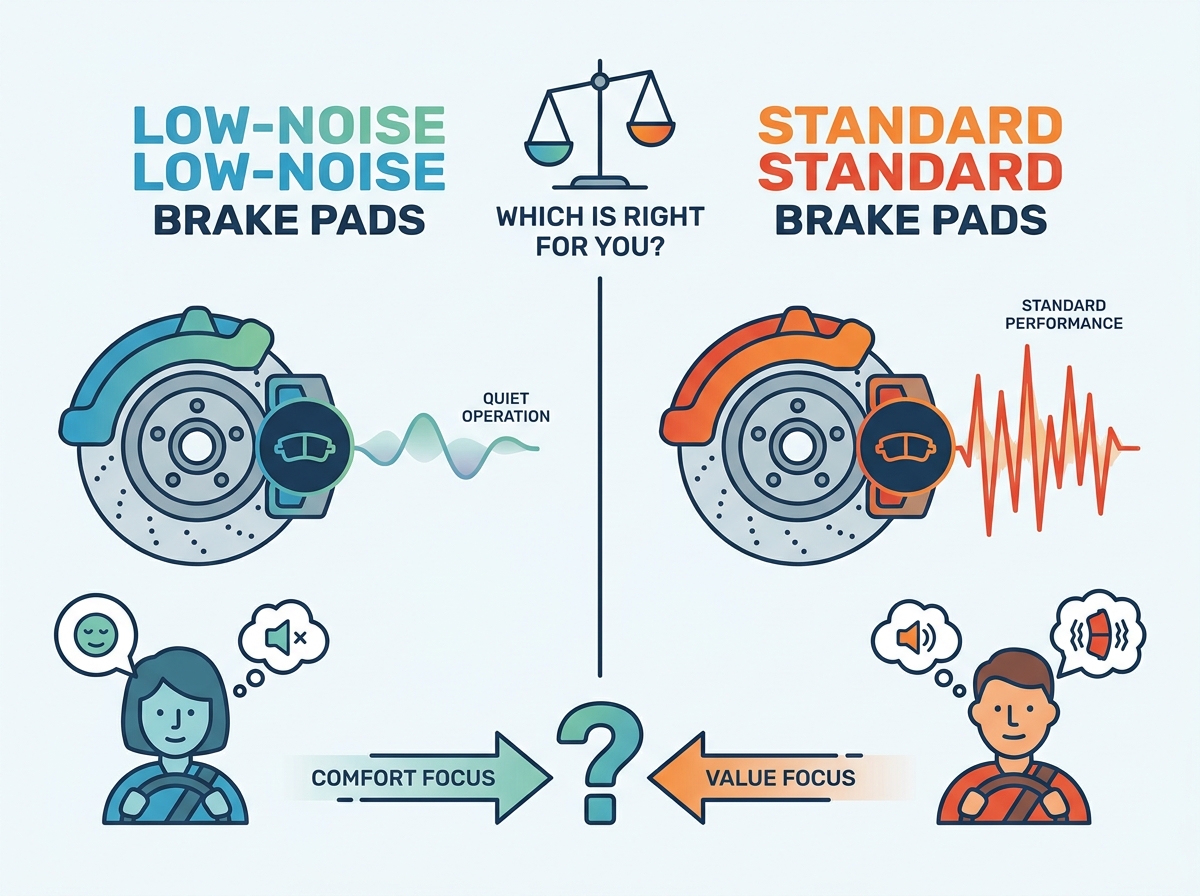
The cold-friction coefficient dictates how a vehicle responds the moment you press the brake pedal. Standard semi-metallic pads provide a firm, immediate pedal feel. Their abrasive nature bites into the rotor instantly. They deliver excellent emergency stopping power even when cold. Ceramic and organic pads rely on an adherent friction mechanism. They require a thin transfer layer of pad material on the rotor to generate maximum friction. Consequently, low-noise pads exhibit a softer initial bite. Drivers notice slightly higher pedal effort is required during the first stop on a cold morning. Once the pads warm up, stopping distances equalize, but that initial cold response remains a distinct characteristic of the material.
Heat dissipation separates standard pads from low-noise alternatives. Semi-metallic pads act as excellent thermal conductors. They draw intense heat away from the rotor face. They transfer this heat through the backing plate into the caliper and surrounding air. Ceramic pads act as thermal insulators. They keep heat concentrated in the rotor and the brake caliper piston. During sustained downhill braking, this insulation overheats the brake fluid. Boiling brake fluid causes catastrophic brake fade. Semi-metallic compounds maintain a much higher threshold for brake fade. They ensure consistent stopping power under extreme thermal loads, making them the only choice for heavy applications.
Standard pads produce heavy, dark, and corrosive iron dust. This metallic dust embeds itself into alloy wheels. It requires harsh chemical cleaners and agitation for removal. If left unattended, the hot iron particles permanently pit wheel finishes. Low-noise ceramic and organic pads produce a light-colored, non-corrosive dust. This fine powder does not stick aggressively to wheels. It washes away easily with standard soap and water. For vehicles with intricate alloy wheels or white finishes, ceramic formulations offer a massive maintenance advantage. The dust is still there, but it remains largely invisible and harmless to the clear coat.
Semi-metallic pads utilize abrasive friction. They physically wear down the cast-iron rotor surface with every stop. The metallic pads boast a long lifespan, but they accelerate rotor wear significantly. You rarely get two pad slaps out of one set of rotors with semi-metallics. Ceramic pads use adhesive friction. They continuously deposit and remove a microscopic layer of pad material on the rotor. This process is exceptionally gentle on cast-iron rotors. It extends rotor life considerably. However, if ceramic pads overheat, they leave uneven material deposits. These uneven deposits cause pedal pulsation. Mechanics often misdiagnose this as warped rotors, but it is actually cementite formation from localized overheating.
| Performance Metric | Low-Noise Pads (Ceramic/NAO) | Standard Pads (Semi-Metallic) |
|---|---|---|
| Noise Level (NVH) | Very Low | Moderate to High |
| Initial Cold Bite | Soft to Moderate | Aggressive / Firm |
| Thermal Capacity | Moderate (Insulator) | High (Conductor) |
| Dust Generation | Low / Light-colored | High / Dark and Corrosive |
| Rotor Wear Rate | Low | High |
| Friction Mechanism | Adherent (Transfer Layer) | Abrasive (Cutting) |
The friction material market features distinct quality tiers. Cheap "white box" low-noise pads use low-grade bonding agents and inconsistent filler materials. These budget organic pads degrade quickly under heat. They suffer from edge crumbling and increased squeal as the pad breaks down. Premium-tier ceramic pads utilize advanced manufacturing processes. They use thermal scorching to burn off uncured resins at the factory, reducing break-in time. Recognizing the "Good-Better-Best" retail tiers helps avoid marketing gimmicks. A low-quality pad labeled "ceramic" underperforms a high-quality organic pad every time. Look for pads with chamfered edges and slotted centers, as these physical features relieve stress and vent gases, further reducing noise.
Selecting a brake pad requires a clear decision framework. You must weigh acceptable NVH levels against required stopping power. OEM manufacturers balance this equation based on the vehicle's target demographic. Luxury sedans arrive from the factory with premium ceramic pads. The engineers prioritize a silent, smooth ride over track-level braking. Heavy-duty trucks utilize semi-metallic pads. Engineers prioritize load-stopping capability over acoustic comfort. You cannot achieve maximum high-temperature friction and absolute silence simultaneously. The physics of friction demand a compromise. If you want a pad that stops a 10,000-pound trailer on a 6% grade, you must accept some grinding noise at low speeds.
Material density dictates the replacement intervals for braking components. Basic organic pads wear out rapidly in stop-and-go traffic. They turn into dust quickly, requiring frequent pad replacements. Premium ceramic formulations offer a much longer service life. Because ceramic pads extend rotor life, you often skip a rotor replacement during the next brake service. The aggressive wear of semi-metallic pads necessitates new rotors with almost every pad change. Evaluating the lifespan of both the pad and the mating rotor provides a clearer picture of the required maintenance schedule. Always measure rotor thickness with a micrometer to ensure it remains above the minimum discard specification.
Standard passenger cars, crossovers, and minivans require quiet operation, clean wheels, and predictable urban braking. These vehicles rarely experience extreme thermal loads. A low-noise ceramic or NAO pad fits this application perfectly. They provide smooth engagement for stop-and-go traffic. They keep alloy wheels free of corrosive black dust. The adherent friction mechanism works flawlessly at standard commuting temperatures.
Trucks, vans, and SUVs used for towing require maximum thermal capacity. Success criteria for this category include resistance to fade under heavy payload and high structural integrity. Standard semi-metallic or heavy-duty specific metallic pads are mandatory here. Ceramic pads overheat rapidly when trying to stop a heavy trailer on a downhill grade. This leads to dangerous brake fade and glazed rotors. Accept the brake dust and the occasional squeal in exchange for reliable stopping power under load.
Sports cars and track-day vehicles demand extreme high-temperature friction stability and aggressive initial bite. Acoustic comfort is entirely secondary. High-carbon metallic or specialized carbon-ceramic systems dominate this category. Track-focused brake pads are notoriously loud on the street. They squeal aggressively at low speeds. However, they provide unmatched stopping power at triple-digit temperatures where standard pads would instantly vaporize their resin binders.
Installing new pads is only half the job. Establishing a mechanical transfer layer is critical for low-noise operation. Failing to properly bed low-noise pads leads to uneven material transfer. This causes judder, vibration, and completely negates the noise-reduction benefits of the ceramic compound. Follow this standard bedding procedure:
Friction material alone cannot silence a brake system. Hardware plays a crucial role in NVH management. You must replace abutment clips. Old clips lose their spring tension and allow the pad to rattle in the bracket. Utilize constrained-layer dampening shims. These rubber-coated steel shims sit on the back of the pad to absorb high-frequency vibrations. Apply high-temp silicone brake grease to metal-to-metal contact points, specifically the caliper slide pins and pad ears. Never apply grease to the friction surface. Skipping hardware replacement guarantees a noisy brake job, regardless of pad quality.
Mating new pads to old rotors carries significant risk. Installing new low-noise pads on old, grooved rotors guarantees squeal. The flat pad cannot make full contact with the uneven rotor surface. This leads to edge-loading, localized overheating, and severe vibration. When switching pad material types, complete rotor replacement is highly recommended. If replacement is not possible, proper rotor resurfacing on a brake lathe is required. Turning the rotor provides a fresh, flat surface with a non-directional finish for the new adherent friction material to bed into properly.
A: Premium ceramic low-noise pads generally outlast standard organic pads and offer a lifespan comparable to semi-metallic pads. Their primary longevity benefit is reduced rotor wear, as they use adhesive friction rather than abrasive friction on the cast iron.
A: Squeaking on new pads usually results from improper bedding procedures, reusing old hardware, lack of high-temp silicone grease, or installing flat pads onto grooved, worn rotors. Environmental moisture can also cause temporary morning squeal.
A: Budget pads use cheaper NAO materials and inferior resins that degrade under heat. Premium pads use dense ceramic matrices, positive molding techniques, thermal scorching, and high-quality constrained-layer shims for superior thermal stability and noise dampening.
A: While physically possible, it is not always safe. Heavy-duty trucks and vehicles used for towing must stick with semi-metallic pads. Ceramic pads lack the thermal capacity required to stop heavy payloads safely on steep grades.
A: When cold, low-noise pads have a slightly softer initial bite, potentially increasing stopping distance marginally compared to aggressive semi-metallic pads. Once at operating temperature, stopping distances are generally comparable for daily driving applications.
A: Both are very quiet. Organic pads are extremely soft and produce minimal noise, but they create more dust and wear out much faster. Ceramic pads offer an optimal balance of low noise, low dust, and long lifespan.
A: Yes, it is highly recommended. Switching friction materials requires a clean, flat surface to establish a proper transfer layer. Reusing old rotors with semi-metallic deposits causes uneven bedding, vibration, and immediate noise issues.


