


Views: 0 Author: Site Editor Publish Time: 2026-07-24 Origin: Site


Mechanical energy storage forms the backbone of automotive suspensions and heavy industrial machinery. Compromised suspension components directly impact safety, vehicle handling, and operational efficiency. When a suspension system fails to absorb kinetic energy properly, the resulting stress transfers directly to the chassis, tires, and surrounding steering components. Mismatched spring rates, delayed replacements, and improper material selection lead to premature component failure. These oversights cause poor handling, degraded ride height, and inflated secondary repair requirements. Ignoring early warning signs of metal fatigue often results in catastrophic failure while under heavy load. This guide provides a comprehensive framework for evaluating Coil Spring types, accurately forecasting replacement requirements, and implementing maintenance protocols. You will learn how to match spring rates to specific applications and maximize component lifespan.
A helical spring operates on basic mechanical design principles. Metal wound into a spiral absorbs, stores, and releases kinetic energy. When a load compresses the suspension, the wire twists. This twisting action stores energy that pushes back against the applied force. This continuous cycle of compression and extension isolates the chassis from impact forces. You see this constantly in heavy equipment and passenger vehicles alike.
Overall strength depends on the relationship between wire diameter, coil diameter, and the number of active coils. Thicker wire and fewer active coils generally produce a stiffer setup capable of handling heavier loads. Conversely, a larger coil diameter with thinner wire results in a softer, more compliant ride. Mechanics must balance these factors when setting up a vehicle for specific payload requirements.
Load distribution across the chassis relies heavily on the integrity of these components. If one corner sags, the weight shifts diagonally. This cross-weight transfer overloads the opposite corner, leading to unpredictable handling. Maintaining balanced energy storage across all four corners keeps the vehicle stable during hard braking and evasive maneuvers.
Spring rate defines the amount of weight required to deflect the suspension by exactly one inch. A rate of 300 lbs/in means it takes 300 pounds to compress it one inch, 600 pounds for two inches, and so forth. This metric remains central to suspension tuning. You cannot guess this number; it requires precise calculation.
Engineers calculate load requirements based on specific vehicle weights, payload capacities, and intended industrial applications. They evaluate the unsprung weight and motion ratio of the suspension geometry. This determines the exact rate necessary to maintain proper ride height and handling dynamics. Installing a component with the wrong rate completely ruins the vehicle's driving characteristics.
Deflection limits also play a massive role in component lifespan. Pushing a metal coil past its designed maximum deflection causes permanent deformation. Once the metal yields, it never returns to its original free length. This is why bump stops are critical. They prevent the suspension from over-compressing and destroying the metal's memory.
Modern suspension systems utilize advanced design configurations to optimize performance within tight spatial constraints. Side-load springs feature an intentional curve. This curve counteracts lateral forces acting on the strut shaft. Tapered wire designs allow the ends to compress flat. This saves space and alters the resistance near maximum compression.
Miniblock designs utilize a barrel shape. This allows the coils to compress within each other without binding. Side-load geometries neutralize lateral forces on radial struts. This significantly reduces internal friction. Friction reduction prolongs shock absorber life and improves suspension response over small bumps.
Wire profiles have evolved beyond simple round stock. Ovate wire provides more travel before coil bind occurs. This shape distributes stress more evenly across the wire's cross-section. High-performance applications often use these specialized profiles to maximize travel without increasing the overall physical footprint of the assembly.
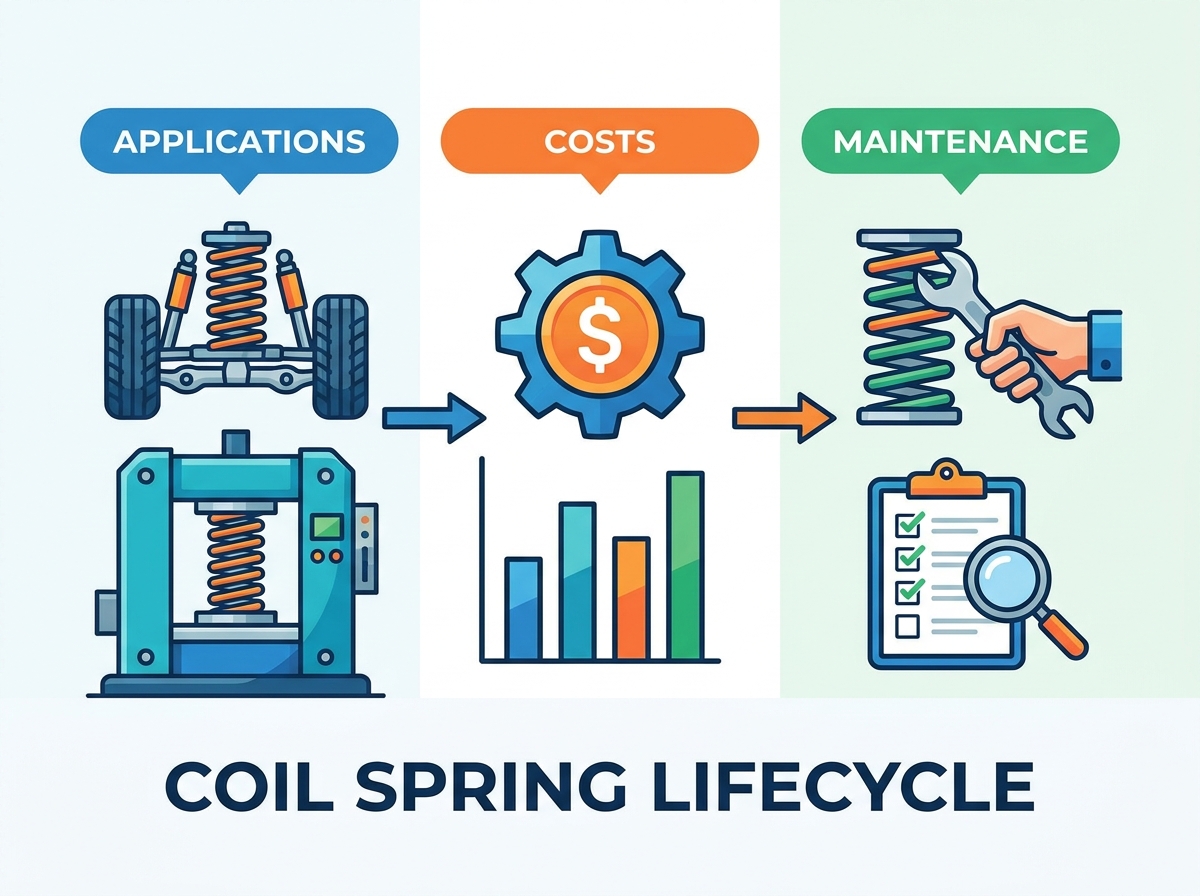
Compression designs represent the most common application in both automotive and industrial sectors. They resist applied compression forces. They push back against the load to maintain separation between components. Vehicle struts rely on these to support the vehicle's weight and absorb road impacts.
Heavy machinery utilizes large-scale versions for shock absorption and vibration isolation. These protect delicate internal components from the extreme forces generated during stamping, pressing, or earth-moving operations. You will find them in everything from bulldozer tracks to industrial stamping presses.
The ends of these components dictate how they seat against their mounting points. Closed and ground ends provide a flat seating surface. This ensures the load transfers straight down the center axis. Open ends require specialized perches to prevent the metal from digging into the mount and causing premature wear.
Extension designs absorb energy by stretching rather than compressing. They feature hooks or loops at each end to attach to separate components. Common applications include garage door mechanisms, farm machinery, and heavy-duty return mechanisms on industrial levers. When you pull them apart, they want to snap back together.
Torsion designs operate by resisting rotational torque. The wire twists around its axis when subjected to a load. Automotive applications include throttle body returns and specific types of independent suspension systems. Industrial uses range from heavy-duty hinges to counterbalance mechanisms on large loading dock doors.
Failure modes differ significantly between these types. Extension hooks often snap off before the main body fails. Torsion designs usually break right at the anchor point where stress concentrates. Inspecting these specific stress points saves significant downtime in industrial environments.
Linear designs provide consistent resistance throughout their entire range of travel. A linear setup with a 250 lbs/in rate requires 250 pounds for the first inch and 250 pounds for the second inch. This consistency delivers predictable handling and a stable ride height under static loads. Race cars often use linear setups for maximum predictability.
Variable rate designs increase their resistance as they compress. The initial coils are softer to absorb small bumps. The tighter coils engage under heavy loads to prevent bottoming out. Variable rate setups serve as the optimal choice for fleet vehicles, towing applications, and scenarios involving constantly changing payload weights.
| Feature | Linear Rate | Variable Rate (Progressive) |
|---|---|---|
| Resistance Profile | Constant throughout travel | Increases as compression deepens |
| Ride Quality (Unloaded) | Stiff and predictable | Soft and compliant |
| Load Handling | Static loads | Fluctuating payloads and towing |
| Primary Application | Track vehicles, standard passenger cars | Work trucks, SUVs, fleet vehicles |
Evaluating a suspension upgrade or replacement requires establishing baseline metrics. The primary goals include restoring factory ride height and ensuring the vehicle or machinery meets its original load-carrying capacity. Sagging metal compromises both metrics. This leads to unsafe operating conditions and poor ground clearance.
Secondary metrics involve ride comfort and handling precision. A successful replacement should eliminate harsh bottoming out over bumps. It must also reduce excessive body roll during cornering. Balancing these criteria determines whether an OEM replacement or an aftermarket upgrade suits the application best.
You must also consider the operating environment. Vehicles working in corrosive environments need different protective coatings than those in dry climates. Upgrading to a heavier duty setup might solve a payload issue but create a harsh ride when empty. You have to weigh these trade-offs carefully before ordering parts.
Accurate part identification prevents the installation of incorrect rates. Counter professionals and technicians must use VIN-specific databases. This verifies exact matches for the vehicle's trim level, engine size, and factory options. Even minor variations in vehicle weight dictate different requirements.
OEMs utilize color-coded paint stripes on the metal to indicate specific rates and load classifications. Technicians must read and interpret these paint codes during disassembly. This guarantees the replacement matches the factory specifications exactly. Do not guess based on physical dimensions alone.
Aftermarket manufacturers often consolidate part numbers. They might offer one part to cover three different OEM paint codes. This consolidation usually results in a compromise. If you want the exact factory ride, you must match the original paint codes perfectly.
Replacing complex, failure-prone electronic or air suspensions with traditional setups has become a popular solution. Air suspension systems frequently suffer from compressor failures, leaking airbags, and faulty ride height sensors. A conversion kit eliminates these failure points entirely. You bolt it in and forget about it.
The upfront savings of a conversion kit often represent a fraction of replacing OEM electronic components. However, operators must weigh these savings against potential changes in adaptive ride feel. While traditional metal provides exceptional reliability, it cannot adjust its rate on the fly like an active air suspension.
Installation of these kits usually requires bypassing the factory computer modules. If you fail to install the bypass modules correctly, the dashboard will light up with suspension error codes. Always follow the manufacturer's wiring instructions to keep the vehicle's CAN bus system happy.
Longevity depends heavily on material selection. High-tensile steel alloys provide the necessary fatigue resistance. They withstand millions of compression cycles without sagging or breaking. The manufacturing process, including shot peening, further enhances the metal's durability by relieving surface stress.
Protective coatings, such as powder coating or heavy-duty epoxy, prevent environmental degradation and rust. Once the protective coating chips or peels, the exposed steel begins to oxidize. Structural rust severely weakens the metal, leading to eventual failure under load.
In regions with heavy road salt usage, standard powder coating often fails prematurely. Some premium aftermarket options use a zinc-rich primer under the powder coat. This sacrificial layer prevents rust from creeping under the paint if the surface gets scratched by road debris.
The industry-standard estimate for a standard repair shop replacement requires significant labor hours per axle. Front strut assemblies generally require more labor than rear solid axle setups. The technician must remove the entire strut assembly from the vehicle before the real work even begins.
Parts typically account for a portion of the total invoice, depending on the vehicle and the quality chosen. Labor makes up the remaining balance. This reflects the time-consuming process of safely removing and compressing the assembly. Rusted bolts and seized mounts often add unexpected hours to the job.
Rear independent suspensions can also be labor-intensive. Sometimes you have to drop the entire rear subframe just to access the upper mounts. Always consult a flat-rate manual before quoting a job to ensure you account for these hidden labor traps.
The specific make and model heavily influence the final invoice. Luxury vehicles or heavy-duty trucks require specialized, higher-capacity components. Complex suspension geometries also increase the labor hours required for the job. European vehicles often require specialized spreader tools to remove the strut from the steering knuckle.
Aftermarket options often cost less than OEM parts, though premium performance setups can exceed OEM equivalents. Regional labor rates also cause significant variations. Shops in major metropolitan areas charge higher hourly rates than those in rural locations. Availability of parts also plays a role; rare vehicles might require custom winding.
Condition of the vehicle matters immensely. A ten-year-old truck from the rust belt will fight the technician every step of the way. Torches, penetrating oil, and air hammers become necessary. This extra effort directly translates to higher labor costs.
Isolated replacements often lead to premature failure of surrounding components. Replacing the metal without addressing the worn shock absorber forces the new component to control the suspension's oscillation entirely on its own. This excessive workload degrades the new metal rapidly.
A complete repair requires replacing strut mounts, rubber isolators, and shocks simultaneously. Furthermore, any suspension work that alters ride height or involves disassembling steering knuckles mandates a post-installation wheel alignment. This restores proper geometry and prevents rapid tire wear.
Routine visual inspections reveal the early warning signs of metal fatigue before a catastrophic failure occurs. Technicians must look for severe rust scaling that flakes away from the wire surface. Missing protective coating exposes the raw steel to moisture and road salt. Surface rust is normal; deep pitting is a failure waiting to happen.
Micro-fractures often appear near the base where it sits in the lower control arm or strut perch. Physical snapping represents the ultimate failure. This usually occurs at the very top or bottom coil where stress concentrates the most. You will often hear a loud bang when this happens.
Check the isolators as well. If the rubber pad is completely chewed through, the metal is grinding directly against the perch. This creates a stress riser in the wire, significantly increasing the chances of a fracture. Replace damaged isolators immediately.
Physical wear directly connects to operational symptoms. A weakened setup fails to support the vehicle's weight. This causes the suspension to bottom out harshly over bumps. Excessive body roll during cornering indicates the metal can no longer resist lateral weight transfer effectively.
Measurable sagging in ride height remains the most definitive symptom. Sagging degrades steering geometry, pulling wheels out of alignment. This misalignment affects camber, caster, and toe. It accelerates tire tread wear and compromises vehicle stability at highway speeds.
| Symptom | Diagnostic Check | Potential Consequence if Ignored |
|---|---|---|
| Harsh bottoming out | Check bump stops and ride height | Bent control arms, blown shocks |
| Uneven tire wear (inner edge) | Measure negative camber | Premature tire blowout |
| Vehicle leans to one side | Measure hub-to-fender distance | Unpredictable handling in emergencies |
| Clunking noise over bumps | Inspect for broken pigtails | Punctured tire from broken metal |
Implementing a scheduled maintenance checklist allows technicians and fleet managers to assess health regularly. Inspections should occur during routine tire rotations, brake service, or any time the vehicle is lifted on a hoist. Early detection prevents roadside breakdowns and expensive tow bills.
Technicians should measure the ride height from the center of the wheel hub to the fender lip. Compare this measurement against factory specifications. Any deviation exceeding half an inch indicates significant sag requiring immediate attention. Do not measure from the ground to the fender, as tire pressure variations will skew the results.
Clean the lower perches during inspections. Dirt, rocks, and road salt accumulate in the lower control arm pockets. This debris holds moisture against the metal, accelerating corrosion. A quick blast with an air nozzle extends the life of the components significantly.
Compressed suspension components store an extreme amount of kinetic energy. Attempting to remove them without the proper tools poses a severe risk of injury or death. The sudden release of a compressed assembly can launch heavy metal components across a shop with lethal force. Never cut corners here.
Strict adherence to shop safety protocols is mandatory. Technicians must use high-quality, application-specific compressors. Wall-mounted strut compressors provide the safest method for disassembling MacPherson strut assemblies. This keeps the operator out of the direct line of fire.
Improper seating causes binding, noise, and premature failure. The end of the coil (the pigtail) must index correctly into the designated notch on the strut mount or lower control arm. Failing to index it alters the ride height and creates a severe pulling sensation in the steering.
Installing mismatched rates on the same axle creates dangerous handling characteristics. The vehicle will lean to one side and react unpredictably during emergency maneuvers. Always verify part numbers and paint codes before installation. Never mix and match brands across the same axle.
Ensure all suspension bolts are torqued at ride height. If you tighten control arm bushings while the suspension hangs in the air, you will tear the rubber bushings as soon as you lower the vehicle. Put the weight of the vehicle on the suspension before applying the final torque wrench.
The right suspension investment balances immediate load requirements with long-term durability and maintenance realities. Accurate diagnosis and proper component selection ensure the vehicle operates safely and efficiently.
A: Most last between 80,000 and 100,000 miles under normal driving conditions. However, heavy towing, frequent off-road use, and exposure to corrosive environments like road salt can significantly reduce their lifespan, causing premature sagging or structural failure.
A: You must always replace them in axle pairs (both fronts or both rears). Replacing only one side results in uneven ride height, unpredictable handling, and compromised braking performance, as the new component will be stiffer than the older, fatigued one.
A: A helical wire design absorbs impacts to provide a smoother ride and better handling in passenger vehicles. A leaf design consists of stacked, curved metal plates designed to carry massive payloads, making them standard on heavy-duty trucks and commercial trailers.
A: Yes, conversion kits offer substantial long-term reliability by permanently bypassing failure-prone air suspension components like compressors and airbags. While you lose adaptive ride height adjustments, you gain exceptional durability and significantly lower future maintenance requirements.
A: Installing a rate that is too stiff causes a harsh, jarring ride and poor traction. A rate that is too soft leads to excessive body roll, premature bottoming out over bumps, and a dangerous lack of stability during cornering or braking.
A: No, a rusted component cannot be repaired. Surface rust can sometimes be cleaned, but structural rust scaling compromises the metal's integrity and fatigue resistance. A heavily rusted unit is a safety hazard and requires immediate full replacement.


