


Views: 0 Author: Site Editor Publish Time: 2026-08-02 Origin: Site


Brake system integrity is the primary fail-safe of any vehicle, yet selecting replacement components is often reduced to finding the lowest initial expense rather than matching precise technical specifications. Chery owners and fleet managers face a highly fragmented aftermarket. Installing the wrong friction material or accepting incorrect fitment leads to accelerated rotor wear, severe thermal fade, increased stopping distances, and compromised safety on the road.
This guide provides a rigorous technical evaluation framework for selecting the exact Brake Pad for Chery models. Moving entirely beyond generic marketing claims, we focus on Original Equipment (OE) specifications, material science, and verifiable performance metrics to ensure your braking system operates exactly as engineered.
Defining a successful brake pad replacement requires looking beyond simply stopping the vehicle. Success means restoring factory stopping distances, experiencing zero caliper fitment issues, and maintaining the manufacturer's NVH (Noise, Vibration, and Harshness) standards. When a replacement pad fails to meet these criteria, the entire braking dynamic shifts. This puts undue stress on the hydraulic system and suspension components.
Chery calibrates brake systems specifically for individual vehicle weights, chassis dynamics, and intended use cases. The braking requirements for a heavy, seven-seat Tiggo 8 Pro differ vastly from those of a compact Arrizo 5. Larger SUVs demand friction materials with higher thermal thresholds to manage the kinetic energy generated during deceleration. Installing a pad designed for a lighter sedan onto a heavy SUV results in rapid material degradation and dangerous brake fade during prolonged descents.
Understanding the component supply chain clarifies quality expectations. Original Equipment Manufacturer (OEM) parts are branded by Chery and sold through official dealerships. Original Equipment Supplier (OES) parts are manufactured by the same factories that supply Chery but are sold under the manufacturer's own brand name. Third-party aftermarket alternatives range widely in quality. High-tier aftermarket brands often re-engineer pads to solve specific OE shortcomings. Lower-tier options might compromise on friction material density and backing plate thickness.
| Part Category | Source | Quality Level | Best Application |
|---|---|---|---|
| OEM (Original Equipment Manufacturer) | Chery Dealerships | Exact factory match | Vehicles under factory warranty |
| OES (Original Equipment Supplier) | Specialty Auto Parts Stores | Identical to OEM, different box | High-quality independent repairs |
| Premium Aftermarket | Certified Distributors | Meets or exceeds OE specs | Performance upgrades, heavy towing |
| Economy Aftermarket | General Retailers | Variable, often lower density | Light-duty, low-mileage driving |
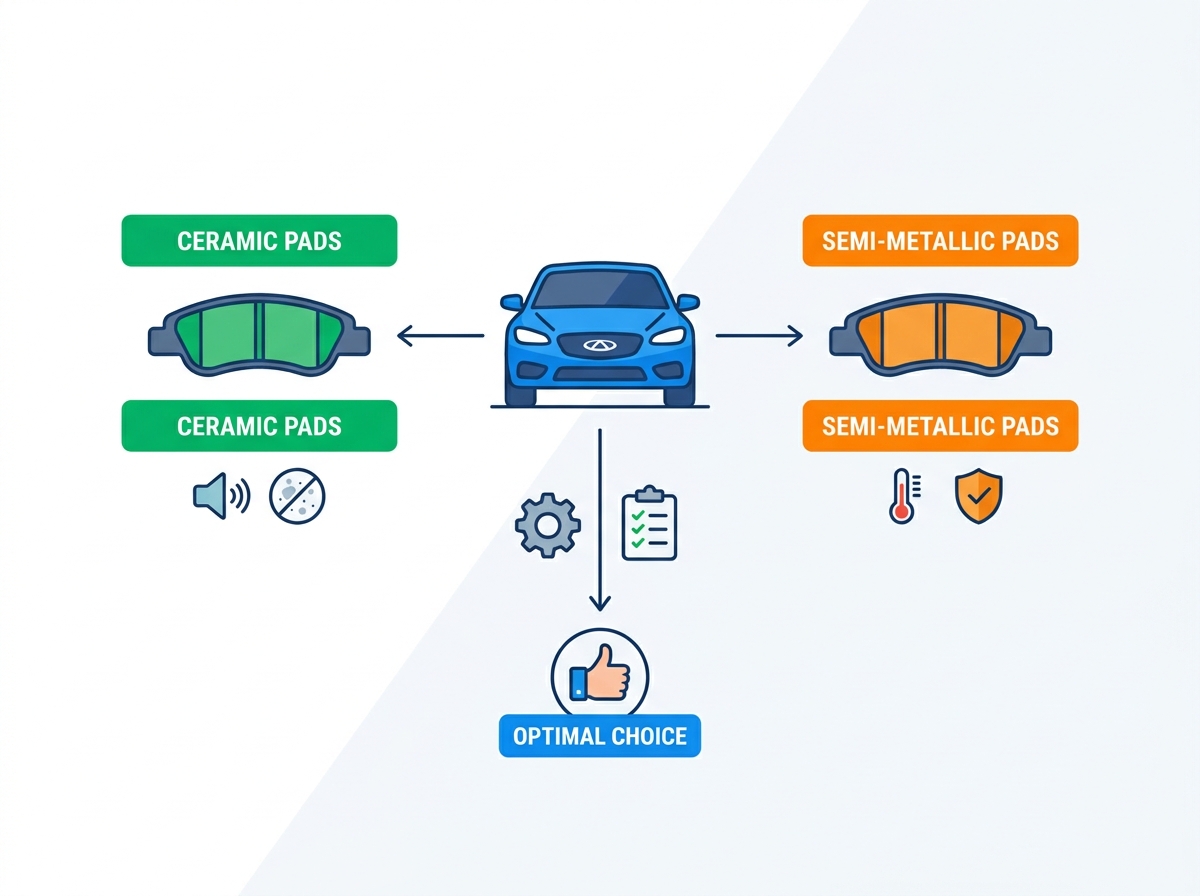
Selecting the correct friction material requires stripping away marketing jargon and focusing purely on chemical composition and physical properties. The three primary friction materials available for Chery vehicles each serve distinct operational environments.
Ceramic pads utilize a dense construction of ceramic fibers, bonding agents, and non-ferrous metal fillers like copper. This composition creates a highly stable friction coefficient across moderate temperature ranges.
Semi-metallic formulations consist of 30% to 65% metal content—typically steel, iron, and copper—bound together with graphite and specialized lubricants. This high metal density provides exceptional heat transfer capabilities.
NAO pads are manufactured from a mixture of organic fibers, including glass, rubber, and Kevlar, bound together with high-temperature resins. They represent the softest friction material available.
| Material Type | Stopping Power (Cold) | Stopping Power (Hot) | Dust Level | Rotor Wear |
|---|---|---|---|---|
| Ceramic | Good | Good | Very Low | Low |
| Semi-Metallic | Excellent | Excellent | High | High |
| NAO (Organic) | Good | Poor | Medium | Very Low |
Mapping specific brake pad specifications to real-world driving outcomes allows for a highly objective selection process. Technical indicators printed on the pad or packaging reveal exactly how the component will perform under stress.
The Department of Transportation (DOT) mandates a two-letter edge code stamped on the side of the brake pad. These letters (e.g., EE, FF, GG) denote the friction coefficient at normal operating temperatures (250°F) and hot operating temperatures (600°F). An "F" rating indicates a higher friction level than an "E" rating. For a Chery SUV, a pad with an "FF" or "GG" rating ensures the vehicle maintains stopping power even when the brakes are heavily heat-soaked.
Thermal fade occurs when friction material overheats, causing the binding resins to vaporize. This off-gassing creates a boundary layer of gas between the pad and the rotor, drastically reducing stopping power. Compounds engineered for high thermal resistance maintain their structural integrity during repeated heavy braking, such as in stop-and-go highway traffic or mountain descents. This ensures consistent pedal response.
Noise, Vibration, and Harshness are primary sources of driver dissatisfaction. Premium replacement pads feature pre-attached rubberized or multi-layer steel shims that absorb high-frequency vibrations before they reach the caliper piston. Additionally, chamfered edges (angled cuts on the leading and trailing edges of the pad) and center slots help evacuate dust and gas. This prevents brake squeal and pedal pulsation.
The type of dust generated impacts vehicle aesthetics and wheel maintenance. Semi-metallic pads produce dark, corrosive metallic dust that can pit clear-coated alloy wheels if left uncleaned. Ceramic compounds produce a fine, light-colored dust that does not easily adhere to wheel surfaces. This preserves the appearance of factory Chery alloys with minimal maintenance.
Physical installation introduces variables that can compromise even the highest-quality friction material. Addressing implementation risks ensures the new components function exactly as designed.
Ordering parts based solely on the make, model, and year is a common pitfall. Automakers frequently change caliper suppliers mid-production year. Using the Vehicle Identification Number (VIN) to cross-reference exact OE part numbers is the only definitive way to guarantee correct backing plate dimensions and hardware compatibility.
Front and rear braking dynamics are structurally and functionally distinct. During deceleration, weight transfer shifts forward, requiring the front pads to handle 60% to 70% of the total stopping force. Consequently, front pads are larger, thicker, and often utilize a more aggressive friction compound than the rear pads. They are never interchangeable.
Installing perfectly flat new pads against worn, grooved, or heavily glazed rotors severely compromises the contact surface area. This mismatch leads to localized overheating, extended stopping distances, and accelerated pad wear. If a rotor exhibits deep scoring, significant lip formation at the outer edge, or thickness variation, a matched pad-and-rotor kit is required to ensure uniform friction transfer.
Reusing old caliper hardware is a critical error. Abutment clips lose their spring tension over time, and degraded slide pin boots allow moisture to corrode the guide pins. This leads to caliper binding, where the pad drags against the rotor constantly. Always replace stainless steel hardware clips, lubricate slide pins with silicone-based grease, and install new electronic wear sensors if your Chery model requires them.
New brake pads require a specific break-in procedure to deposit an even transfer film of friction material onto the rotor face. Skipping this step causes uneven material transfer, leading to brake judder (often misdiagnosed as warped rotors). Follow this standard protocol:
Evaluating brake components requires looking at long-term operational factors. The interaction between different materials dictates maintenance intervals and overall system health.
There is a direct inverse relationship between pad hardness and rotor life. Highly aggressive semi-metallic pads will typically outlast organic alternatives, but their abrasive nature machines away the cast-iron rotor at an accelerated rate. Conversely, softer NAO pads preserve the rotor indefinitely but require much more frequent pad replacements. Ceramic pads generally offer the best equilibrium for standard passenger vehicles.
Modern brake manufacturing is heavily regulated to ensure safety and environmental protection.
Consult your vehicle manual for exact OE part numbers. Utilize a verified parts catalog to cross-reference your VIN, and source components from certified distributors.
A: Lifespan depends heavily on material and driving conditions. Ceramic pads in urban environments typically last 40,000 to 70,000 miles. Semi-metallic pads subjected to heavy SUV loads or aggressive driving may require replacement between 30,000 and 50,000 miles.
A: While ceramic pads offer excellent low-dust and low-noise characteristics, heavy SUVs like the Tiggo 8 often benefit from the superior thermal capacity and high-temperature friction stability of semi-metallic pads, especially if used for towing or driving in mountainous terrain.
A: Objective symptoms include an illuminated dashboard wear sensor light, physical pad thickness measuring under 3mm, audible high-pitched squealing from mechanical wear indicators, or a noticeable steering wheel vibration during deceleration.
A: Yes. Consumer protection laws generally safeguard your right to use aftermarket parts. As long as the replacement pads meet or exceed OE specifications and are installed correctly, they will not void your vehicle's factory warranty.
A: Front pads are significantly larger and thicker because the front axle handles up to 70% of the vehicle's braking force due to weight transfer. Rear pads are smaller and handle less load. They have different backing plate shapes and are never interchangeable.
A: Post-installation squeaking is usually caused by failing to perform the bedding-in process, omitting anti-rattle abutment clips, or lacking high-temperature silicone brake grease on the caliper contact points and pad ears.


