


Views: 0 Author: Site Editor Publish Time: 2026-07-23 Origin: Site


Brake noise drives costly customer comebacks for repair shops, inflates fleet maintenance overhead, and causes severe driver fatigue. Noise, Vibration, and Harshness (NVH) rarely happens in isolation. It acts as a clear symptom of friction material mismatch, poor thermal management, or degraded hardware. When a vehicle rolls into the bay squealing, the immediate reaction is often to swap the pads. However, without understanding the underlying mechanics of friction and vibration, that swap is just a temporary bandage. This guide provides a technical framework for evaluating a Low-Noise brake pad. We will help you balance acoustic comfort with thermal capacity, rotor wear, and stopping power, ensuring you select the exact friction profile required for your specific application.
Brake squeal originates as high-frequency vibration. When friction materials contact the spinning rotor, they generate mechanical energy. This energy transfers through the brake caliper, mounting brackets, and suspension components. If the frequency matches the resonant frequency of the wheel assembly, it amplifies into an audible squeal. Managing this vibration at the source is the core of NVH engineering. You cannot eliminate vibration entirely, but you can shift its frequency out of the audible range or dampen its amplitude before it resonates.
Inconsistent friction transfer layers on the rotor create stick-slip vibrations. As the pad grips and releases the rotor surface at microscopic levels, it stutters. This stuttering sends shockwaves through the backing plate. A smooth, uniform transfer layer prevents this erratic engagement and keeps the braking process quiet. When a pad lacks the proper chemical makeup to lay down an even transfer film, the resulting metal-on-friction contact becomes highly unstable.
Even the best friction material will generate noise if paired with a flawed rotor. Glazed, scored, or improperly machined rotors ruin acoustic performance. Lateral runout and thickness variation cause the pad to bounce against the rotor surface, acting like a hammer against a bell. You must ensure the rotor is perfectly flat, properly surfaced with a non-directional finish, and washed with hot soapy water to remove machining oils before installing new pads.
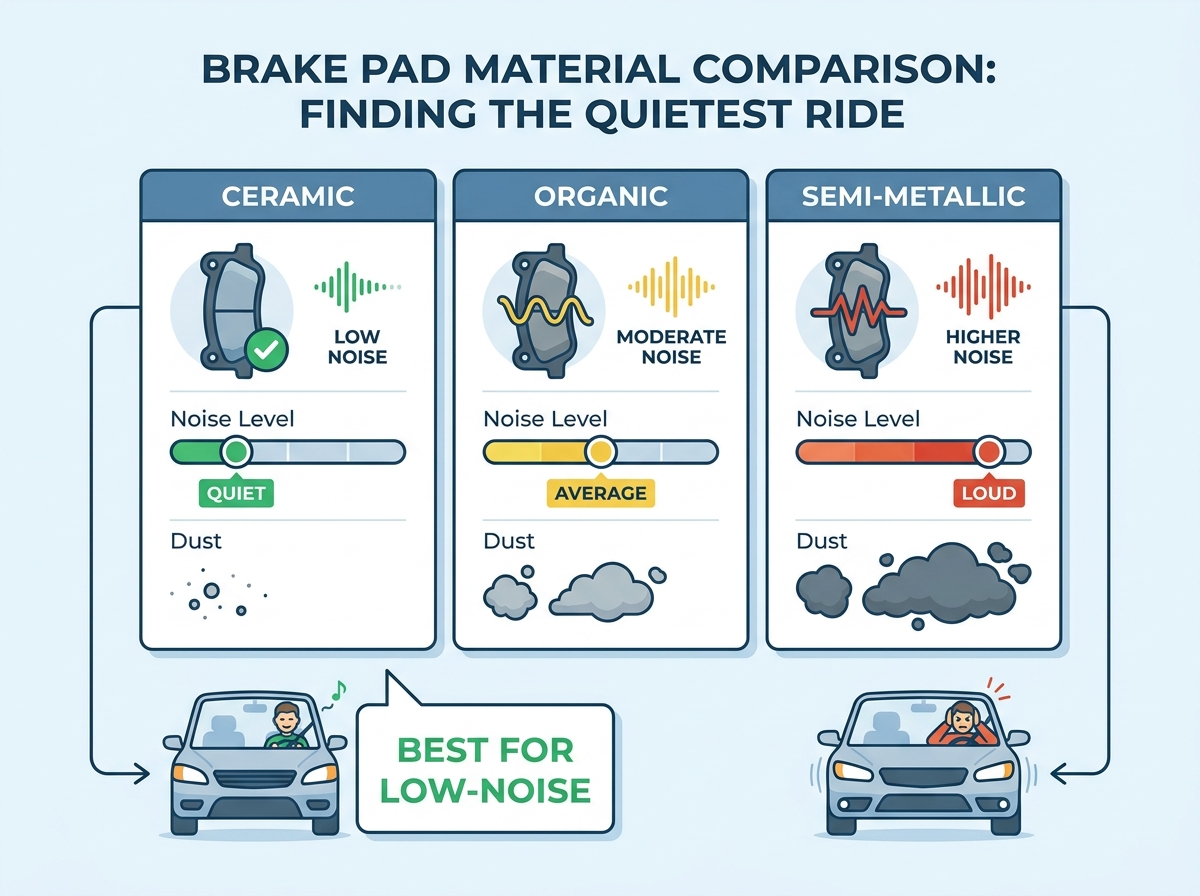
Ceramic pads utilize a dense mixture of fine ceramic fibers, bonding agents, and non-ferrous metal fillers. Manufacturers bake these compounds at extreme temperatures in a positive mold to create a highly durable friction block. The absence of heavy steel fibers makes the material inherently smoother against the iron rotor. This smooth interaction drastically reduces the abrasive scraping sounds common with older pad technologies.
Premium ceramic compounds push vibrational frequencies beyond the range of human hearing. They operate at a pitch that humans cannot detect, resulting in perceived silence. They also absorb micro-vibrations before they reach the caliper piston. We recommend ceramic pads for daily drivers, luxury vehicles, and light fleet applications. They excel where low noise and minimal wheel dust are primary success criteria, keeping alloy wheels clean and drivers satisfied.
NAO pads rely on organic fibers like glass, rubber, Kevlar, and carbon compounds. Manufacturers bond these materials with high-temperature resins. This creates a softer, more forgiving friction surface compared to metallic alternatives. The manufacturing process is generally less intensive than ceramic positive molding, which keeps costs down while still providing a viable acoustic solution.
Their naturally soft composition absorbs vibration and operates very quietly. They provide excellent initial bite at low temperatures, making them great for cold-weather commuting. However, NAO pads have notable limitations. You will experience faster pad wear and higher compressibility. This compressibility often results in a spongy pedal feel. They also degrade rapidly under high thermal loads, making them unsuitable for aggressive driving or mountainous terrain.
Semi-metallic pads contain a high steel and iron content, typically ranging from 30% to 70%. Low-metallic variants contain 10% to 30% metal mixed with organic materials. These metals provide exceptional heat conductivity and mechanical strength. They pull heat away from the friction boundary layer, preventing the resins from boiling and outgassing.
The abrasive nature of metallic pads inherently generates higher decibel levels. They often produce low-frequency groans and high-pitched squeals during slow stops. You must compromise on noise when high-temperature fade resistance is mandatory. Heavy towing, track use, and commercial hauling require the thermal stability that only metallic pads provide. If you put a ceramic pad on a one-ton truck pulling a heavy trailer, you risk catastrophic brake fade.
Environmental legislation mandates the phased reduction of copper in brake pads to below 0.5% by 2025. Copper historically acted as a primary heat dissipator. It also served as a highly effective noise-damping lubricant within the friction matrix. Removing it presented massive acoustic challenges for engineers, as copper's unique malleability helped smooth the friction interface.
Modern premium manufacturers use advanced alternative metalloids and engineered ceramic fibers to compensate for the lack of copper. These new formulations manage heat transfer efficiently without increasing harshness. They maintain the quiet operation expected from high-end ceramic pads while complying with strict environmental laws. The transition required entirely new resin binders to hold these alternative materials together under extreme shear forces.
| Material Type | Noise Level (NVH) | Dust Generation | Thermal Capacity | Rotor Wear |
|---|---|---|---|---|
| Ceramic | Extremely Low | Low (Light colored) | Moderate to High | Very Low |
| NAO (Organic) | Very Low | Moderate (Dark) | Low | Low |
| Semi-Metallic | High | High (Corrosive) | Extremely High | High |
Budget pads use coarse, inconsistent fibers. Premium pads utilize highly purified, sub-micron fibers. This difference in raw material purity dictates how the pad interacts with the rotor. Coarse materials create uneven friction, leading directly to vibration and noise. When you inspect a cheap pad, you can often see large chunks of filler material on the surface, which act like rocks dragging across a steel plate.
Premium brands put pads through rigorous dual-dynamometer NVH testing protocols. They map noise generation across various temperatures, pressures, and speeds. Budget manufacturers skip this expensive phase entirely. They rely on generic formulas that fail under real-world driving conditions. A pad might be quiet at 70 degrees Fahrenheit but scream like a banshee when the ambient temperature drops below freezing.
Cheap pads use inferior resins that degrade rapidly under thermal stress. This degradation leads to material delamination and uneven friction transfer. Once the resin burns off, the pad loses its structural integrity. Early-onset squeal and compromised safety are the inevitable results of poor bonding quality. You will often see the edges of cheap pads crumbling after just a few thousand miles of use.
Multi-layer shims act as a dampening barrier between the backing plate and the caliper piston. They typically feature steel sandwiched with elastomeric rubber or fiberglass. This constrained layer absorbs the kinetic energy that causes squeal. Think of it as a shock absorber for high-frequency sound waves. Without a high-quality shim, the metal backing plate vibrates directly against the metal caliper piston.
Look for mechanically attached, staked, or vulcanized shims. Purely adhesive-backed options migrate under high heat. When the adhesive melts, the shim slips out of place. This shim slippage instantly ruins the acoustic dampening properties of the brake assembly. Once the shim slides down and contacts the rotor hat, you get a continuous, rotational scraping noise.
Patented, curved, or V-shaped slots interrupt and disperse harmonic vibrations before they amplify. Vertical or diagonal slots in the friction material relieve thermal stress. They also vent outgassing resins and shift the pad's resonant frequency away from audible ranges. A solid block of friction material rings like a tuning fork; cutting a slot through the center breaks that resonance.
Angled, radial, or J-chamfers prevent the leading edge of the pad from digging into the rotor. This geometry smooths the initial bite during brake application. Proper chamfering is critical for preventing low-speed squeal when approaching a stoplight. As the pad wears down, the chamfer profile changes, which is why some pads become noisier at the end of their lifecycle.
Galvanized plating is essential to prevent rust jacking. Rust jacking occurs when corrosion builds up between the backing plate and the friction material. It causes delamination, uneven caliper pressure, and severe noise. Painted backing plates offer minimal protection, as the paint easily chips during installation or from road debris, exposing bare steel to moisture and road salt.
Mechanical Retention Systems (MRS) eliminate the vibration risks of pure chemical adhesives. Advanced manufacturing techniques use unclipped brass pins or integrally molded matrix hooks on the backing plate. These structures mechanically lock the friction material in place, ensuring long-term stability and silent operation. When the friction puck is physically anchored to the steel plate, shear forces cannot tear it loose.
Ceramic materials trap heat. They push thermal energy into the rotor and caliper components. Metallic materials conduct heat away from the friction zone. This fundamental difference dictates how a pad handles repeated heavy braking. If the caliper fluid boils because the ceramic pad pushed too much heat into the piston, you lose pedal pressure entirely.
Low-noise organic pads lose their friction coefficient rapidly during repeated hard stops. As the resins overheat, they release gases that create a boundary layer between the pad and rotor. This phenomenon, known as brake fade, significantly increases stopping distances. You press the pedal hard, but the vehicle simply refuses to slow down because the pad is hydroplaning on its own gas.
Pad noise and rotor longevity share an inverse relationship. Low-noise pads like Ceramic and NAO extend rotor life significantly. Metallic pads act like a machining tool, wearing down the iron rotor surface with every stop. You will replace rotors twice as often if you run aggressive semi-metallic compounds.
Ceramic pads produce light, non-corrosive dust that easily washes away. Metallic pads generate heavy, ferrous dust. This hot metal dust embeds itself into clear-coated alloy wheels, causing permanent damage if left uncleaned. The iron particles oxidize, turning into stubborn rust spots that require harsh chemical decontamination to remove.
Low-noise brake pads perform differently in sub-zero temperatures. Some high-end ceramics require a brief warm-up period to reach their optimal friction coefficient. You might notice slightly less initial bite on a freezing morning. Organics, conversely, offer immediate cold bite but sacrifice high-end temperature stability. You have to match the pad's temperature window to the climate and driving style.
We recommend premium Ceramic or high-end NAO pads for daily drivers. This selection prioritizes acoustic comfort, low maintenance, and clean wheels under standard thermal loads. Commuters rarely generate the heat required to induce brake fade in these materials. The primary goal here is a smooth, silent stop at every traffic light.
Fleet managers should choose fleet-specific Ceramic or Low-Metallic hybrids with mechanical retention plates. This choice balances the need for reduced NVH with extended service intervals. Driver comfort remains high, while predictable cost-per-mile metrics keep operations efficient. Downtime is the enemy of fleets, so pad longevity and consistent performance are paramount.
Severe-duty Semi-Metallic pads are mandatory for heavy loads. You must accept the noise trade-off. Prioritizing acoustic comfort in a heavy-duty application introduces severe safety risks. Thermal fade and structural pad failure will occur if you use standard ceramic pads for heavy towing. A little brake squeal is a small price to pay for stopping a 10,000-pound trailer safely on a steep grade.
Never install new pads on old, unmachined rotors. This practice, known as "pad slapping," guarantees noise. You must replace or resurface the rotors to establish a proper, uniform friction transfer layer. A fresh surface is non-negotiable for quiet braking. The old rotor surface is contaminated with the previous pad's friction material, which will clash with the new compound.
Mandate the replacement of abutment clips, slide pin boots, and caliper grease. Reusing fatigued or corroded hardware guarantees NVH issues regardless of pad quality. The caliper must slide freely, and the pads must retract smoothly to prevent dragging and squealing. Use a high-quality silicone-based or ceramic brake grease on the slide pins, avoiding petroleum-based products that swell rubber boots.
Follow a strict bedding-in procedure immediately after installation. This process properly cures the pad resins and mates the pad to the rotor. Skipping the bedding-in procedure leads to immediate glazing and persistent squeal.
A: Yes, ceramic pads are inherently quieter. Their dense, non-ferrous composition absorbs micro-vibrations and pushes resonant frequencies above human hearing. Semi-metallic pads contain abrasive steel fibers that naturally generate low-frequency groans and high-pitched squeals against the iron rotor.
A: Pads wear in a specific directional pattern based on forward motion. When you reverse, the trailing edge becomes the leading edge. If the pads lack proper chamfers, this sharp edge digs into the rotor, causing a temporary, high-frequency vibration and squeal.
A: No. While slots and chamfers slightly reduce the total friction surface area, they improve overall braking efficiency. They vent outgassing resins, reduce thermal stress, and ensure the pad engages the rotor smoothly, preventing glazing and maintaining consistent stopping power.
A: It is highly discouraged. Low-noise ceramic or organic pads trap heat and degrade rapidly under heavy loads. Towing requires semi-metallic pads that conduct heat away from the friction zone to prevent dangerous brake fade, even if they produce more noise.
A: Both are quiet, but they achieve it differently. Organic pads use soft materials like rubber and Kevlar to absorb vibration, making them virtually silent but prone to rapid wear. Ceramic pads use dense fibers to shift noise frequencies beyond human hearing while offering better durability.
A: If properly bedded, new pads should stop squeaking within the first 100 miles. This allows the friction material to transfer an even layer onto the rotor. If squeaking persists beyond a few days, it indicates hardware issues, improper installation, or glazed rotors.
A: Yes. Heavy accumulation of metallic brake dust can pack into the caliper abutment brackets and slide pins. This restricts pad movement, causing the pad to drag against the rotor. Ceramic pads produce less dust, reducing the likelihood of dust-induced NVH issues.


